
 E-Paper



Free solar panels for Delhi houses using 400 units of power
In addition, vendors installing the systems will provide free maintenance for five years to consumers of this solar power initiative.

 Prefer HTon Google


Delhi households with an average monthly electricity consumption of up to 400 units will be able to get rooftop solar systems of up to 3kW installed at zero upfront cost under the Delhi government’s amended solar policy announced on Tuesday.
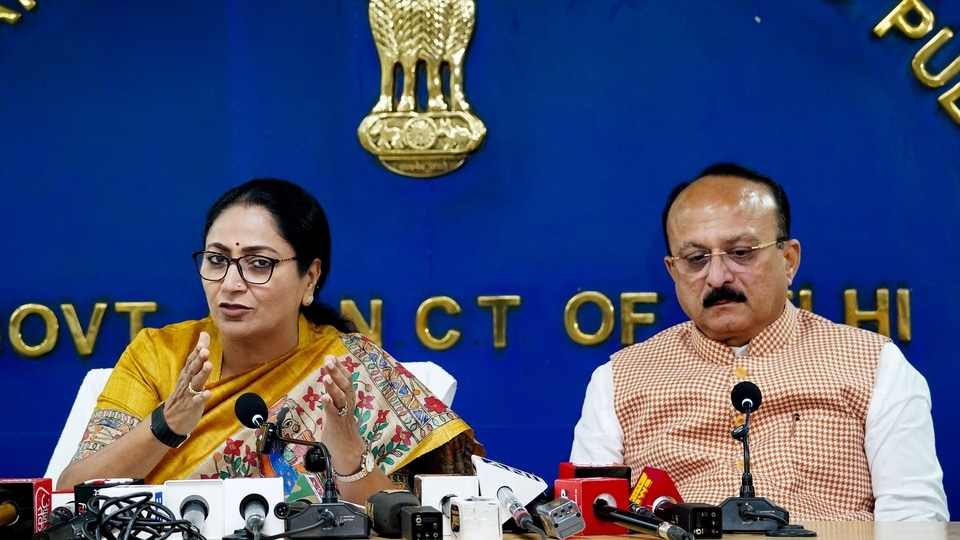
Chief minister Rekha Gupta said the government aims to install solar systems on 230,000 rooftops by March 2027 and add 500MW of rooftop solar capacity across the city.
Updates to Delhi's solar energy policy
Announcing the second amendment to the Delhi Solar Energy Policy-2023, Gupta said the move was aimed at making rooftop solar accessible to ordinary households without requiring them to make an initial investment. The changes were approved at a cabinet meeting on Tuesday.
Under the revised scheme, domestic consumers with an average monthly consumption of up to 400 units in 2025-26 will be eligible for systems of up to 3kW, subject to technical feasibility.
The Centre’s subsidy under the PM Surya Ghar scheme will be supplemented by a Delhi government capital subsidy and an additional top-up to cover the difference between the subsidy and the tendered cost of the solar system.
Also Read I The supply chain behind solar panels: Why India is drawing up a fresh incentive plan for polysilicon
For households consuming up to 200 units a month, the support will vary according to the size of the system. A 2kW system, estimated to cost around ₹1.30 lakh, will receive ₹60,000 as central subsidy, ₹52,000 from the Delhi government and an additional ₹18,000 top-up. The total support of ₹1.30 lakh would effectively cover the estimated cost of the system.
For a household in this category installing a 2kW system, the government estimates electricity savings of around 200 units a month, translating into a benefit of about ₹300 a month at ₹3 per unit.
Varying subsidy models
With a 3kW system, consumers are expected to save around 200 units a month and export another 100 units to the grid. Payment for the exported electricity is estimated at around ₹650 a month, taking the average additional monthly benefit to about ₹950.
For households consuming 201-400 units a month, the subsidy structure will remain the same for a 2kW system — ₹60,000 from the Centre, ₹52,000 from the Delhi government and ₹18,000 as a top-up. For a 3kW system, the Centre and Delhi government will provide ₹78,000 each, along with a ₹19,000 top-up. The average additional monthly benefit for this category is estimated at ₹1,659.
The policy will also retain the existing electricity subsidy. Households consuming up to 200 units will continue to receive 100% electricity subsidy, while also getting an incentive linked to energy savings from solar power.
For households consuming more than 400 units a month, a 3kW system costing around ₹1.75 lakh will receive ₹78,000 each from the Centre and Delhi government, with no additional top-up. The consumer contribution will be ₹19,000.
The average additional monthly benefit for these consumers is estimated at ₹2,143, with surplus electricity eligible for payment at ₹6.50 per unit.
Also Read I Authorities to distribute solar power banks in Nepal's flood-hit regions
The revised framework also provides support to group housing societies for installing solar systems in common areas. A proposed 100kW system, estimated to cost ₹45 lakh, will receive ₹18 lakh as central subsidy and ₹11 lakh as Delhi government subsidy, leaving a consumer contribution of ₹16 lakh.
The estimated average additional benefit from such a system is around ₹81,247 a month.
Reduce burden, expand capacity
The government has also sought to reduce the maintenance burden on consumers. Vendors installing the systems will provide free maintenance for five years. Thereafter, consumers can opt for maintenance and insurance services through discoms or their empanelled agencies for the remaining life of the system, which is expected to be around 25 years.
The scheme will be implemented through a utility-led aggregation model. Indraprastha Power Generation Company Limited (IPGCL) will select solar vendors through competitive bidding and coordinate installation, vendor management and grievance redressal.
The government said 10,073 solar systems had so far been installed in Delhi, with a substantial number on government buildings. It now aims to significantly scale up rooftop installations and add 500MW of capacity by March 2027.
Also Read I A forced pause for India’s solar power generation
Delhi power minister Ashish Sood said the cabinet decision would institutionalise the benefit of free electricity while enabling consumers to become electricity producers through rooftop solar.
Gupta said the objective was to move Delhi beyond simply providing subsidised electricity and towards enabling households to generate their own power, in line with the Centre’s PM Surya Ghar initiative.


Stay updated with all top Cities including, Bengaluru, Delhi, Mumbai and more across India. Stay informed on the latest happenings in World News along with Delhi Election 2025 and Delhi Election Result 2025 Live, New Delhi Election Result Live, Kalkaji Election Result Live at Hindustan Times.


