
 E-Paper



Delhi chokes under ‘severe plus’ air as AQI hits 460, GRAP stage 4 curbs continue
The capital’s 24-hour average air quality index (AQI) recorded at 460 at 8 am. It was 431 at 4 pm on Saturday.

 Prefer HTon Google


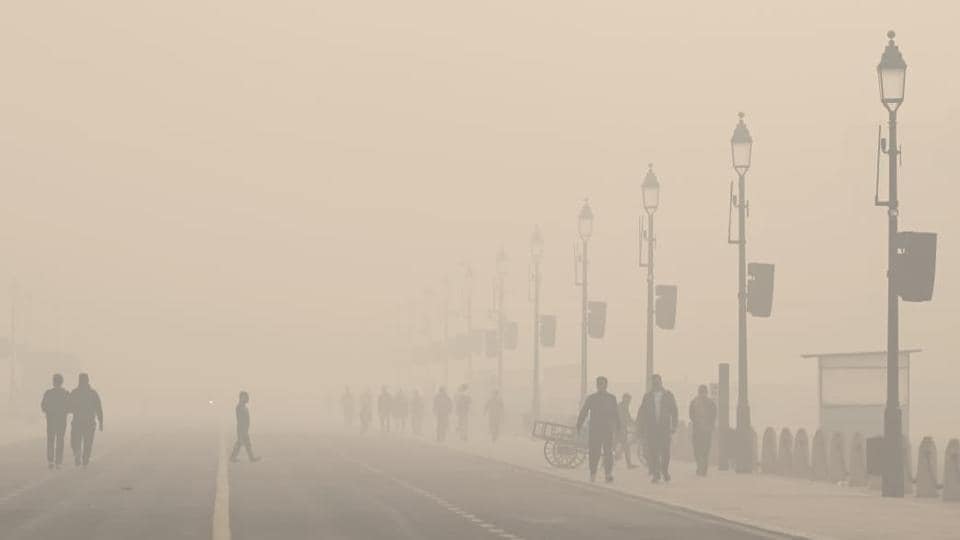
New Delhi: A thick blanket of smog choked Delhi on Sunday, keeping air quality in the ‘severe plus’ category a day after authorities imposed stage 4 curbs under the Graded Response Action Plan (GRAP), with the capital’s 24-hour average air quality index (AQI) recorded at 460 at 8 am.
On Saturday, the AQI touched 401 in Delhi at 10am, barely breaching the “severe” mark, but the commission announced curbs under Stage 3 before 11am. This was upgraded to stage 4 in the evening after the Central Pollution Control Board (CPCB) released its daily bulletin at 4pm, recording an average AQI for Delhi at 431.
Follow all the latest updates on Delhi pollution
Forecasts show no immediate relief is in sight, with the AQI set to stay severe throughout Sunday. It may marginally improve to ‘very poor’ on Monday, the Early Warning System for Delhi (EWS) said.
At 8 am, all 39 active ambient air quality stations were in the ‘severe’ category, with some stations on the brink of ‘maxing out’ at 500. These included Rohini (499); Bawana, Jahangirpuri and Vivek Vihar (495 each); and DTU, Wazirpur and Ashok Vihar (493 each).
Conditions remained unfavourable for the dispersion of pollutants, with calm winds and moderate fog persisting. The India Meteorological Department (IMD) had issued an alert for possible dense fog in the city on Sunday morning.
The lowest visibility was recorded at 350 metres at Palam and 200 metres at Safdarjung, the IMD said.
“Palam reported visibility of less than 1,000 metres and was in the shallow fog category since 9 pm on Saturday. It dropped to 500 metres at 3 am, 400 metres at 7 am and further down to 350 metres at 8 am. Safdarjung meanwhile recorded 300 metres at 5.30 am and further touched 200 metres at 8 am,” an IMD official said.
Fog is classified as shallow when visibility is between 500 and 1,000 metres, ‘moderate’ when between 200 and 500 metres, and ‘dense’ below 200 metres.
Winds were almost calm, with enough moisture available for fog, Skymet vice-president Mahesh Palawat said. “Winds have been mostly calm since Friday. This has led to the accumulation of pollutants and no dispersion. We can expect similar conditions on Sunday due to the prevailing western disturbance, before some marginal relief from Monday as winds increase again,” he said.
The Central Pollution Control Board (CPCB) classifies air quality as “moderate” when the AQI is between 101 and 200, “poor” between 201 and 300, and “very poor” between 301 and 400. Beyond 400, air quality is termed “severe”. For the purpose of GRAP, 450 and above is termed “severe plus”, with CPCB values not going beyond 500 — a threshold already considered seriously dangerous by the pollution agency.
Under stages 3 and 4 of GRAP, there is a ban on all construction and demolition activities in the region; a ban on private four-wheelers (BS-III petrol and BS-IV diesel); a ban on the entry of trucks into Delhi; and mandatory hybrid classes (up to Class X), among other restrictive measures aimed at curbing pollution.
Previously, a three-day streak of ‘severe’ air quality was recorded from November 11 to 13.


Stay updated with all top Cities including, Bengaluru, Delhi, Mumbai and more across India. Stay informed on the latest happenings in World News along with Delhi Election 2025 and Delhi Election Result 2025 Live, New Delhi Election Result Live, Kalkaji Election Result Live at Hindustan Times.


