
 E-Paper



Delhi downs its shutters for the weekend
The weekend curfew prohibits all non-essential activity, and exempts some categories of businesses and workers such as health care professionals, government and judicial officials, diplomats, and media persons.

 Prefer HTon Google


A weekend curfew was imposed in the Capital on Friday night as the city entered a crucial phase of its Covid-19 outbreak, with 17,335 new cases taking the number of active infections in the city to 39,873.
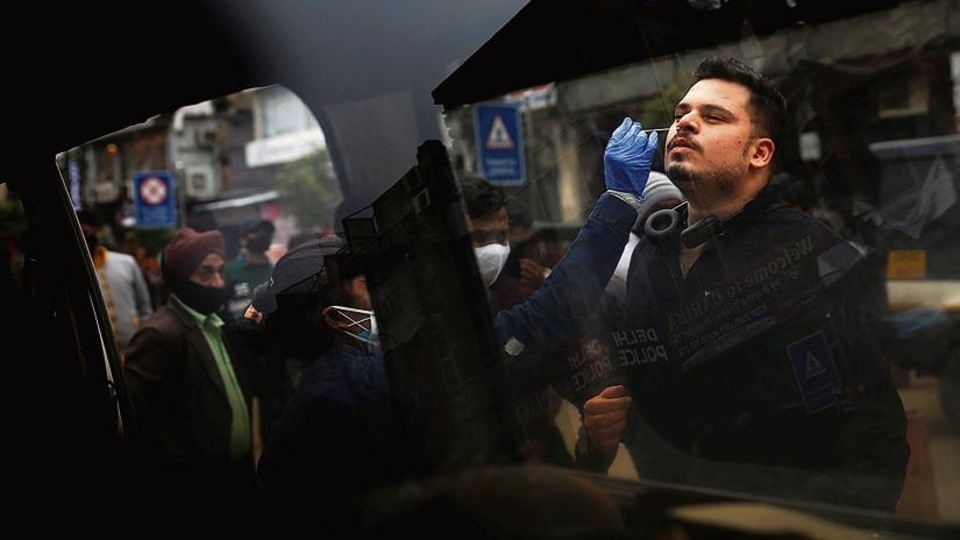
Activities have gradually wound down in the city after the highly transmissible Omicron variant sent case rates spiralling, although fewer people are in hospitals – a trend that will be crucial to watch over the coming week.
Delhi recorded over 17,000 new cases on Friday, rising from 5,481 on Tuesday, 10,665 on Wednesday, and 15,097 on Thursday. The positivity rate, which was below 1% on December 28, is now 17.73%.
The weekend curfew prohibits all non-essential activity, and exempts some categories of businesses and workers such as health care professionals, government and judicial officials, diplomats, and media persons.

People coming from or going to airports, railway stations or bus terminals will be allowed travel with valid tickets, as will those who work for services such as grocery shops, internet service providers, banks and petrol pumps. Delivery of food and online shopping deliveries will be allowed, and people can attend weddings, which will need to have at most 20 attendees, by showing an invitation card.
Delhi’s health minister Satyendar Jain said the rate of hospitalisation has been roughly six times lower compared to previous waves in the city, urging people not to panic, but at the same time exhorting them to continue wearing masks and maintaining distance properly.
“The best way to avoid corona is to wear a mask and practise social distancing. Only go to hospitals if you have severe symptoms; treatment at home is entirely feasible,” he said on Friday, before adding that there will be no lockdown and construction work will be allowed to continue as well.
The Omicron variant has been established in scientific studies to be significantly less likely to lead to severe disease, partly due to the large number of people with vaccination or a previous infection and because the virus intrinsically may have mutated to become less virulent.
But it has spread rapidly, causing cases to accelerate at an unprecedented pace. The sharp jump has forced staff shortages and raised fears that the tsunami of cases could still lead to a large number of people who need medical attention, even if they are fewer as a proportion of all infected than those needing critical care before.
Some of the disruption seemed to set in as two of cities biggest hospitals closed regular clinical services on Friday: the All India Institute of Medical Sciences (AIIMS) and Safdarjung Hospital issued orders to restrict non-Covid services for outpatient departments (OPD), speciality clinics and centres till “further decision”.
Jain, while speaking at the briefing where he made the above remarks, said the city was prepared with adequate number of beds in case hospitalisations were to surge.
Experts said while lockdowns will not be particularly helpful in reducing the spread, a weekend lockdown drives public messaging since voluntary compliance of Covid-appropriate behaviour is lacking.
“The occupancy of Covid beds is currently very low as compared to what was witnessed in the previous waves. The government should monitor the situation and enforce Covid appropriate behavior among general public strictly. Not all people have self-discipline in the society that is why restrictions are needed. In the national perspective, however, avoiding rallies may be better strategy than imposing curfew,” said Jugal Kishore, head of the department of community medicine at Safdarjung hospital.
“A complete lockdown was necessary in earlier waves to prepare the health systems and check the transmission so that unprepared systems can’t handle the patient load. The cases surging now are primarily asymptomatic or mild in nature,” said Giridhara R Babu, head, epidemiology, Indian Institute of Public Health.
“A lockdown is economically devastating for poor people and does not yield added benefits at this stage when the health systems have been boosted to handle patient load. A complete ban on all mass gatherings (especially indoor) is what is needed now along with strict compliance of mask use,” he added.
The relatively milder nature of the current outbreak has led to some alterations in protocol in order to minimise the disruption to everyday life. The home isolation period has been reduced from 10 days to seven, as long as there has been no fever for three consecutive days, and the Delhi administration has not announced the strictest of restrictions that would have otherwise been enforced as part of the graded response action plan (Grap) on Covid-19.
Nonetheless, the rise has put some people on edge and the government has assured there will be no lockdown, which in the past has sparked large movement among migrant workers, which led to further spread of the infection as they crowded at train and bus stops to head back home.
“The construction activities are allowed and labourers who are staying on the site can work or those who are going to work on foot are also allowed,” said a senior revenue department official who asked not to be named.
A Delhi Disaster Management Authority order lacked clarity on the movement of domestic help, but a senior revenue department official said they are allowed to move about if going to work on foot.
“There is no lockdown in Delhi, and construction work will continue as usual so there is no reason for labourers and migrant workers to be concerned,” Jain said.
During the weekend, to facilitate commute for essential workers, the Delhi Metro and buses are permitted to use 100% seating capacity.
Authorities across Delhi’s revenue districts said they were prepared to strictly enforce the weekend curfew, and had mobilised enforcement and awareness teams from Friday evening.
Traders said the curbs are hurting them economically. Manpreet Singh, treasurer of the National Restaurants Association of India, said the restrictions have come as a blow to industry. “With odd-even, stores open only 2-3 times a week. How does the government expect shopkeepers and restaurants to pay the salaries and other fixed expenses when the shops reopening is restricted? It will hit jobs also. Restrictions should be linked to occupation of hospital beds and not with number of cases,” Singh said.
Harsh Vardhan Bansal, director of Vegas Mall in Dwarka, said the precautions are necessary in fighting Covid but livelihood needs were equally important, asking the government to strike a finer balance.


