
 E-Paper



Delhi HC forms panel to clear Tughlaqabad Fort encroachments, aid rehab plan
Seven-member panel led by housing secy to draft policy on removal, rehab; CBI asked to report on officials’ role in illegal occupation.


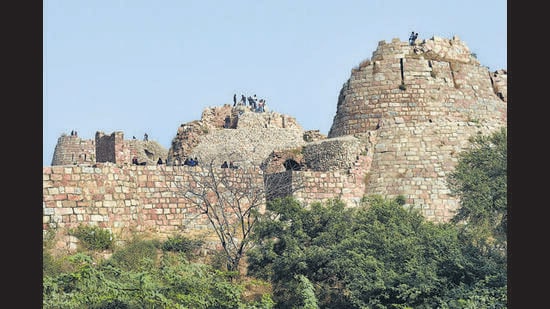
The Delhi High Court on Wednesday stressed that Tughlaqabad Fort is a monument of national importance, and that it must remain free of encroachment to preserve its historical heritage and ethos, as it constituted a seven-member committee to devise a comprehensive policy for removing unauthorised occupants and illegal structures in and around the fort area.
A bench of chief justice DK Upadhyay and justice Tushar Rao Gedela said the committee, headed by the Union housing ministry’s secretary, will first conduct a detailed survey before finalising its policy.
Besides the ministry secretary, the panel includes the Director General of the Archaeological Survey of India (ASI), the Delhi government’s housing secretary, the municipal commissioner, the DDA vice-chairman, the Delhi Police commissioner, and the divisional commissioner of the revenue department. It has also been asked to recommend rehabilitation measures for those found eligible.
The court was hearing a batch of petitions --one dating to 2001 -- seeking protection and preservation of the fort. Its order followed the ASI’s demarcation report, which confirmed that while there were no encroachments inside the fort itself, illegal constructions had sprung up along and beyond its boundary wall. The report also noted ASI’s repeated pleas of helplessness in removing long-term dwellers from economically weaker sections living in makeshift shelters.
Considering the report, the court said, “The Tughlaqabad Fort is one such monument which is of national importance, ancient, and reflects our historical ethos and heritage and therefore needs to be preserved. These encroachments, illegal constructions, therefore will have to be removed not only to ensure that the mandate of the Ancient Monuments and Archaeological Sites and Remains Act, 1958 is followed but also to ensure that our historical heritage and ethos are preserved for posterity.”
It directed the committee to explore government rehabilitation schemes, including the PM–Unauthorised Colonies in Delhi Awas Adhikar Yojana, while framing its policy. “We express our hope that the committee shall take into account all aspects and decide on removal of unauthorised occupants, construction, and rehabilitation of residents who may be found eligible,” the bench said.
In its order, the court also directed the Central Bureau of Investigation (CBI) to update it on the status of proceedings initiated to investigate the role of officials who may have colluded in allowing residents to unlawfully occupy the area. “Residents, though unlawfully, have been residing for long, maybe with the connivance of the authorities… it appears the matter was once taken up by the CBI but nothing is known of the outcome. Counsel for the CBI is directed to seek instructions,” the court noted.
The matter will be heard next on December 3.
The encroachment issue has previously reached the Supreme Court as well. In February 2016, the apex court ordered the removal of illegal structures from the fort area. Later, in October 2016, the Delhi High Court categorically prohibited any further encroachment or construction near the fort.
Stay updated with all top Cities including, Bengaluru, Delhi, Mumbai and more across India. Stay informed on the latest happenings in World News along with Delhi Election 2025 and Delhi Election Result 2025 Live, New Delhi Election Result Live, Kalkaji Election Result Live at Hindustan Times.


