
 E-Paper



Delhi on course to record worst November air
The number of “severe” air days is now behind only November 2016 (10) and November 2021 (11). But this number is likely to rise, forecasts show.


The Capital is on course to recording its worst November air quality in at least eight years, as pollution levels jumped into the “severe” zone on Friday, a grim record that underscores the severity of the health emergency that residents of Delhi have been subjected to.
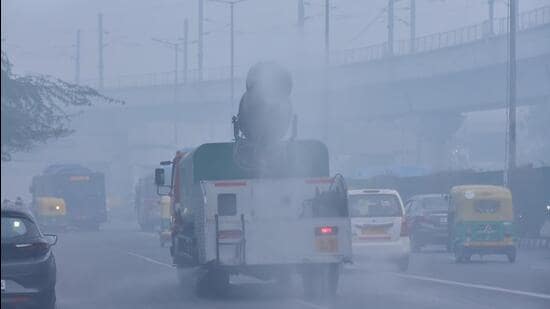
The 24-hour average AQI stood at 4pm on Friday stood at 415, according to the Central Pollution Control Board (CPCB), a deterioration — that came partially on account of unfavourable meteorological conditions — from 390 a day ago.
With this, Delhi’s average AQI so far this month picked up to 375, only a shade better than 376 in the same month in 2021, which is so far Delhi’s most polluted November.
Further, Met officials have warned that the air quality is unlikely to swing too much over the weekend at least, with a western disturbance likely to bring the city only a smattering of rain, that too only on Monday.
So with six days of the month still to go and weather conditions unlikely to be forgiving, this month is likely to surge past the November 2021 record, highlighting the administrative failure to curb emissions either locally, or in states where farmers burn paddy stubble, particularly Punjab.
The number of “severe” air days too is now behind only November 2016 (10) and November 2021 (11).
Weather officials said that no favourable change in meteorological conditions — an increased wind speed and rise in temperatures — is expected on Saturday, which would keep the air quality “severe”, likely giving Delhi its 10th such day this month. However, AQI is expected to improve on Sunday, when minimum temperature begins to rise again and winds start to pick up due to a western disturbance, which is also forecast to bring light rain to Delhi on Monday.
Even though the number of “severe” days this month has not been the highest in the last eight years, AQI has been on the brink of severe with readings of 390 or higher on another six days, taking the number of such days to 15 — the highest tally in November in the last eight years. The previous high of 13 such days was recorded in November 2021.
An AQI of 51 to 100 is classified as “satisfactory”, between 101 and 200 is classified as “moderate”, between 201 and 300 as “poor”, between 301 and 400 as “very poor” and over 400 as “severe” by CPCB.
Forecasts for the remainder of the month too paint a grim picture, as Delhi’s AQI is not likely to dip below 301.
“Delhi’s air quality is likely to be in the ‘severe’ category from Friday till Saturday. The air quality is likely to improve to the ‘very poor’ category from Sunday till Monday. The outlook for the subsequent six days shows the air quality is likely to remain largely in the ‘very poor’ category,” said the Early Warning System (EWS) for Delhi, a pollution forecasting model.
CPCB began sharing AQI from April 2015 onwards. Since then, the number of severe days in the month of November has been three in 2022, nine in 2020, eight each in 2019 and 2018, seven in 2017, 11 in 2016 and seven in 2015. The number of days with an AQI of 390 or higher was three in 2022; 13 in 2021; nine in 2020; eight each in 2019 and 2018; seven in 2017; 11 in 2016 and seven again in 2015.
Even as measures under stage three of the Graded Response Action Plan (Grap) are in place since November 2 now, when AQI crossed 400 for the first time, Delhi environment minister Gopal Rai on Friday called an emergency meeting on air pollution, directing agencies for strict enforcement of measures under the plan and to plan special campaigns around prevention of biomass burning.
Rai, citing data shared with him by the Delhi Pollution Control Committee (DPCC) and the environment department, said that currently, around 36% of the pollution was due to vehicles in Delhi, followed by 31% from biomass burning. The government did not share from where this data was sourced.
Stage 3 puts a ban on private construction, plying of BS III petrol and BS IV diesel vehicles, and buses that are not BS VI, CNG or electric are banned from plying to Delhi from NCR. There are also restrictions on using diesel generator sets.
However, experts say the interventions are clearly not enough.
“Each city has a base emission load, which remains same throughout the year, but these emissions accumulate in winter due to unfavourable meteorological conditions. We cannot control meteorology, but we can try to bring down these emissions by better management of waste, of stubble, better traffic management and also dust.” said Dipankar Saha, former head of CPCB’s air laboratory.
Low temperatures make the atmosphere more stable, aiding calm wind conditions and making the dispersal of pollutants difficult.
Sunil Dahiya, analyst at the Centre for Research on Energy and Clean Air said unfavourable meteorological conditions remain a deciding factor when it comes to influence on Delhi’s air quality.
“Delhi needs the help of favourable meteorology, particularly in November, when Diwali and farm fires add to the pollution. Last year, Delhi saw only three severe air days as conditions were largely favourable, but this year, they are not,” he said, adding that efforts are needed to tackle each pollution source.
Stay updated with all top Cities including, Bengaluru, Delhi, Mumbai and more across India. Stay informed on the latest happenings in World News along with Delhi Election 2025 and Delhi Election Result 2025 Live, New Delhi Election Result Live, Kalkaji Election Result Live at Hindustan Times.


