E-Paper



Delhi pollution: Air quality may deteriorate over next 48 hours
Delhi’s average air quality index (AQI) was recorded at 353 (very poor) on Monday, maginally poor from 330 on Sunday. However, it may shift towards the higher end of the very poor range (up to 400), forecasters said

 Prefer HTon Google


New Delhi: Air quality in Delhi will gradually deteriorate over the next 48 hours due to poor wind speed even as the contribution of farm fire emissions is expected to stay low, forecasting agencies said on Monday.
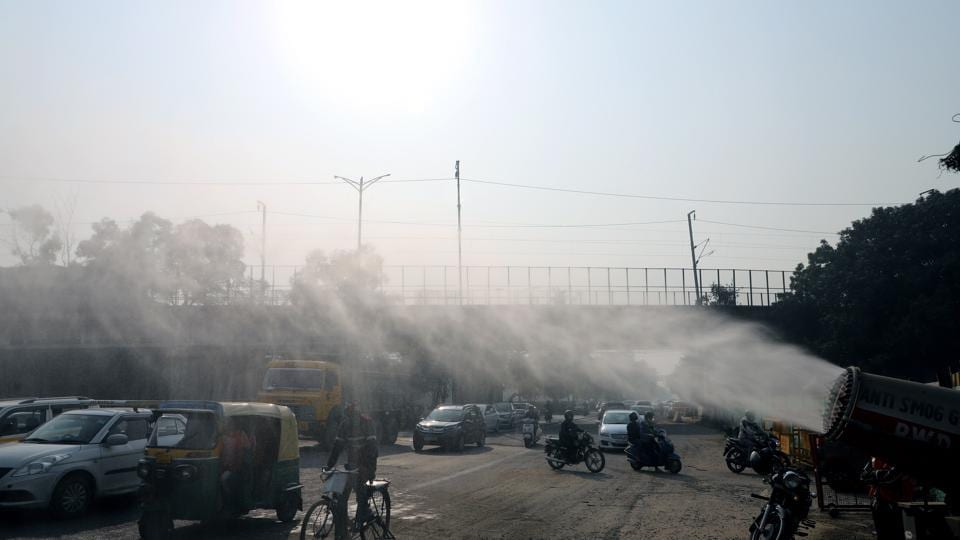
Delhi’s average air quality index (AQI) was recorded at 353 (very poor) on Monday, maginally poor from 330 on Sunday. However, it may shift towards the higher end of the very poor range (up to 400), forecasters said. They added that farm fires contributed 10% of the particulate matter 2.5 (PM2.5) pollutants to the capital’s air.
According to the Early Warning System for Delhi (EWS), a forecasting system developed under the ministry of earth sciences, wind is likely to blow at 4-8 km/hr in the early morning hours on Tuesday and Wednesday.
Gufran Beig, founder and project director at the System of Air Quality and Weather Forecasting and Research (Safar), said while calm wind conditions were impacting Delhi negatively, the share of stubble burning could reduce further from Tuesday, with wind direction expected to change to easterly. “This will reduce the impact of stubble burning further, even as pollutants accumulate locally. This may push air quality to the higher end of very poor, but it is unlikely to touch severe,” said Beig.
Data from the Decision Support System (DSS) --- a new source-wise forecasting tool launched by the ministry of earth sciences this year -- shows that the contribution of vehicles is expected to remain highest among local sources of pollution in the next two days, hovering between 20 and 25%. This is followed by around 7-8% contribution from industries in Delhi and NCR. The share of stubble burning could meanwhile drop to around 6% in the next two days, the data shows.
Another factor negatively impacting Delhi’s air at the moment is a drop in temperature. While Delhi recorded the season’s lowest minimum temperature of 10.1 degrees Celsius on Sunday, it was recorded at 10.3 degrees Celsius on Monday. IMD has forecast that it may drop to 9 degrees by Wednesday.
Senior IMD scientist RK Jenamani said visibility dropped slightly on Monday, and the relative humidity went up by 10-15%. “Visibility was between 1,000 and 1,500 metres at Palam on Monday as compared to 1,500 to 2,200 metres on Sunday. Similiarly at Safdarjung, it was between 800 and 1,200 metres as compared to 1,000-1,500 metres on Sunday. Relative humidity has increased, with shallow fog expected on Tuesday,” he said.
Dipankar Saha, former head of CPCB’s air laboratory, says even with a reduction in stubble emissions, pollutants in Delhi had become trapped. “An accumulation is taking place, which will only go away if wind speeds pick up,” he said.