
 E-Paper



Delhi pollution season far from over yet, shows data
CPCB data from the last five years shows that Delhi records two 15-day spells where the air quality typically deteriorates


The Capital will likely record another spell of bad air in the second half of December but will fall short from plunging into the “severe” zone, according to data from the Central Pollution Control Board (CPCB).
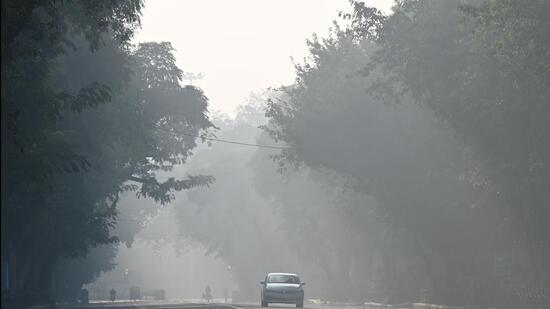
CPCB data from the last five years shows that Delhi records two 15-day spells where the air quality typically deteriorates — in the first half of November and the second half of December, the latter being the second most polluted time of the year in the city based on the average air quality index (AQI).
Experts attributed the hazardous AQI levels in November to an array of factors including the annual problem of farm fires followed by toxic firecrackers being burst around Diwali along with local emissions. However, the December streak is primarily due to local pollutants becoming more prominent as low temperatures and dense fog trap them closer to the surface, they said.
The air quality in December till now has oscillated between “poor” to “very poor” and the month started on a relatively cleaner note, even as November ended in the “severe” category. The first ten days of December have clocked no “severe” air days. Forecasts by the Early Warning System (EWS) for Delhi, which the Commission for Air Quality Management (CAQM) in NCR relies on for decision-making purposes, show Delhi is likely safe from “severe” air till December 19.
Delhi Pollution Control Committee (DPCC), which assessed CPCB’s AQI for Delhi between 2018 and 2022 showed the period November 1-15 had the highest AQI through the year — 370 (very poor), with the second highest 15-day spell being December 16-31, when the average AQI was 351 (very poor). The third worst spell was January 1-15, when the average AQI was 324 (very poor).
“This is a natural phenomenon as low temperatures negatively impact air quality. They make the atmosphere more stable and lead to calm wind conditions. In late December and early January, we also see dense fog and the sun does not come out much. The local pollutants being released, trap pollutants and again, in the absence of strong winds, severe air days return,” said Dipankar Saha, former head of CPCB’s air laboratory.
Saha flagged that Delhi’s background emissions were fairly high in the winter months even in the absence of stubble burning.
CPCB classifies an AQI between 0-50 as “good”, between 51 and 100 as “satisfactory”, between 101 and 200 as “moderate”, between 201 and 300 as “poor”, between 301 and 400 as “very poor”, and over 400 as “severe”.
This November, the average AQI in the first half was 376 (very poor). In the second half of November, when there is usually a respite, the average AQI was 370 (very poor) this year. In comparison, the average AQI for November 16-30 was 299 (poor) for the period 2018-2022.
In December so far, the average AQI has been 321 and the last “severe” air day was recorded on November 24, when the AQI was 415. In December 2022, the average AQI in the first half was 301. Between December 16-31, the average AQI was 337.
A similar study carried out by the Delhi Pollution Control Committee in 2021 for the period 2016-2020 found that Delhi averages a PM2.5 concentration of 285 micrograms per cubic metre (µg/m3) between November 1-15, the highest all year. The second-highest average PM2.5 concentration came between December 16-31, when the PM2.5 concentration was 218µg/m3. The 24-hour safe standard for PM2.5 is 60µg/m3.
“The data, year-on-year, shows two distinct periods of air pollution. Even though pollution levels have improved slightly, another spike is likely in the coming two weeks,” said a DPCC official.
The EWS statement said: “Delhi’s air quality is likely to remain in the ‘very poor’ category from December 11 till 13. The outlook for the subsequent six days shows the air quality is likely to be between the ‘very poor’ and ‘poor’ category.”
An IIT Delhi study in 2019, analysing 15-year annual data for Delhi, showed a similar trend for the city’s air pollution. It found prominent spikes in air pollution. While the first spike was seen from October 29 to November 4 and was largely attributed to stubble burning, a second spike — lower than the first — was recorded from December 31 to January 6. This, the study said, was largely down to open waste burning, low temperatures, and moderate to dense fog.
While in the first spell, the peak PM2.5 concentration breached 500µg/m3, the concentration during the second spell was around 350µg/m3.
Sagnik Dey, lead researcher of the IIT Delhi study and coordinator at the Centre for Excellence for Research for Clean Air, said the data assessed was for a substantial period, indicating the pollution spike was largely recorded around the same period each year. “The first spell has more to do with Diwali and stubble burning. We found that while meteorological conditions were less adverse, these emissions play a key role in driving up pollution levels suddenly. In the second spell, it is all down to local emissions and low temperatures play a key role,” said Dey.
Stay updated with all top Cities including, Bengaluru, Delhi, Mumbai and more across India. Stay informed on the latest happenings in World News along with Delhi Election 2025 and Delhi Election Result 2025 Live, New Delhi Election Result Live, Kalkaji Election Result Live at Hindustan Times.


