E-Paper



Delhi: SC appointed panel finds alarming violations in Ghazipur poultry market
The report said that despite the bird flu scare earlier this year, conditions in the biggest wholesale poultry market of the city remain alarming

 Prefer HTon Google


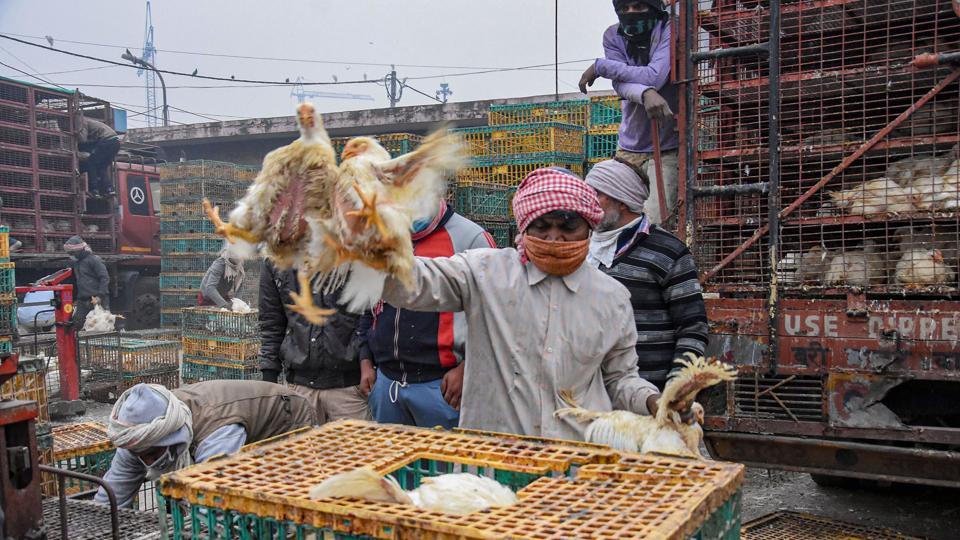
A Supreme Court appointed panel has listed major violations of safety rules at the Ghazipur poultry market (popularly known as the Ghazipur Murgha Mandi) that pose serious public health concerns, senior municipal officials said.
The slaughter house monitoring committee, constituted in accordance with 2012 Supreme Court order, submitted its report to the principal secretary of the urban development department on September 30. HT has seen a copy of the report.
The report said that despite the bird flu scare earlier this year, conditions in the biggest wholesale poultry market of the city remain alarming. The report flags that no records of the source of consignments are being maintained and no veterinarian was found in the market during an inspection by committee members on September 23, 2021 that is a mandatory condition for running a slaughter house.
The Ghazipur poultry market is managed by Delhi Agricultural Marketing Board.
The committee also reported that blood and offals were being directly discharged into the drain without any treatment. The panel was headed by the director of veterinary services, South Delhi Municipal Corporation (SDMC) Ravindra Sharma, and had members from the veterinary services, animal husbandry department and Food Safety and Standards Authority of India (FSSAI).
The report also noted that shops meant for sale of live birds were being used for slaughter of birds in large numbers even though trade of livestock and slaughter of birds are two distinct activities requiring different licences to operate.
“It can be estimated that more than four lakh poultry birds were being brought into the market. The health status of these birds, majority of which were found injured and some were so sick that they were drifting in and out of consciousness,strongly indicated that there was a lack of sufficient veterinary attention being provided. No consignment that was being brought into the market had a ‘fitness certificate to transport’ which is provided by a veterinarian,” the report states.
It is important to note that similar violations were also flagged by the same panel in November 2020 but little seems to have changed on the ground.
The report also noted the possible environmental impact due to non-scientific disposal of by-products. “It is estimated that more than three thousand birds were being slaughtered in each outlet in the mandi. Fresh blood was either being collected in barrels or poured in drains. Slaughtering and dismembering of carcasses was being carried out next to drains, and offals and blood were being discharged into drainage system without any treatment or processing (thereby) posing serious risk to public health,” the report said.
Noting that there is complete neglect of hygiene and general sanitation in the market, a monitoring committee member said that they have found several instances of violation of slaughterhouse rules (2001) and the Prevention of Cruelty to Animals Act, 1960.
The committee has recommended action by specific agencies dealing with the full range of violations at the market. It said that health and hygiene violators be dealt by FSSAI, Delhi Police should prosecute traders who are found transporting birds in violation of rules, and the Delhi Pollution Control Committee should impose environmental compensation cess on those found polluting water.
Mohammad Imran alias Kallu, a member of the Ghazipur poultry market association, said the traders were shifted from places such as Jama Masjid and Qasabpura to Ghazipur in 1990s but adequate facilities were not provided to them. “This concerns small animals, so a separate slaughterhouse may not be needed. However, there is no no modern slaugtherhouse for poultry in the city. We also want facilities such as proper drainage, wash rooms, etc. The traders pay a fee to operate from the market but facilities are not provided to us,” he added.
Officials of the Delhi Agricultural Marketing Board did not respond to repeated calls made to elicit response on the panel’s findings and recommendations.