
 E-Paper



Delhi Statistical Handbook 2025: Rise in respiratory deaths, pivot in public transport
The Delhi Statistical Handbook 2025, prepared by the Directorate of Economics and Statistics, presents consolidated information across 23 chapters

 Prefer HTon Google


The Delhi government this week released the 50th edition of its annual statistical handbook, a comprehensive compilation of socio-economic data that provides a revealing snapshot of the Capital’s changing character.
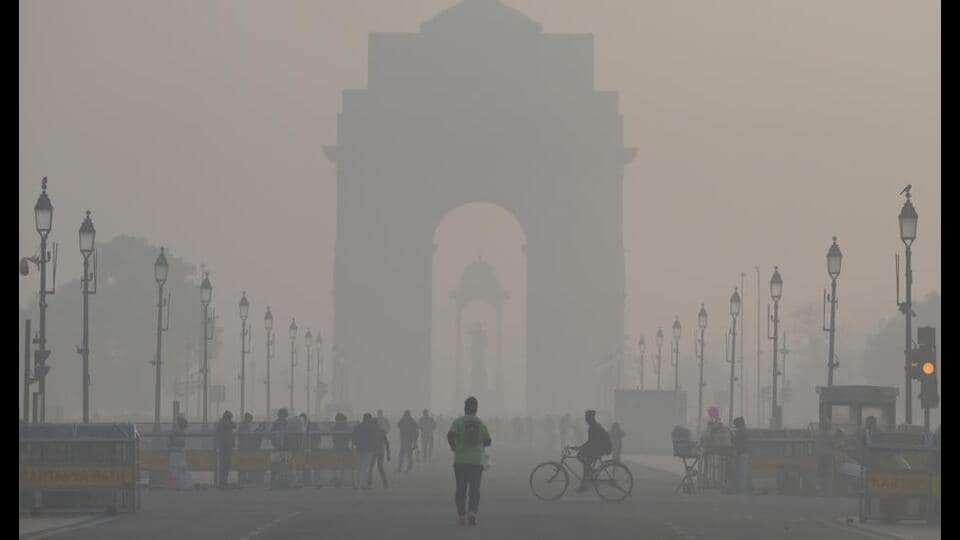
The Delhi Statistical Handbook 2025, prepared by the Directorate of Economics and Statistics, presents consolidated information across 23 chapters, tracking vital indicators from public health and crime to transportation and environmental management.
The latest edition underscores a city in transition, grappling with the severe health impacts of pollution, accelerating a green transition in its public transport, and confronting complex crime trends, even as it makes measured progress in infrastructure and service delivery.
Health: Rise in respiratory deaths
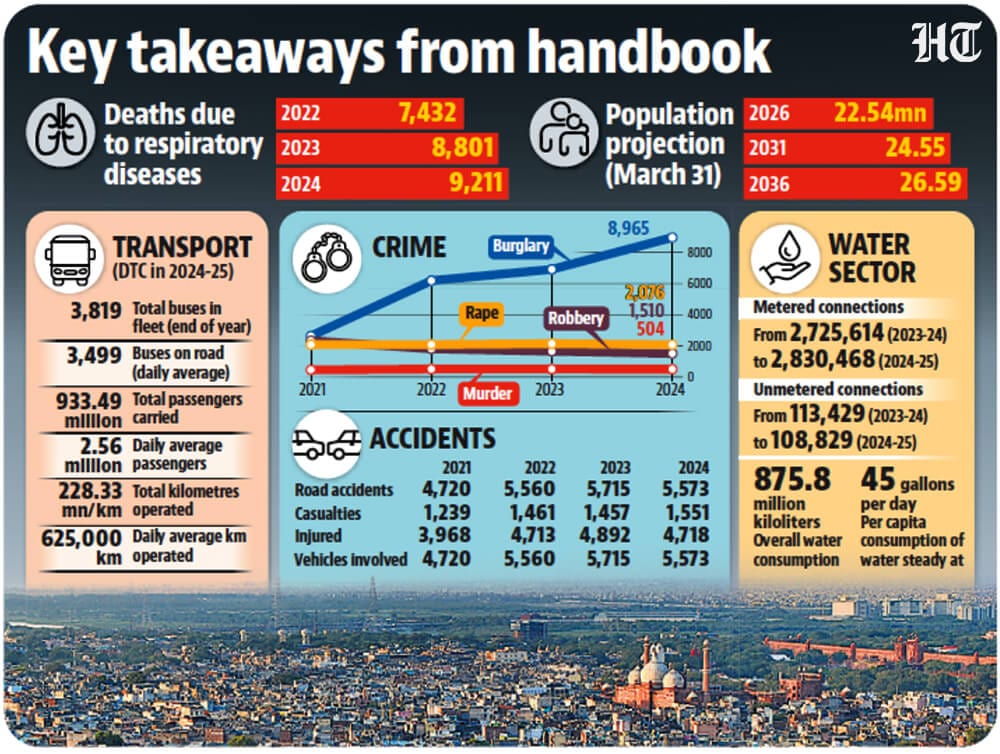
A particularly alarming finding in the report is the steady increase in deaths due to respiratory diseases. The data shows a clear upward trajectory in the post-pandemic period, with respiratory deaths rising from 7,432 in 2022 to 8,801 in 2023, and further climbing to 9,211 in 2024.
While the figure for 2021 – 14,442 deaths – was heavily influenced by the Covid-19 pandemic, which frequently caused fatal respiratory failure, the consistent rise in the subsequent three years appeared to suggest the escalating burden of chronic air pollution on public health. Respiratory diseases encompass conditions such as asthma, pneumonia, tuberculosis, and chronic obstructive pulmonary disease, all exacerbated by prolonged exposure to poor air.
This trend forms part of a broader increase in overall mortality. The total number of deaths in Delhi rose to 139,480 in 2024, up from 132,391 the previous year.
Of these, circulatory diseases – conditions affecting the heart and blood vessels like coronary artery disease and heart failure – remained the leading cause of death, followed by infectious and parasitic diseases. The gender breakdown of deaths showed 85,391 males, 54,051 females, and 38 individuals classified under other genders, with 90,883 of the total deaths being medically certified.
The health sector data also highlighted a persistent gender disparity in family planning procedures. Female sterilisation continued to dominate overwhelmingly, accounting for over 97% of all sterilisations conducted in the Capital. Of the 14,543 procedures performed in 2024, only 301 were conducted on men. To be sure, the pattern is consistent in 2022-23, 97.4% of sterilisations were performed on women and in 2021-23, when this was 97.3%.
Transport: Electric bus fleet expansion
The report documents a significant and accelerating shift towards electric mobility within Delhi’s public transport network. By the end of the reporting period, the Delhi Transport Corporation (DTC) was operating 3,819 buses, of which 1,725 were 12-meter electric buses. This substantial fleet underscores a strategic move away from CNG-powered vehicles.
On a daily average, 3,499 DTC buses were operational, serving a massive annual ridership of 933.49 million passengers, which translates to a daily average of 2.56 million commuters.
The electric buses are not just symbolic; they are becoming workhorses of the system. The 12-meter electric buses alone carried 367.34 million passengers during the year, a figure that nearly matches the ridership of the non-AC CNG services. This, officials said, highlights their rapid integration and acceptance as a core component of the city’s transport mix.
Operationally, e-buses demonstrated superior reliability, recording far fewer breakdowns per 10,000km compared to their CNG counterparts. To be sure, e-buses are also newer to the fleet, so this may have added to their reliability rate.
Safety metrics showed a marginal improvement. The number of accidents involving DTC buses declined slightly to 97 in 2024-25, down from 101 the previous year. Among these, fatal accidents accounted for 21 cases. The cluster bus system operated by the Delhi Integrated Multi-Modal Transit System (DIMTS) ran 3,147 buses, carrying 556.3 million passengers annually. The collective data signals a successful public transport pivot towards electrification, rising passenger dependence, and gradual safety improvements.
Water: Treatment capacity up
The report highlights substantial investment in water and sewage infrastructure, a critical area for the Capital, particularly amid shortages and quality issues being reported recently in NCR towns. There was a significant increase in installed sewage treatment capacity, from 667 million gallons per day (MGD) in 2024 to 764 MGD in 2025. Key expansions included the Okhla Sewage Treatment Plant (STP), whose capacity increased from 140 MGD to 170 MGD, along with additions at Rithala (40 MGD) and Yamuna Vihar (5 MGD). This growth is part of a longer-term strategy, with installed STP capacity having risen from 597 MGD in 2020-21 to the current 764 MGD. The government has stated an ambitious goal to nearly double this capacity to around 1,500 MGD by 2028, which is central to its Yamuna rejuvenation plans.
On the delivery side, the Delhi Jal Board (DJB) reported an increase in metered water connections by over 100,000, from 2.73 million in 2023-24 to 2.83 million in 2024-25. Concurrently, unmetered connections decreased from 113,429 to 108,829. Despite these improvements in infrastructure and metering, the per capita water consumption in Delhi remained steady at 45 gallons per day between 2024 and 2025.
Crime: A mixed picture
On a positive note, crimes against women have shown a consistent declining trend over the last four years. The total number of registered cases, including rape, dowry deaths, and molestation, dropped by nearly 12% between 2021 and 2024. The figures fell from 5,208 cases in 2021 to 5,119 in 2022, then to 4,982 in 2023, reaching a four-year low of 4,584 cases in 2024.
Cases of missing minors also declined, with 5,846 children reported missing in 2024, down 7% from 6,284 in 2023. Police reported a recovery rate of more than 50% for these cases.
However, such progress is offset by several concerning increases. Cases of missing adults rose to 19,047 from 18,197 the previous year. Most alarmingly, burglary cases surged by nearly 30%, from 6,916 cases in 2023 to 8,965 in 2024. Attempted murder cases also rose significantly by about 18.6%, from 757 to 898.
Road safety deteriorated, with fatalities rising to 1,551 in 2024, up from 1,457 in 2023 and continuing a rising trend. Furthermore, the fire department received 36,486 calls in 2024, a notable increase from 31,399 calls in 2023, suggesting a rise in fire incidents or public reporting.
Power and environment
The energy sector showed steady growth, with Delhi’s installed power generation capacity increasing to 2,495,000 KW in 2024-25, up from 2,397,000 KW the previous year. The number of electricity consumers also continued to rise, reaching 7,384,862 in 2024-25.
On the environmental front, it reported an expansion of Delhi’s green cover. It reached 25.04% of the total geographical area in 2023, covering 371.31 square kilometres -- an increase from 23.06% (or 342 sq km) in 2021. Over the last two decades, the green cover has grown by over 100 sq km, from 268 sq km (18.07%) in 2003. A significant portion of this, 192.28 square kilometers, is classified as forest cover, with the highest concentration in the southern district (70.89 sq km), largely comprising the ecologically vital Southern Ridge.
Stay updated with all top Cities including, Bengaluru, Delhi, Mumbai and more across India. Stay informed on the latest happenings in World News along with Delhi Election 2025 and Delhi Election Result 2025 Live, New Delhi Election Result Live, Kalkaji Election Result Live at Hindustan Times.


