
 E-Paper



Delhi University directs classes, labs to be open 8am to 8pm
The directive has drawn mixed responses from staff, who said better resource utilisation is welcome, but taking the decision without discussion was not feasible

 Prefer HTon Google


The Delhi University has directed its constituent colleges and departments to keep classrooms and laboratories open and operational for 12 hours — 8am to 8pm — on all working days to achieve optimum utilisation of resources.
Colleges have been asked to submit the action taken report by May 31 to the dean, academic affairs. Currently, classes take place maximum till 5pm. The directive has drawn mixed responses from college principals and teachers, who said that better utilisation of resources is welcome, but taking the decision without discussion with staff and statutory body members, and the simultaneous infrastructure expansion was not feasible.
The varsity, in a notification dated May 1 but issued on Thursday by registrar Vikas Gupta, noted that the University Grants Commission (UGC) has requested Central universities and higher education institutes to take appropriate measures for the implementation of UGC guidelines for the optimum utilisation of resources so as to extend benefits to students and researchers.
The UGC guidelines the notification was referring to were issued on January 12, and state that classrooms and laboratory facilities should be opened at least from 8 am to 8 pm on all working days.
“Accordingly, all the colleges and departments are required to take appropriate measures to open the classrooms and lab facilities from 8am to 8pm on all working days,” the DU notification said.
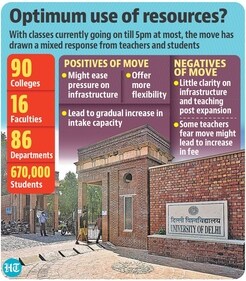
DU vice-chancellor Yogesh Singh said the move will allow colleges to hold classes in a staggered manner and ease pressure on infrastructure. He said the decision will offer students more flexibility, and while the university has sufficient teachers, more posts will be created if required.
“Currently, the classroom size has increased since the infrastructure is limited. We have classrooms with a 110-120 students’ capacity in some places. In such a situation, teaching and learning suffers. If resources are made available from 8am to 8pm, we can hold classes in a staggered manner. More teachers will not be required but if we feel the need, we will create more posts,” said Singh.
The directive has drawn mixed responses from college principals and teachers.
Manoj Khanna, principal of Ramjas College, said efforts seeking better utilisation of resources were welcome. “We have resources and if they are being used from 8am to 8pm, there is nothing bad about it. We talk about new colleges but if resources already available are used to their maximum capacity, it will be a good step. Even now, if required, our library stays open till 6-8pm,” said Khanna.
He said that it was too early to say how the teaching hours will work out and the modalities pertaining to staff requirements will need deliberations. “Right now, we don’t know if duty hours will be increased or not. It’s too early to say and we need more details. We will have to assess if extra staff is needed and how the modalities can be worked out,” said Khanna.
Naveen Gaur, teacher at Dyal Singh College and a former member of DU academic council, said the college infrastructure was currently under strain, and the extension of class timings might ease the pressure on colleges. He, however, said that implementation of the guidelines in a haphazard hurried manner without assessing the challenges of different colleges should be avoided.
“Right now, time-table creation has become difficult due to infrastructural gaps. Colleges don’t have rooms and slots available to hold tutorials. Labs are heavily overcrowded and since equipment is not sufficient, we end up making groups of 3-4 students. Ideally, one shouldn’t have more than two students. If well implemented, the capacity of lab-based courses can be increased,” said Gaur.
Abha Dev Habib, who teaches at Miranda House, said the government has imposed a new undergraduate programme — referring to the new four-year courses — and done academic restructuring without the expansion of other resources. “The university is trying to offer more choices to students as part of the four-year programme. With its existing structure, colleges are unable to meet the demands of the four-year programme. It’s becoming difficult to complete the classes by 5pm. If the government wanted to start four-year programmes, it should have taken the expansion of teachers and infrastructure into account. If classes take place from 8am to 8pm, where will students find time to self-study and socialise? This is an unhealthy situation for students, many of whom live as paying guests,” said Habib.
Manoj Sinha, principal of Aryabhatta College and general secretary of the DU Principals’ Association, said while the move was welcome, colleges would need strengthening of infrastructure and logistics. “With the implementation of the NEP (National Education Policy), the focus on practicals and hands-on training has increased and more working hours are needed in institutes. For implementation, institutions will need intense help on infrastructural and logistical strengthening,” said Singh.
He added that college can offer more courses to students with an increase in timing but this would also require expansion of teaching and non-teaching staff. “Human resources will have to be strengthened in terms of both teaching and non-teaching staff. The move will require planning depending on the capacity of different colleges,” said Sinha.
A section of faculty members said the move was an attempt to convert the public-funded university to a self-financed one. Rajesh Jha, a teacher at Rajdhani College and a former academic council member, said that the guideline is ill-conceived and seeks to convert the university from academic line to an assembly line. “University system offer spaces to create and develop new ideas. This is not a place for production work culture,” said Jha.
He added that the guidelines called for utilisation of resources without the investment of additional resources which is not feasible. “This idea is good for a small institution but Delhi University colleges’ resources are already overburdened due to intake of a large number of students without any significant increase in infrastructure. Government has increased the number of students in EWS expansion but has not sanctioned any teaching post as well as infrastructure,” said Jha.
Anirudh Mehta, a student at Hindu College, said while infrastructure is not under major strain at his college, students might face challenges on the travelling front if classes were to take place till 8pm. “Our seniors tell us that there used to be a lot of strain on infrastructure earlier. With CUET, at least in my college, it’s not a major problem. I am okay with classes in the evening but I travel from Gurgaon so commuting will be more stressful. Other students might have other challenges,” said Mehta.


