E-Paper



Delhi’s other stray menace: Cattle that roam streets, as shelters packed to capacity
Once restricted only to areas on the city’s outskirts and near rural belts, stray cattle have slowly but steadily become a common sight throughout the city.

 Prefer HTon Google


New Delhi: Stray dogs are currently in the spotlight due to the Supreme Court ruling on moving them from streets to shelters, but the Capital also suffers from another menace, of stray cattle, which freely roam on arterial roads and have caused multiple accidents, and in one instance, even stopping the chief minister’s convoy.
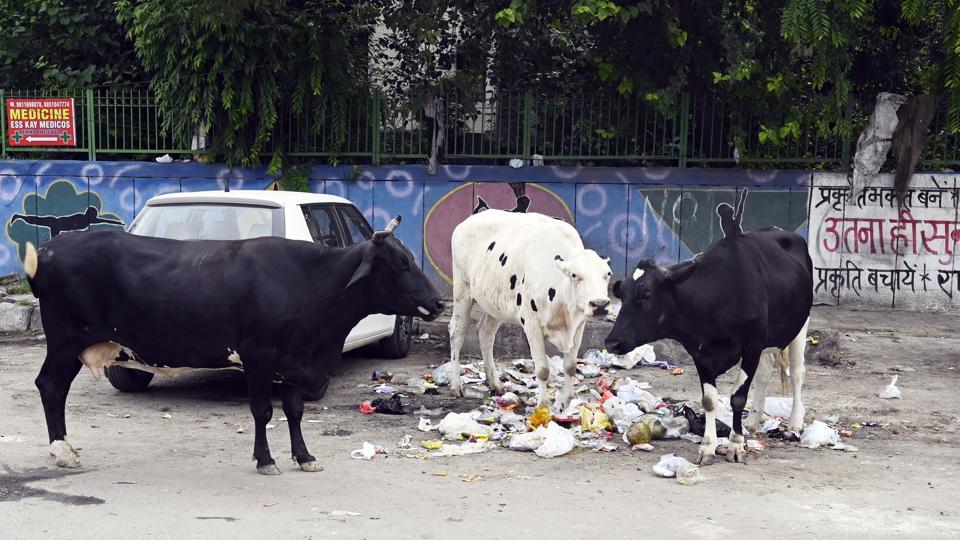
Once restricted only to areas on the city’s outskirts and near rural belts, stray cattle have slowly but steadily become a common sight throughout the city, with cow shelters packed to capacity.
Also Read | ‘Impractical, illogical, illegal’: PETA India on SC's stray dogs removal order
Ashok Bhasin, who heads the North Delhi Residents Welfare Federation, said that minor accidents have become a daily occurrence in localities around the North Campus. “Every day, we receive complaints of two-wheeler accidents due to stray cattle. A major accident which led to injuries was reported from Gol Mandi nine days back. The entire belt from Malkaganj, Chandrawal and Azad Market to Sabzi Mandi is full of illegal dairies. The cattle feed on garbage spilling from dhalaos. The Municipal Corporation of Delhi (MCD) has failed to curb illegal dairies, as well as in garbage management,” he said.
The continued presence of a large number of stray cattle is linked with lax enforcement, operation of illegal dairies in residential areas, continued unregulated influx of cattle from neighbouring states, and 75% of designated cow shelters running at capacity.
Also Read | SC orders removal of all stray dogs from Delhi-NCR
Despite assurances of a new dedicated law and model gaushalas, things have not changed on the ground.
The Lodhi Colony residents’ welfare association (RWA) said that complaints to authorities have not yielded any results.
Mukesh Kumar Sinha, general secretary of the RWA, said: “We face the risk of accidents. There are illegal dairies in Kotla, which leave their cattle to feed in open. People also feed them for religious reasons but this poses a safety hazard on busy roads.”
A senior MCD official said that the civic body is only tasked with capturing stray cattle roaming the streets and dropping them at the cow shelters designated by the animal husbandry department of the Delhi government. “Delhi has only four such operational gaushalas, most of which are filled to capacity. Only one gaushala is accepting captured cows,” the official said, requesting anonymity.
The Gopal Gausadan has a capacity of 3,200 animals; Sri Krishna gaushala can house 7,600 cattle; Manav Gausadan can house 500 cattle, and Dabur Hare Krishna Gaushala in Surhera can accommodate 4,000 animals. A fifth gaushala, Acharya Sushil Muni, was closed due to rampant mismanagement in 2018. “Animal husbandry department needs to open more gaushalas in other parts of the city which will also solve the logistics problem,” the official added.