
 E-Paper



Delhiwale: Aakash’s “bainga”
As winter approaches, vendor Aakash returns to sell his addictive gajak, an iconic seasonal snack, using a unique balancing apparatus called bainga.


The day is still searing hot, but there are signs of winter knocking at the door. The evening darkness is descending upon the city much earlier than it were wont to do. A more substantial sign of the shift in season is perceptible in the return of a young vendor of gajak.
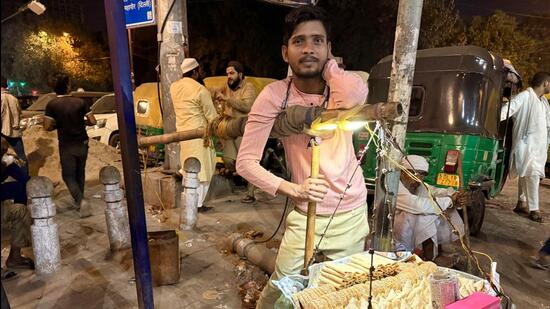
Said to inoculate instant warmth into the body, the crisp gajak annually arrives in the capital with the onset of cold weather. Made of jaggery and sesame, it is so addictive that you might keep nibbling at it until the appetite is ready to burst.
As for vendor Aakash, he says he himself makes these gajaks at his home in Khajuri. Indeed, many gajak sellers make their own gajak. The unusual thing about Aakash’s gajaks is that they are of three different types, yet they taste the same. One variety is called samosa—because it is shaped like a samosa. Another is tikki—it is shaped like aloo tikki. The third variety is named roll, and its shape resembles a stuffed roll.
But wait, this is not the only extraordinary thing about Aakash’s mobile stall (he spends his day walking from one market to another). The stall’s main apparatus looks like a weighing balance. Aakash calls it bainga. This warm September evening, the gajaks are stacked neatly on a metal paraat. The paraat hangs by a strong plastic cord. The cord is tied to a wooden rod. The other end of the rod is tied to a rusting tin canister. The canister is filled with modestly weighty boxes, presumably to balance the bainga. This rod is slung along Aakash’s shoulder. A part of the rod is wrapped thickly in a woollen muffler; the improvised arrangement serves as a soft cushion to the young man’s shoulder.
Overall, the sight is captivating—the bainga being more of a scene stealer than the gajaks. You might recall a memorable scene in Satyajit Ray’s film Pather Panchali in which a village vendor is carrying his yoked sweets in such a bainga.
In the Millennium City of Gurugram, a street seller of mithai employs an exactly similar bainga. During a long-ago encounter in that town’s Sadar Bazar, the vendor had compared his bainga to a scene in Ramayan. “It was this kind of palki in which Shravan Kumar was carrying his parents to the teerth (pilgrimage).”
Now, a customer approaches Aakash’s stall. He studiously gazes at different types of gajaks. “20 rupees for two,” the vendor says. The customer walks away without making a purchase.
After the forthcoming winter concludes, Aakash will return to selling summertime fruits—on a cart.

Stay updated with all top Cities including, Bengaluru, Delhi, Mumbai and more across India. Stay informed on the latest happenings in World News along with Delhi Election 2025 and Delhi Election Result 2025 Live, New Delhi Election Result Live, Kalkaji Election Result Live at Hindustan Times.


