
 E-Paper



Delhiwale: The house of zari
Dispatch from a slowly disappearing world

 Prefer HTon Google


An entire household is contained in this room. This household contains a life that has largely disappeared.
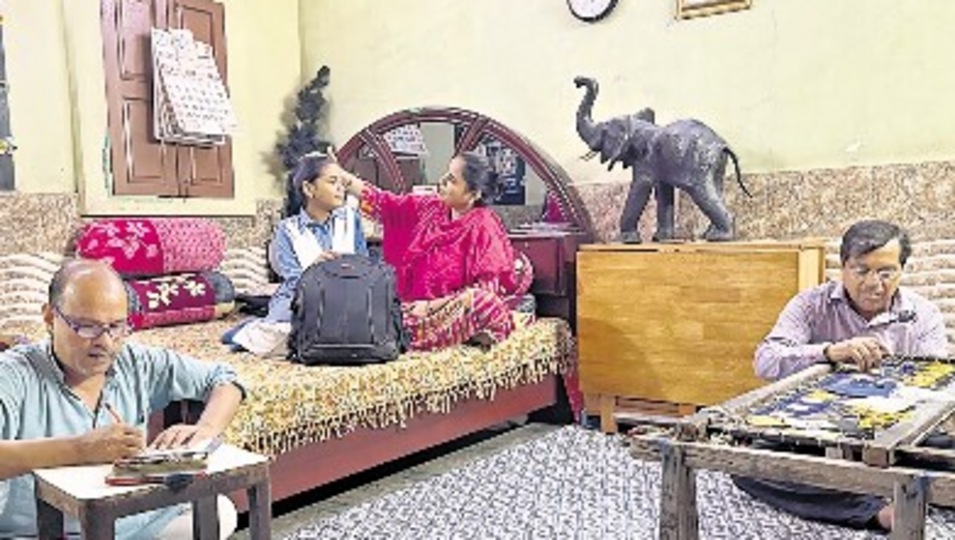
The second floor apartment in Old Delhi’s Gali Chandi Wali houses a family of zardozi karigars (workers) who “design, embroider and manufacture fabrics of zari thread by hand.”
This afternoon, Muhammed Afaq is finishing an embroidery on his traditional “karchup” wooden desk. His younger brother Irshad is doing something similar. Both are perched on the floor. Afaq’s wife, Saira Bano, is sitting on the double bed, combing her hair. Their elder daughter Neha is attending a mehndi-design class at Fatima Academy in Lal Kuan. The younger Ilma, a 10th standard student, is at Anglo-Arabic School in Ajmeri Gate.
“Two of us — we are four brothers — work jointly,” says Afaq in his soothing please-feel-at-home voice. All brothers have their independent domestic territories in the aged mansion adorned with steep staircases, arched doorways and taaks. These different rooms house the sons of late Muhammed Iqbal, a zardozi artisan, who was the son of Muhammed Islam, who too was a zardozi artisan.
Irshad picks a zari thread, “See, it is of copper, which is coated with (imitation) gold … it is slightly more sakht (stiffer) than other threads.”
This sight of zardozi karigars working at home, often with hired labourers, was common in the Walled City until 30 years ago, before the upsurge in “factory production” and “synthetic embroidery.” The brothers, though, continue to receive assignments, including from abroad. “We mostly make badges for colleges and clubs,” mutters Irshad. He shows a photo of a flag on his mobile phone that they made for a client in Israel.
These days the work the family executes at home is limited to making sample designs. “Once the client gives an ok, we purchase the raw materials and hand them to our labour (sic).” The labourers lived in Old Delhi, and would come daily to the houses of artisans, where they would work with the family. Today, many of these labourers reside in distant Gurugram, Afaq explains, obliging him to frequent day-long commutes.
Continuing the traditions of such families, where women too would be a part of zari production, Afaq’s wife regularly gives a helping hand. Saira Bano’s father, Muhammed Nazir, was a zardozi artisan too.
Afaq and Saira Bano are determined that their girls must secede from their heritage. “Our handwork demands too much effort, yields too little money… our daughters willl find other professions,” the mother says. “Definitely, 100 percent,” asserts the father solemnly.
Minutes later, Ilma arrives from her school. She climbs on the bed; and embraces Saira Bano, who kisses her head.


