E-Paper



DMRC bores through tunnel for Golden Line
The Golden Line will connect Aerocity on the Airport Express Line to Tughlakabad on the Violet Line, and is expected to be completed by mid-2026. DMRC officials said 47% of the civil work on the line has been completed so far, with the corporation looking to complete work on its underground sections as a priority.

 Prefer HTon Google


The Delhi Metro Rail Corporation (DMRC) on Wednesday announced that it has completed boring through an 865-metre underground tunnel near Chhatarpur as part of work on the upcoming 23.62-km Golden Line (Aerocity to Tughlakabad).
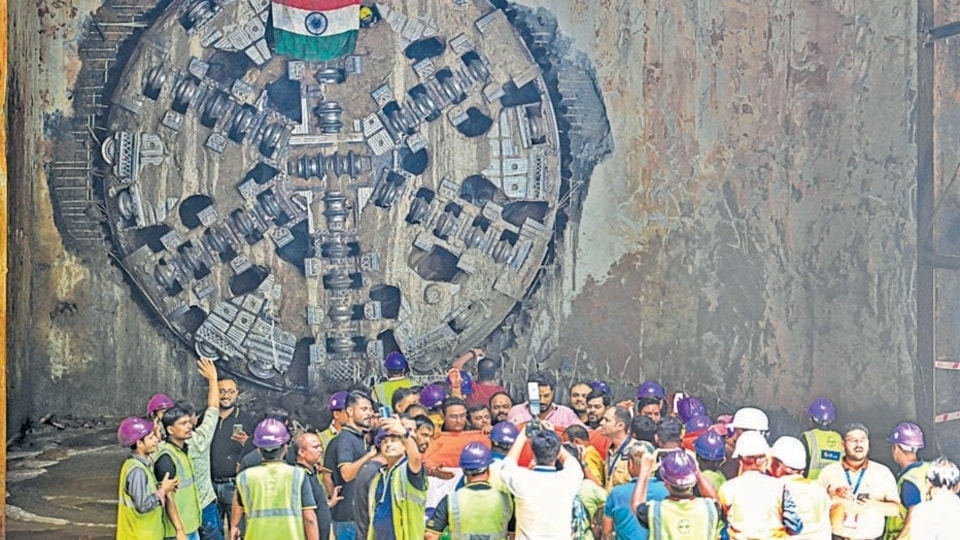
Boring work on the tunnel was completed on Wednesday, after a tunnel boring machine (TBM) broke through the last remaining underground section near the Chhatarpur temple.
“A TBM broke through on Wednesday morning at the Chhatarpur Mandir station after boring an 865-metre tunnel. This breakthrough was achieved using a mammoth 97-metre TBM,” said Anuj Dayal, principal executive director, corporate communications at DMRC.
Lieutenant governor VK Saxena and Delhi transport minister Kailash Gahlot were also present for the occasion. Others at the spot included Delhi chief secretary Naresh Kumar and DMRC MD Vikas Kumar.
Read more: Wall collapse aftermath: DMRC replaces walls of 5 Pink Line stations with steel railings
The Golden Line will connect Aerocity on the Airport Express Line to Tughlakabad on the Violet Line, and is expected to be completed by mid-2026. DMRC officials said 47% of the civil work on the line has been completed so far, with the corporation looking to complete work on its underground sections as a priority.
The 865-metre tunnel in question will lie between the existing Chhatarpur Metro station — set to be an interchange station between the Yellow and Golden lines — and the proposed Chhatarpur Mandir station, officials said. It has been constructed at an average depth of 15 metres, with 618 rings installed inside for structural stability, they said.
Dayal said two parallel circular tunnels for up-and-down movement will be constructed on this stretch as part of the corridor, with work on the other parallel tunnel on this section expected to be completed by next month.
On this stretch, the challenge included the shifting of a 66KV high-tension line which fell directly overhead.
“Additionally, the TBM had to cross below the existing Yellow Line viaduct without disrupting Metro operations on the Yellow Line,” Dayal said, adding that the tunnel was built using Earth Pressure Balancing Method (EPBM) technology, and that ground movement was monitored to ensure no structures nearby were impacted.
Read more: Delhi Metro Phase 4: DMRC sets these dates for three priority corridors to open
DMRC currently operates a 393km network in Delhi-NCR, with 12 Metro lines (including the Airport Express Line, the Rapid Metro in Gurugram, and the Aqua Line in Noida-Greater Noida) and 288 elevated and underground stations.
The corporation, as part of its phase 4 expansion, is constructing 65.2km of rail tracks across three priority corridors — Janakpuri West to RK Ashram Marg (28.92km, which will be an extension of the existing Magenta Line), Majlis Park to Maujpur (12.55km, which will be an extension of the Pink Line), and the new Golden Line.
The 23.62km Golden Line has 15 stations — four elevated and 11 underground. It will have four interchange stations at Aerocity, Chhatarpur, Saket and Tughlakabad.
“As part of the Phase 4 work approved so far, 40.109 kilometres of underground lines are being constructed. The Aerocity-Tughlakabad corridor has underground sections totalling 19.343km,” Dayal said.