
 E-Paper



Driving urban mobility, hostility: An auto story
Experts say what makes autorickshaws so indispensable in Indian cities — unlike in most global metros — is their sheer adaptability.

 Prefer HTon Google


Autorickshaws were once the defining Delhi motif, often seen on book covers and tourist souvenirs. Over the decades, however, they’ve spread far beyond the Capital, becoming common fixtures in other metro cities such as Mumbai, Chennai, Bengaluru, Pune, and others. Today, it’s hard to imagine any Indian city without them.
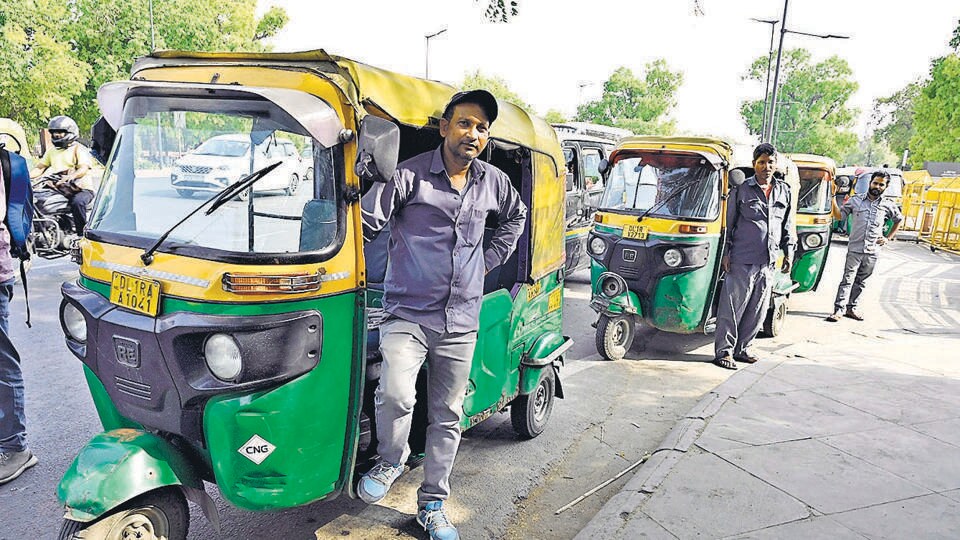
What hasn’t changed, though, is their notoriety.
Delhi’s autowallahs have a reputation for charging exorbitant fares, refusing rides, behaving rudely, or worse. But commuters in Chennai, Bengaluru, Pune and in other cities would tell you their own drivers are no different. And yet, cities can’t seem to do without them.
Experts say what makes autorickshaws so indispensable in Indian cities — unlike in most global metros — is their sheer adaptability. They navigate congested lanes, can wait in tight spaces, and offer door-to-door service. More importantly, they provide flexibility that fixed-route transit systems simply can’t.
But increasingly, these three-wheelers drive not just urban mobility, but also hostilities on the streets in almost every city they operate in.
In Bengaluru, for example, a fare dispute now can quickly flare into a larger debate around identity and livelihoods. Auto unions, raising issue Kannada pride, are branding the increasingly popular bike taxis as “outsiders”.
“People think these disputes are about regional identity, but they are not. The real issue is the low meter fare set by the government, which often leads to arguments between passengers and drivers,” said Autorickshaw Drivers Union (ARDU), Bengaluru’s general secretary Rudra Murthy.
“The last fare hike came in 2021. We’ve been pushing for a revision, but it’s still under discussion. So, drivers find it difficult to stick to the meter, and that often fuels tension,” he said.
A journey into the auto’s past
Autorickshaws rolled into Indian cities in the 1940s and early 1950s, inspired by Italy’s Piaggio Ape. Early models, like Bajaj’s two-stroke versions, offered speed, durability, and affordability—quickly gaining traction in political and commercial hubs like Delhi and Kolkata, quite a novelty in a city known for its hand-pulled rickshaws.
“By the 1960s, they were a common sight in the Capital, zipping through its congested bazaars and government colonies. They offered a cheaper alternative to taxis and were more flexible than buses, but even in those days, there were complaints against drivers for overcharging,” said Suneet Sharma, who retired as the principal of a government school in Janakpuri, and who has been using autos in the Capital for over five decades now.
Mumbai, with its taxi culture and suburban trains, was not that enthusiastic about autos, but these three-wheelers eventually found a foothold in the suburbs.
By the 1990s, autos became ubiquitous in most metro cities — they were a lifeline for commuters negotiating Chennai’s flood-prone streets; Bengaluru’s IT workers living in Whitefield and Electronic City relied on autos to connect suburban offices to arterial roads; while Pune, with its rising student population and manufacturing hubs, too adopted them.
In the early 2000s, Delhi led the push toward cleaner urban transport by mandating a shift to compressed natural gas (CNG) for all auto-rickshaws. But regulatory friction remained. Permit caps in cities like Delhi and Bengaluru created black markets and dominance of unions. Drivers also resorted to fare meter tampering, marring their reputation.
Today, there are an estimated 1.5–2 million autos operating across Indian metros and Tier-2 cities, indispensable, but often at odds with the cities they serve.
The tech disruption
Ride-hailing giants like Ola and Uber once tried to formalise India’s autorickshaw sector with digital bookings, fixed fares, and GPS tracking. But the partnership frayed as drivers’ unions protested high commissions and loss of autonomy. Seeking control, they began launching their own apps.
In Bengaluru, ARDU helped launch Namma Yatri in 2022, developed by Juspay Technologies and supported by the Beckn Foundation under the Open Network for Digital Commerce (ONDC). Promoted as a zero-commission alternative, the app saw rapid adoption—10,000 drivers signed up pre-launch, followed by 50,000 more, with 150,000 customer downloads in just three months.
Yet by late 2023, ARDU exited the partnership, citing pricing disputes. Soon after, the union launched Metro Mitra — an app focused on Metro station connectivity, developed with the Bangalore Metro Rail Corporation Limited (BMRCL). It offered government-set fares ( ₹30 for the first 2 km, ₹15/km after, plus a ₹10 app fee) and aimed to restore confidence in meter-based rides.
But Metro Mitra has struggled to take off. Its narrow focus on Metro users limited its driver pool, and commuters remain loyal to more flexible platforms. “It didn’t work for either side,” said ARDU’s Murthy.
In early 2025, Uber responded to the shift by moving to a zero-commission model too, adopting a flat subscription fee—adopting the approach of Namma Yatri and Rapido.
Driving hostilities?
In cities like Delhi, autorickshaw drivers have long wielded political influence, mobilising their community to sway elections. Strong supporters of the Aam Aadmi Party (AAP) over the past decade, many shifted their allegiance to the Bharatiya Janata Party (BJP) in the 2025 assembly elections, citing unresolved issues around permits and fare structures.
In Bengaluru, tensions often flare around language, with some auto drivers asking passengers to speak only in Kannada. But experts argue these flashpoints are rooted more in economics than identity.
“We need to understand that these battles—whether about language or identity—are essentially economic,” said Vivek Kumar, a sociology professor at Jawaharlal Nehru. “Political parties court them because autos double up as free-moving advertisements during elections.”
According to Kumar, the behaviour of drivers is also shaped by their precarious economic status and migration patterns. “Most drivers in metros are migrants with no stake in the city’s reputation. They just want to maximize earnings in a day,” he said.
In 2023, Delhi set its latest auto fares — ₹25 to ₹30 for the first 1.5 km, and from ₹9.50 to ₹11 per km thereafter.
In Delhi, many drivers don’t own their autos or permits. They rent vehicles daily and often earn just ₹400– ₹500 after costs, said Delhi Auto Rickshaw Sangh general secretary Rajendra Soni.
“The cost of a new auto, thanks to limited permits and black marketing, can be as high as ₹8 lakh in Delhi. That’s why we’ve been demanding an increase in the number of permits,” he said.
To be sure, the Supreme Court in 2024 dismissed Bajaj Auto’s plea to raise Delhi’s cap on autorickshaws.
Soni said Delhi cannot function without autorickshaws. “Every time there’s a strike, the city feels it. The government needs to create at least 5,000 auto stands and revise fares at right time to reduce conflict,” he said.
The road ahead
Amit Bhatt, an urban mobility expert and managing director of International Council on Clean Transportation (ICCT), said people choose autos for short, point-to-point trips — something buses can’t match. “Their popularity, along with the exponential rise of e-rickshaws, exposes a major gap in last mile connectivity in cities,” he said.
The National Urban Transport Policy of 2006 had laid out a vision for Unified Metropolitan Transport Authorities (UMTAs) in all cities with populations over one million. These bodies were meant to coordinate between transport agencies, regulate fares, and integrate modes like autos and metros. While cities like Chennai, Hyderabad, and Mumbai have set up UMTAs, they remain largely toothless. “They lack statutory powers and financial autonomy, so have failed to make an impact,” Bhatt said.
Shreya Gadepalli, urban mobility expert and founder, UrbanWorks Institute said cities cannot wish away autorickshaws. “Millions rely on them because they’re cheaper than taxis, offer crucial last-mile connectivity, and shared autos reflect growing demand for public transport,” she said, adding that autos are especially popular among women. “Because women remain visible while riding in an auto, unlike in the closed confines of a taxi, they often feel safer. That, along with affordability, makes autos an enabler of women’s mobility and independence.”
Gadepalli advocates integrating auto-rickshaws into formal transit systems. In fact, some cities have shown that better integration is possible. Kochi Metro, for instance, has formally partnered with auto unions. Designated auto bays, fixed fares, and union agreements now govern last-mile connections at Metro stations. Ahmedabad too has experimented with integrating autos into its BRT system, offering feeder routes and fare transparency.
Integrating autorickshaws with Metro systems using smart cards and fare validators could create a seamless, multimodal network, said Gadepalli. “Besides, partially subsidising fares would make the system more equitable and help reduce tensions over high fares. The fact is autos exist, prove an important service, and need to be supported.”


Stay updated with all top Cities including, Bengaluru, Delhi, Mumbai and more across India. Stay informed on the latest happenings in World News along with Delhi Election 2025 and Delhi Election Result 2025 Live, New Delhi Election Result Live, Kalkaji Election Result Live at Hindustan Times.


