
 E-Paper



Experts caution as palms dot Delhi in spruce-up plan
The experts also point to similar drives undertaken recently as part of its streetscaping project in Aurobindo Marg and Nelson Mandela Marg, to highlight that palm trees are not the best option, and that other native species are more viable and beneficial options.


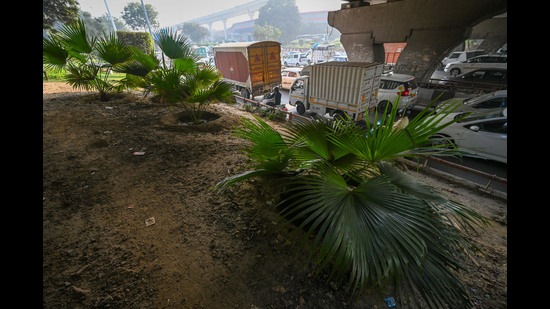
With preparations for a series of G20 events underway in the Capital, several key stretches from the Indira Gandhi International (IGI) airport leading to Dhaula Kuan and central Delhi are being spruced up with beautification and street-scaping work. A part of this effort is hundreds of palm trees (Phoenix sylvestris) being planted along the central verges. But a number of these trees, planted within the last two months, appear to be struggling in the Delhi winter, prompting experts to question the choice of trees both for their low ecologic benefits and their chance of survival during cold weather.
The experts also point to similar drives undertaken recently as part of its streetscaping project in Aurobindo Marg and Nelson Mandela Marg, to highlight that palm trees are not the best option, and that other native species are more viable and beneficial options.
Also read: Delhi colder than Nainital today amid severe cold wave; train and flight travel hit
A spot check by HT along the newly planted stretch this week found that, in several of the trees, the crown was yet to bloom completely; and in some cases, the leaves were wilting to one side.
Palm trees are now a prominent feature of national highway (NH8) till Dhaula Kuan, in the Delhi cantonment, and towards Sardar Patel Marg. Similar palms have been planted along the Dhaula Kuan flyover, while the much smaller Chinese fan palm (Livistona chinensis) chosen for the area underneath the flyovers. Further ahead, under NDMC’s jurisdiction from SP Marg owards, similar Chinese fanpalms are seen near roundabouts.
Pradip Krishen, environmentalist and author of the acclaimed book Trees of Delhi, said the city has failed to learn from similar experiments in the past, and from palm trees planted along the same stretch a few years ago.
“This variety of palm, Phoenix sylvestris, is the only palm species which is somewhat native to the region, but it grows in extremely moist areas and deep depressions as it requires a lot of water. A total of 26 such trees were planted between Panchsheel Marg and SP Marg around five years ago, and 21 of these trees died. While they were replanted after that, the ones planted again did not survive either. Now, once again we are going for the same species because a fully grown tree with a height of 12 to 15 feet can be simply transplanted to a street to beautify it,” said Krishen.
He added that the trees growing along the new stretch appeared to be struggling on two accounts – the lack of water, and poor growth due to the winter. He suggested that alternatives such as neem, jamun and imli were better native options for the stretch.
Faiyaz Khudsar, scientist in-charge at the Yamuna Biodiversity Park (YBP) in north Delhi, said trees, including palms, become difficult to maintain in the winter, with their root system unable to grow easily. “Usually plantation for any trees is avoided in the winter period and resumed from the second week of February. The chlorophyll does not resynthesise when temperatures are low, leading to poor availability of food and the roots also find it difficult to grow during the winter months,” he said.
Phoenix Sylvestris is also called the Indian date. The tree is native to north India and is found growing naturally along the Yamuna floodplains. However, in Delhi, palm trees have also been planted on the arid and rocky Aravalli ridge, forming a micro-habit at a location entirely unsuited for them, said Khudsar.
At Nelson Mandela Marg and Aurobindo Marg, where similar plantations were undertaken in August and September as part of the Delhi streetscaping project, the palms appeared to be faring much better during the spot check, but said it was the wrong place to plant this species because the terrain in the area is an extension of the Aravalli ridge.
“The palms found near the Aravallis are not in the rocky terrain, but near streams or water deposits. The trees are not likely to grow well on their own, and require a lot of maintenance,” said Vijay Dhasmana, an ecologist and curator of the Aravalli Biodiversity Park (ABP) in Gurugram.
Padmavati Dwivedi, a tree activist, said the greening agencies in Delhi were not limited to these palms, with other exotic species such as Calliandra also given preference over native plants or trees. “We opposed the planting of these palms, as they offer no ecological benefits, but after a brief hiatus, work resumed and they were able to complete the streetscaping work at Aurobindo Marg. Palms require a lot of water, have very little canopy, and if the crown of the tree gets damaged, it will not grow again. The trees offer little benefit to Delhi,” she said, adding that the forest department has a rich repository of native species it should choose from.
Also read: Video: Car catches fire at busy stretch in Delhi's ITO
A PWD official, who asked not to be named, said the trees were growing fairly well at Nelson Mandela Marg, and while some had dried out on Aurobindo Marg, the learnings from the earlier project were being implemented in the new plantations. “All plants, including palms, are being planted with proper care and guidance. If any isolated tree dries up, it will be replaced,” he said.
An NDMC official, meanwhile, said while palms had already been planted under their jurisdiction, trees, flowers and saplings were being planted according to the right season. “We have planted palms and sandalwood too. Plants and trees are being provided the right care and the remaining plantation will be done as per the right season, keeping in mind species that can survive the winter. As the warmth returns, more flowers will be planted along the roads, including tulips,” the official said.
The forest department, the primary greening agency in Delhi, is also involved in plantation work ahead of G20, but said it had not planted any palm trees. “The tree does not feature in our list of native species. We are looking to add native shrubs and saplings within forest land at present,” said a forest official in the south division.

Stay updated with all top Cities including, Bengaluru, Delhi, Mumbai and more across India. Stay informed on the latest happenings in World News along with Delhi Election 2025 and Delhi Election Result 2025 Live, New Delhi Election Result Live, Kalkaji Election Result Live at Hindustan Times.


