
 E-Paper



Failing to keep pace: Delhi's waste processing gap widens; 44% of waste remains unprocessed
Official data shows that the waste generation assessment has increased, with the Municipal Corporation of Delhi failing to keep pace with Delhi's output.

 Prefer HTon Google


Of every 100kg of waste generated in Delhi, 44 kg remains unprocessed and ends up at its already oversaturated landfill sites. Even as the national capital's plans to add more garbage processing plants have been marred by delays and deadline extensions.
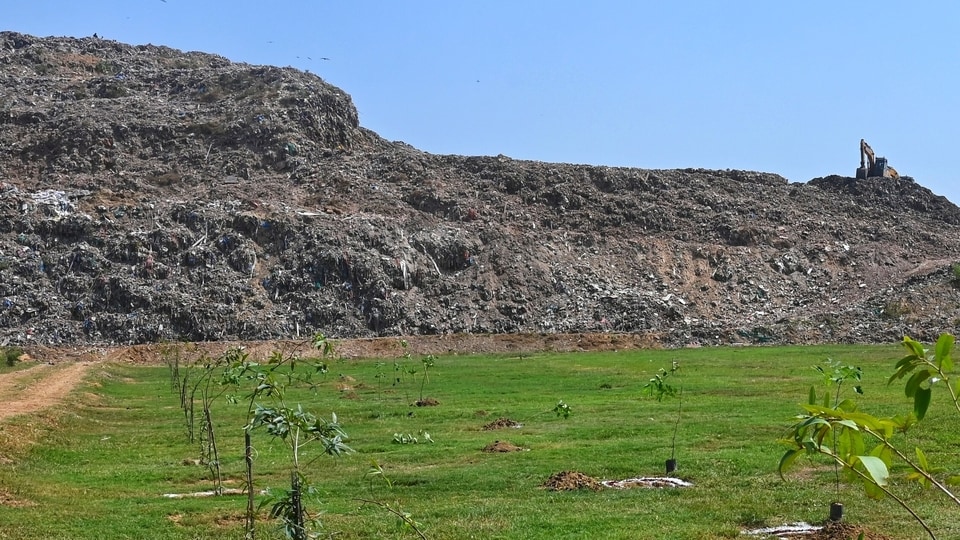
Official data shows that the waste generation assessment has increased, with the Municipal Corporation of Delhi failing to keep pace with Delhi's output.
In its latest report, the Delhi Pollution Control Committee (DPCC) has stated that Delhi generates 1386 Tonnes per day (TPD) of garbage, of which 57.2% is processed or recycled, while 44.16% (6131 tonnes) remains unprocessed and ends up at the three landfill sites.
In the corresponding period last year, Delhi was estimated to generate 11842 tonnes per day, with 4534 tonnes remaining unprocessed. Overall, around 1597 tonnes of additional waste is now categorised as unprocessed and needs to be dumped at the three landfill sites in Okhla, Bhalswa and Ghazipur.
The civic body, in its report, has said that around 60% (8100 tonnes) of the garbage it collects is non-biodegradable, while 40% (5400 tonnes) is classified as wet, biodegradable waste.
Plans for the future
According to projections in the Delhi Master Plan 2047, waste generation in Delhi is likely to rise to around 25,000 tonnes per day by 2047. A senior municipal official said that the corporation is in the process of setting up four new waste-processing plants in Singhola, Narela, Bhalswa, and Okhla to address the fresh waste problem.
"A sharp increase in the waste generation may also be due to mixed waste being received and collected in the zones where the contracts of private concessionaires have ended, and new contractors are taking up the work. Due to a lack of resources during the transition phase, sorting and dhalao-level segregation are also affected. At many sites, construction waste also ends up getting mixed with domestic garbage," an official said.
Delhi's three out of 12 administrative zones-- Central, South and West Delhi-- are undergoing such a transition phase.
Experts have argued that decentralised processing of waste, segregation and composting of the wet waste should be taken up by Delhi. However, the city still uses incineration as its primary waste processing method.
The delays
There are four existing waste-to-energy plants with a combined capacity of 6550 TPD. A 200 TPD composting plant at Okhla has been lying closed for several years, and a project to upgrade it to a Bio CNG plant has witnessed years of delays.
NGT has also recently pulled up MCD over the non-operation of the Ghazipur waste-to-energy plant. A Waste to Energy Plant of 1300 TPD capacity is working near Ghazipur dumpsite with an electricity generating capacity of 12 MW, but the old plant is prone to breakdowns and maintenance repairs
A civic official said that the capacity of the Ghazipur and Tehkhand plants will be increased, while two new waste-to-energy plants are in the pipeline, helping bridge the waste-processing gap.
"8150 tonnes of processing capacity will be added by December 2028 through capacity expansion and new plants in Narela-Bawana, Tehkhand, Okhla and Ghazipur," the official added.


Stay updated with all top Cities including, Bengaluru, Delhi, Mumbai and more across India. Stay informed on the latest happenings in World News along with Delhi Election 2025 and Delhi Election Result 2025 Live, New Delhi Election Result Live, Kalkaji Election Result Live at Hindustan Times.


