E-Paper



Ghazipur landfill fire: Small fires common sight, locals claim
Residents of the Ghazipur Dairy area, located within a kilometre’s radius of the landfill site, said many people have left after developing respiratory problems.

 Prefer HTon Google


As flames at the Ghazipur landfill site started to raged on and became stronger on Monday, 51-year-old Naresh Kumar, who runs a hardware store barely 500 metres away in Mulla Colony, realised he had no other option but to shut down his store for the day and head home. The smoke had become so strong that Kumar was unable to breathe or see anything clearly. However, for Kumar, and for others who live in the shadow of Delhi’s tallest mountain waste, it was nothing new.
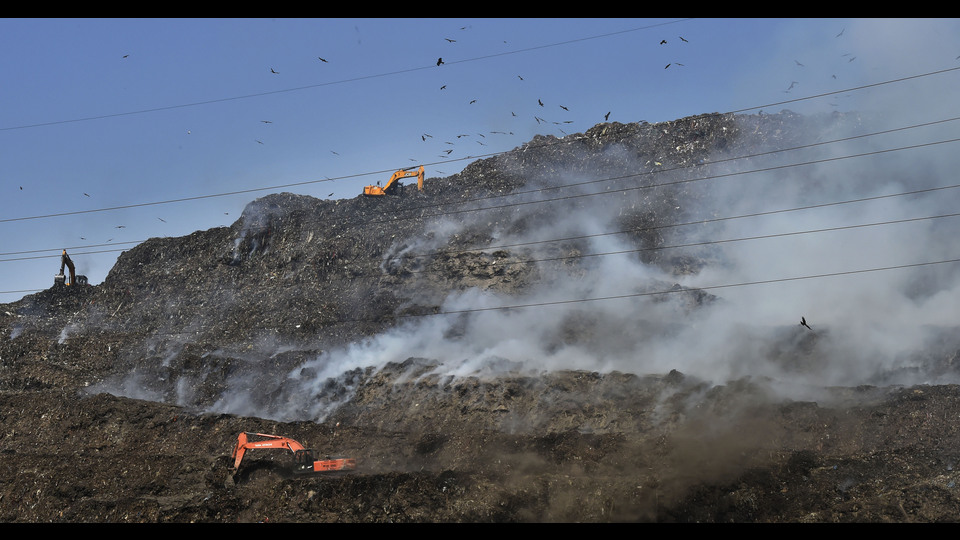
“We’re accustomed to this sight now. Small fires keep breaking out every now and then, and the landfill site only gets attention when there is a major fire. If the wind is strong, the smoke can directly blow towards the colony and that is what happened on Monday too,” says Kumar, whose wife has developed breathing problems over the last decade.
“People are tired of promises that the landfill will be cleared, but we have seen no visible reduction so far. Delhi’s air is already polluted and a fire only adds to our problems,” says Kumar, who has been living in the area for close to three decades now.
When HT visited the landfill site on Tuesday, smoke was still seen coming out of the waste, with a small section of the landfill still on fire at 5pm. Firefighters were still at the site, and efforsts were on to douse the flames.
Ismail (28), who drives an e-rickshaw around the Ghazipur murga mandi was among those tracking the progress agencies were making to douse the fire. He said fire incidents are more common than one thinks, but in most instances they very small in size. “Most fires break out and die out within an hour or so on their known. I have grown accustomed to the stench of the landfill but I know several people who live in the area and find it hard to breathe,” he said.
Residents of the Ghazipur Dairy area, located within a kilometre’s radius of the landfill site, said many people have left after developing respiratory problems. Neetu Kumari (56), who has been living in the area for the best part of two decades, said she developed breathing problems recently.
“Living so close to a landfill is bound to expose us to all types of pollution and when it catches fire, it feels a hundred times worse. Like Monday, the smoke and smell was so strong that you could even feel it indoors. In winters too, living around the landfill makes it impossible to breathe. Nearly half of this area’s population is bound to have one respiratory issue or other,” she said.
Azad Singh, 36, another local resident, said he was contemplating shutting down his dairy and buy land in some other area. “My family has been living here for decades now, but over time, it has become unsustainable to remain in the area. The dairy is a source of income for the family but we may move elsewhere and open a dairy there.”
Apprehensions over the impact of such fires is also evident across the border in Vaishali, where several hotels and a super-speciality hospital are all present within a 5-km radius of the landfill site. “I have driven across the landfill site and seen fires breaking out myself. It becomes difficult to breathe when one is right next to it and its impact will be greater on people who constantly live around it,” said Akash Chaubey, 25, who works at a boutique hotel in Vaishali.
Fire at the landfill emits carbon monoxide, hydrogen sulphide, dioxins and furans. Combustion also leads to a spike in PM 2.5 concentration.
Dr JC Suri, senior pulmonologist and director, respiratory diseases at Fortis Hospital in Vasant Kunj, says landfill sites hold all kinds of waste and the toxicity of what is being inhaled depends on the kind of waste being burnt. “Various items will emit different kinds of gases and toxic fumes, but the affected persons may develop respiratory problems over prolonged exposure with those living in close proximity being the worst hit. Changes in the bronchi, bronchospasms, lung injuries are some of the problems that such people can have,” he said.