
 E-Paper



Good to poor in 48 hours: Bad air back in Delhi, and set to get worse
Pollution levels started rising from Tuesday night when the wind blowing into Delhi changed direction from northeast to northwest, bringing in plumes of smoke from agrarian states upwind – Punjab and Haryana

 Prefer HTon Google


Air pollution levels rebounded sharply into the poor zone on Wednesday after unseasonal rains and strong winds led to a rare ‘good’ Air Quality Index (AQI) day for this time of the year earlier this week, a turn for the worse that experts fear will only deteriorate in coming days.
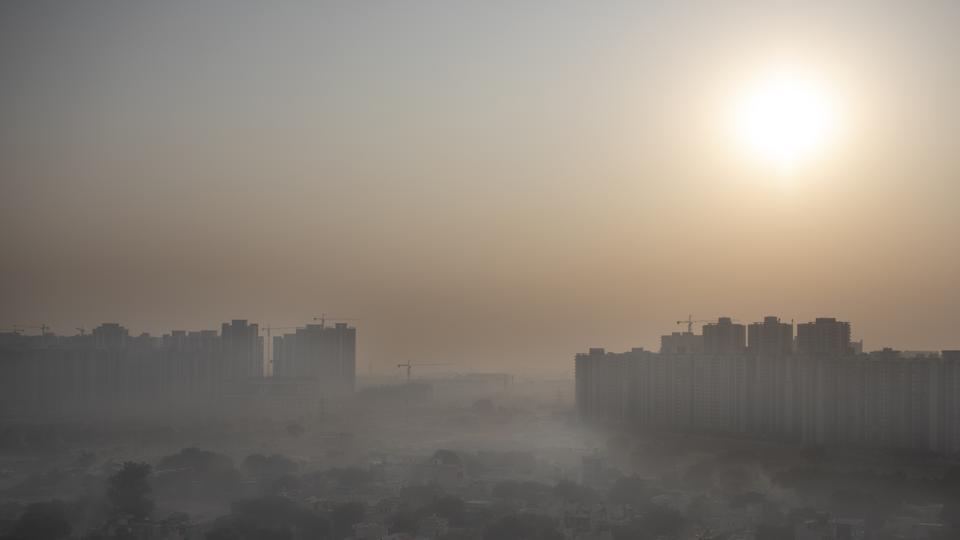
Central Pollution Control Board (CPCB) recordings showed the 24-hour average AQI at 4pm on Wednesday at 221 – a drastic worsening from Monday’s 46 (good) and Tuesday’s 69 (satisfactory).
Experts said the sharp fall in air quality was due to the impact of smoke from farm fires in neighbouring states, and calm local winds.

Pollution levels started rising from Tuesday night when the wind blowing into Delhi changed direction from northeast to northwest, bringing in plumes of smoke from agrarian states upwind – Punjab and Haryana.
After an AQI of 69 at 4pm on Tuesday, the index deteriorated to 184 on Wednesday at 11am. An AQI between 0 and 50 is considered “good”, 51 and 100 “satisfactory”, 101 and 200 “moderate”, 201 and 300 “poor”, 301 and 400 “very poor”, and 401 and 500 “severe”.
As of 7pm on Wednesday, the average AQI in 26 (out of 36 localities with pollution-monitoring stations) was in the ‘poor’ category. Two areas — Dwarka and Anand Vihar — slipped into the ‘very poor’ zone, with readings of 311 and 348 respectively.
Senior scientists from the India Meteorological Department (IMD) said the spike in pollution levels was primary because of the large number of farm fires in neighbouring states and calm local winds, which had a relatively higher share of moisture, enabling local pollutants to hang close to the air near the ground levels instead of being dispersed higher in the atmosphere.
They also warned that the situation is likely to get worse in the coming days.
On Wednesday, the humidity levels in Delhi were 53%.
“The air quality is expected to remain in the ‘poor’ category this week,” said VK Soni, head of IMD’s environment and research department.
The Capital’s air quality had steadily worsened all month, a decline that accelerated on Friday, when the AQI reached the far end of the “moderate” zone at 198.
On Saturday, as winds calmed, the AQI reached 284, before climbing to 298 the next day. It then fell by over 250 points on the back of a record October rain on Monday.
Between Sunday and Monday, the national capital recorded 87.9mm rainfall, the fourth highest in a day ever in October, and the highest since 1956, when the city received 111mm rain, according to IMD data.
This resulted in the first good AQI day since August 31, 2020.
An analysis by the Union ministry of earth science’ air quality monitoring centre, System of Air Quality and Weather Forecasting and Research’s (Safar) shows that 746 fires were reported in Punjab and Haryana on Wednesday, contributing to 12% of Delhi’s PM 2.5 levels (particulate matter with diameter less than 2.5 micrometres).
“Fire emission from upwind region enhances PM2.5 concentration as winds at transport level are from northwest region. Stubble burning share is likely to increase in next two days if there is no rain. The overall AQI is likely to further degrade to higher end of poor for next three days,” Safar’s air analysis for Delhi read.
Their analysis also attributed the pollution spike to high stubble fire count, calm winds and low ventilation and local dust.


