
 E-Paper



Hazy conditions, slow winds lead to sharp spike in Delhi air pollution; city gets reprieve from cold
The deterioration comes soon after a brief respite on Sunday, when the AQI fell below 300, snapping a 24-day streak of “very poor” air between November 6 and 29

 Prefer HTon Google


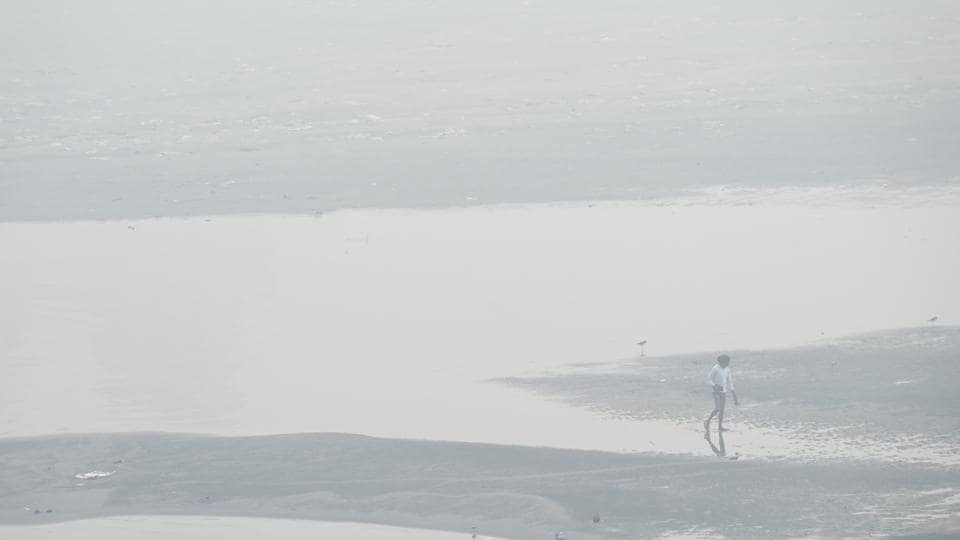
A dense blanket of haze settled over the Capital on Tuesday, trapping pollutants close to the surface as wind speeds dropped sharply, sending Delhi’s air quality index (AQI) hurtling from the lower end of the “very poor” category to its upper fringe.
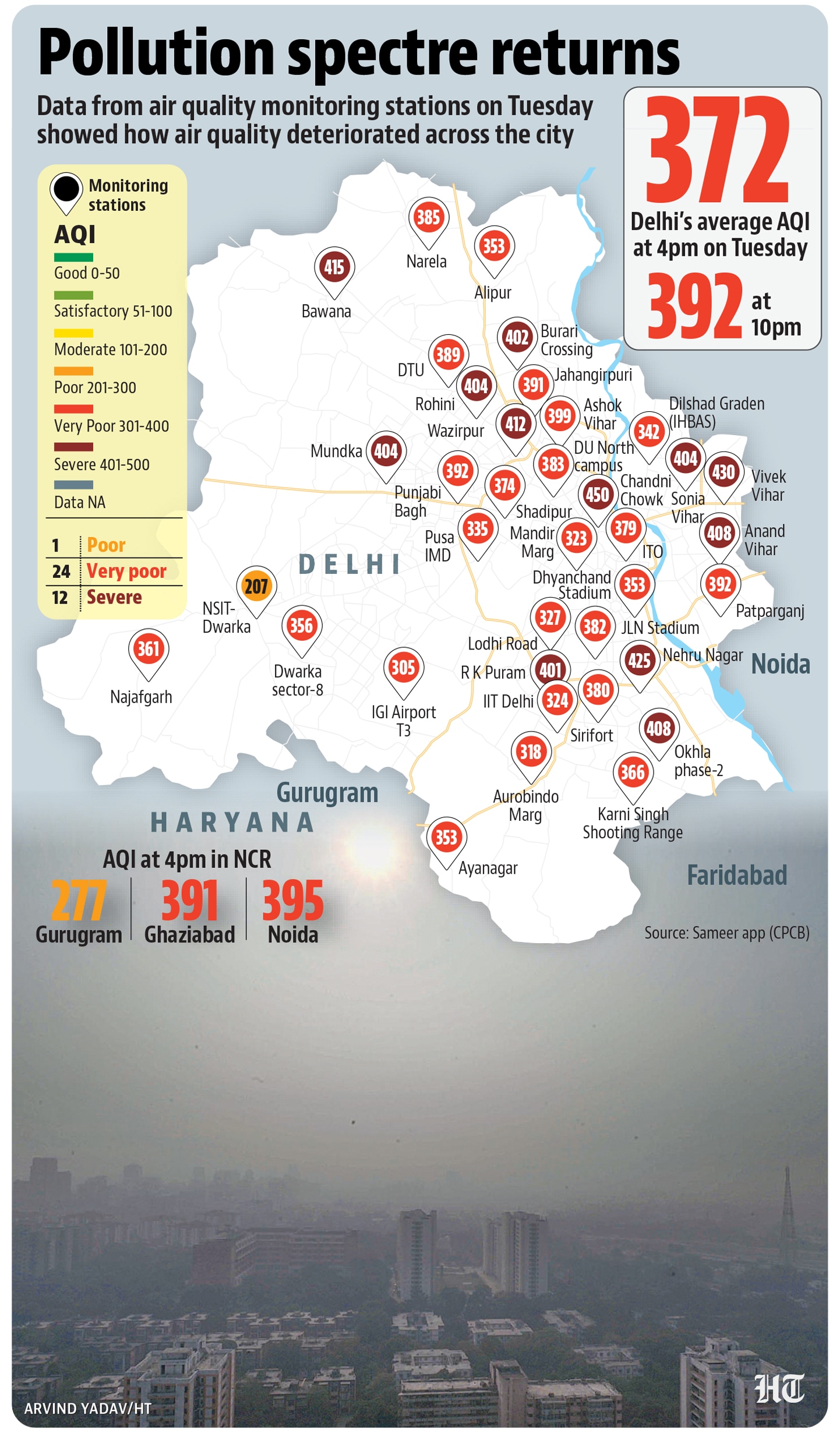
According to the Central Pollution Control Board’s (CPCB’s) 24-hour average bulletin, the AQI rose from 304 on Monday to 372 at 4pm on Tuesday. By 10pm, it had climbed to 392 – hovering just shy of the “severe” mark.
Forecast agencies, however, signalled a potential short-term reprieve. Wind speeds are expected to strengthen on Wednesday, likely dispersing at least part of the rapidly accumulating pollution load.
Delhi’s air quality is likely to be in the ‘very poor’ category from December 3 till December 5. The outlook for the subsequent six days from December 6 onwards also shows AQI staying in ‘very poor’,” said the Centre’s Air Quality Early Warning System (EWS) for Delhi on Tuesday.
CPCB data from the 39 active ambient air quality stations across the city at 4pm showed that 14 of them were in the “severe” range, with 24 others in “very poor”. The worst AQI was 458, at Chandni Chowk, followed by 436 at Nehru Nagar and 433 at Vivek Vihar.
Mahesh Palawat, vice president at Skymet, a private weather forecaster, said winds became calm in the early hours of the day, and did not go beyond 7km/hr, even post noon. “Wind speed had dropped, leading to stagnation as pollutants began to accumulate in the air. Proper relief is only expected from December 5, when strong winds will blow from the north, also leasing to a dip in mercury,” he said.
The CPCB classifies air as “good” when AQI is 50 or lower; “satisfactory” between 51 and 100; “moderate” between 101 and 200; “poor” between 201 and 300; “very poor” between 301 and 400; and “severe” when it exceeds 400.
The deterioration comes soon after a brief respite on Sunday, when the AQI fell below 300, snapping a 24-day streak of “very poor” air between November 6 and November 29. Three days in this period—November 11 to 13—also logged “severe” air.
The deteriorating air quality is also impacting outdoor activity in the city. The Bank of India New Delhi Half Marathon, scheduled for December 14, was postponed, citing poor air quality in the city. “Sometimes, the bravest step forward is a pause. With AQI levels rising to unsafe highs, we have made the difficult decision to postpone the December 14 New Delhi Half Marathon,” the organisers said on the website of the marathon.
Reprieve from severe cold
The deterioration in the air quality coincided with a spike in the minimum temperature, as Delhi clocked a normal minimum of 9.6 degrees Celsius (°C), up from a season low of 5.7°C recorded on Monday, which was five degrees below normal. This was the lowest minimum temperature recorded in the first week of December in at least 14 years, according to records starting 2011 available on the India Meteorological Department (IMD) website.
Although the IMD initially issued an alert for possible “cold wave” conditions in isolated pockets of the city from December 2-5, officials said the alert is now only in place for December 5.
“The wind direction changed and was westerly to southwesterly predominantly on Tuesday, as compared to icy-cold northwesterly winds earlier,” an IMD official said, stating northwesterly winds would return from Wednesday and mercury would dip again. “It may dip between 5-7°C by December 5 again,” the official said.
The IMD defines “coldwave” as a phenomenon when the minimum temperature is below 10°C and its departure is also 4.5°C or lower from normal. At least two stations in the city need to meet this criteria on two consecutive days.
Historically, the minimum dips below 5°C in December, but usually in the second half of the month. The lowest minimum last December was 4.5°C (December 12 and 16). In 2023, it was 4.9°C (December 15). It was 5°C in 2022 (December 26); 3.2°C in 2021 (December 20); 3.1°C in 2020 (December 31) and 2.4°C in 2019 (December 28).
The maximum temperature on Tuesday, meanwhile, was 25.8°C, which was a degree above normal. It was 26.1°C a day earlier. The maximum is forecasted to be in the 23-25°C range on Wednesday and in the 22-24°C range on Thursday and Friday.


Stay updated with all top Cities including, Bengaluru, Delhi, Mumbai and more across India. Stay informed on the latest happenings in World News along with Delhi Election 2025 and Delhi Election Result 2025 Live, New Delhi Election Result Live, Kalkaji Election Result Live at Hindustan Times.


