E-Paper



Ice boxes, ventilator beds in RML’s facility for heat stroke in Delhi
In the past week, the hospital has tended to 20 to 30 patients suffering from heat stroke-like symptoms

 Prefer HTon Google


For the past week, the emergency teams at Ram Manohar Lohia (RML) Hospital in New Delhi have tended to 20 to 30 patients suffering from heat stroke-like symptoms from noon to midnight every day.
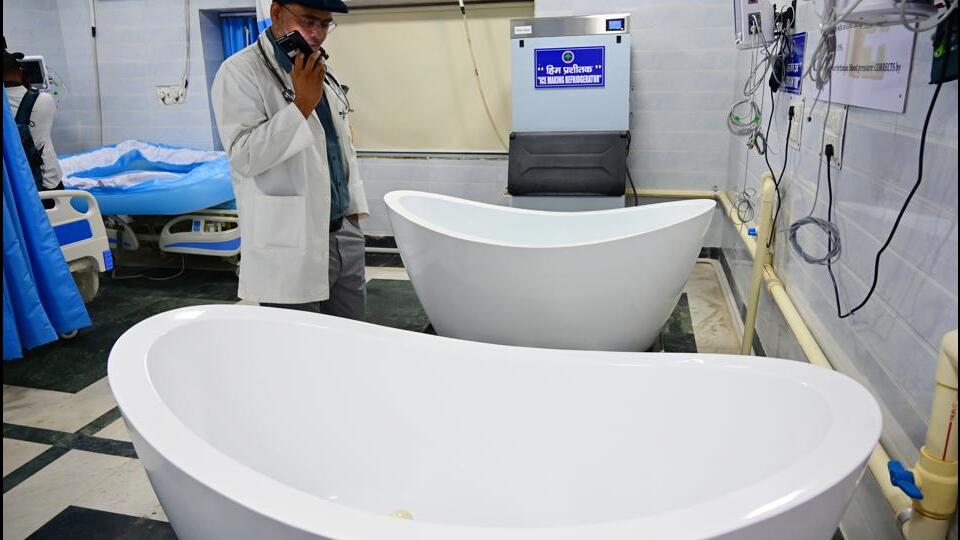
It takes not more than five minutes to shift a critical heat stroke patient from the hospital’s main emergency building to the old one, where north India’s first state-of-the-art Heatstroke Immersion Cooling Unit is housed on the ground floor.
The first and most crucial step, to stabilise a critical heat stroke patient with high fever, is to bring their body temperature down as quickly as possible. “The faster the cooling, the better the prognosis or treatment outcome,” said Dr Ajay Shukla, medical superintendent, RML Hospital.
Once inside the heat stroke unit, the patient is immersed in the ice-filled submersion tub.
The unit has two ceramic immersion tubs, a 250kg ice-making refrigerator, rectal thermometers, ice boxes, two ventilator beds, and an inflatable tub meant for patients who arrive in an ambulance.
The submersion tub has a capacity of 300 litres and can be filled in two to three minutes as it is connected to high-flow sources. Normally, it requires 50kg of ice to fill the tub and keep the temperature between 0 and 5 degrees Celsius, which is essential for rapid cooling in two to three minutes. The ice-making machine has the capacity of generating 250kg of ice per day.
“We have to bring down the temperature of this tub between 0 and 5 degrees Celsius. We expect the patient to have a temperature of about 50 degrees Celsius on arrival. This has to be brought down rapidly to a target of 101 degrees Fahrenheit (around 38 degrees Celsius). That target is at the rate of 0.15 to 0.18 degrees Celsius per minute,” said an on-duty doctor on condition of anonymity.
“We have monitors fitted in the unit to read the temperature of the tub and the patients simultaneously. If a patient collapses during the process then there are two ventilator beds as a backup. The patients are removed from the tub and shifted to the beds,” added the doctor.
Immersion tubs are for those patients who are conscious or semi-conscious and can breathe on their own. Unconscious patients or those on ventilators when brought in are transferred straight to the ventilator beds in the red zone meant for critical patients. “Cooling down for such patients is carried out on ventilator beds. We don’t use submersion method for them — instead, we use a surface cooling method where we keep ice slabs on the surface of the body and give cold fluids via person’s veins,” said the doctor.
The inflated tube is largely kept for ambulance services. “If we get a call from some distant place then we send this tube, ice and tarpaulin in the ambulance to start the treatment on the spot. We have to induce rapid cooling so there is no scope for wasting time in bringing the patient to the hospital. We stabilise them there only. This inflatable tub has a capacity of 300 litres,” added the doctor.
The team has managed a couple of severe cases on the field using the tube.
The hospital launched the unit on May 8, anticipating a severe heat wave and a rise in cases of heat-related illnesses. The first case arrived on May 22 but it was from May 27 that the hospital saw a rush of patients.
“I train doctors in managing heat stroke. I never thought while we were launching this unit that it would be used for real patients. We thought this would only serve the purpose of training doctors,” said Dr Ajay Chauhan, professor, medicine department, RML.
Delhi has seen at least 61 deaths due to heat stroke so far this year, according to data shared by hospitals and the state government.