E-Paper



In Delhi’s pollution season, potholes are adding to the pain
A report from the air pollution action group notes that the “maximum long-term issues require surfacing of roads, which is also the highest contributor to PM2.5.

 Prefer HTon Google


Roads riddled with potholes sending up clouds of dust with each passing vehicle are a familiar sight along several corridors in the Capital and the latest spell of rain has worsened the situation, signalling an additional headache ahead of the annual air pollution season.
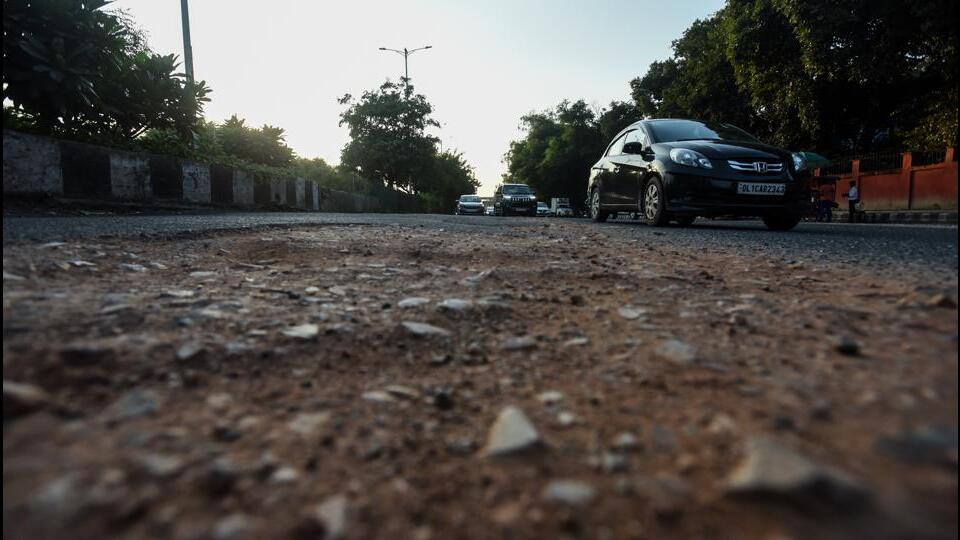
On the directions of the Commission of Air Quality Management (CAQM), nine agencies in Delhi are working with the APAG (Air Pollution Action Group) on a project for the “abatement of air pollution from dispersed sources”. More than 7,500 long-term issues have been identified collectively under this initiative, ranging from unsurfaced parking lots, barren land needing greening to broken footpaths and construction waste, but a large chunk (61.07%) of these issues are related to unpaved stretches (27.15%) and potholes (33.92%).
A senior municipal official associated with the programme said the project has divided the matter into short-term measures that are related to citizen complaints on 311 mobile applications and long-term issues that require project approval and sanction of funds.
“Weekly review meeting are being held while the pendency is also reviewed at the level of the environment ministry on a regular basis,” a senior official said. Of the long-term issues, 2,570 pertain to potholes, 2,057 to unpaved roads, 1,067 to construction waste, and 730 to broken footpaths. The group has identified 424 pieces of barren land for greening and 37 unpaved parking sites that are adding to dust pollution.
A report from the air pollution action group notes that the “maximum long-term issues require surfacing of roads, which is also the highest contributor to PM2.5. Overall, 75% of these long-term issues belong to the MCD, the Public Works Department (PWD) and road-owning agencies. The agency-wise distribution shows that 32.5% spots come under the MCD, 22.79% under the PWD, 20.88% under the I&FC and 7.6% under the DSIIDC, 4.09% under the DDA and the rest with other agencies including DUSIB, CPWD and DJB.
Officials from the PWD and the MCD said that repair work on these potholes is already underway.
The sustained spell of rain observed in Delhi over the last week of September and early October left several arterial stretches battered. Delhi Traffic Police was forced to issue a series of traffic advisories related to potholes on roads on Vande Mataram Marg, the Ring Road stretch from Ashram to Kilokari, Mayapuri to Dhaula Kuan, Ring Road from Azadpur to Shalimar Bagh, GT Karnal Road to Libaspur. Pothole advisories were also issued for Bijawasan road, Najafgarh road, and Sansad Marg, among other sites. Another spell of rain has been forecast over the next week.
A senior PWD official said the repair work started after the recent rains stopped, and directions have been issued to all divisions to carry out repair work in their areas.
“We have asked the maintenance wing to carry out surveys of all such stretches so that patchwork can be carried out. Several portions of ring road at sites like Bhikaji Cama Place, Lajpat Nagar etc are currently under repair,” the official added.
MCD stated that on Tuesday, it allocated ₹2.5 lakh per zone for patch repair of roads . “We have allocated this fund to make roads patch free in its jurisdiction in view of continuous downpour witnessed in recent days. Fund has been allocated to Executive Engineers (Maintenance) for purchase of the pre-mix cold emulsion bitumen for patch repair,” an MCD official said.
The MCD and the PWD are the two major road maintenance agencies. The zonal distribution of the issues earmarked in the project shows that of the 2,378 spots falling under the MCD, 166 were in Narela zone, 296 in City SP, 294 in Najafgarh, 93 in Keshavpuram, 315 in Shahdara North, 167 in Civil Lines, 261 in Central zone, 171 in South, 301 in Rohini, 59 in Karol bagh, 209 in Shahdara South and 46 spots in West zone. Similarly, in case of the PWD, which manages roads wider than 60ft, Shahdara North and South zones along with West, Karol Bagh and Rohini zones have the bulk of these issues.
BS Vohra, who heads the East Delhi RWA joint front, said several stretches in east Delhi are in bad shape and agencies should focus on improving road infrastructure before the pollution season rather than focusing on challaning citizens. “If a small construction site for a house is operational, hefty fines are issued under air pollution control norms. Agencies should also be fined for their failure to maintain roads. We have roads like east Delhi’s road number 57, stretches near Krishna Nagar to Azad Nagar, which are riddled with potholes. Who will hold the agencies accountable?” he asked.
Dust remains one of the key pollution components in Delhi. A study by IIT Kanpur has shown that dust from roads, digging and agriculture accounts for the highest suspended particulate matter sources in Delhi, contributing 38% of PM2.5 and 56% of PM10 in the Capital. It is estimated that more than 131 tonnes of dust is generated everyday in Delhi with construction sites, loose soil, road dust and poorly maintained roads being some of the key contributing factors.
Dipankar Saha, former head of the Central Pollution Coontrol Board CPCB’s air laboratory, said dust spillage on roads is a major issue. “Most roads are suffering from dust accumulation. In case of damaged roads, the moving vehicles lift dust particles that are not able to settle on the ground. This re-suspended dust can only be prevented by proper road maintenance and greening of the areas along the road. Greening does not only mean tree plantation but covering the top layer with binding grass as well. Broken roads leading to clouds of dust is an issue in Delhi but it is an even greater problem in nearby NCR areas,” he said.
Anumita Roychowdhary, executive director, Centre for Science and Environment (CSE), said the issue of damaged roads adding to air pollution requires a mandate for robust and diligent road audits by all road owning agencies to identify stretches that are unpaved and require repair for continuous action.
“Road audits need to address carriageways, footpaths, and road shoulders. Road construction and design have to follow quality benchmarks to be more resilient to flooding. Additionally, roadside vegetative barriers are critical to douse the dust,” she said.