
 E-Paper



Indo-Gangetic Plains blanketed in smog as post-Diwali air worsens
Despite early winter, PM2.5 levels rose eightfold overnight in Delhi, with Jind, Dharuhera, and Gurugram ranking among India’s most polluted cities.

 Prefer HTon Google


The national capital may be synonymous with pollution, but the chokehold of pollution this Diwali covered an area far beyond Delhi. From Haryana to eastern Uttar Pradesh, air quality plunged across the Indo-Gangetic Plains, revealing the depth of the country’s post-Diwali pollution crisis that extends well past Delhi.
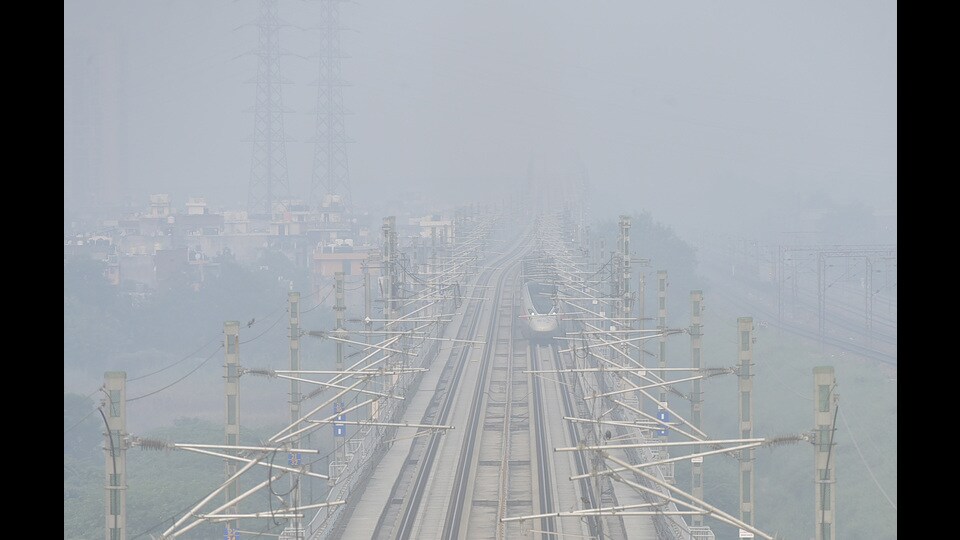
During the peak of Diwali celebrations, Jind in Haryana recorded the worst air quality index (AQI) in the country on Tuesday, touching 421 in the “severe” zone. Joining it in the “severe” zone was Dharuhera with an AQI of 412.
Three other towns from Haryana – Narnaul (AQI of 390), Rohtak (376) and Gurugram (370), all in the “very poor” zone – made the notorious distinction of making the list of top five most polluted towns in the country, according to Central Pollution Control Board data.
Delhi, Noida, Ghaziabad, Manesar, Hapur, were among the cities that had “very poor” air along with towns such as Bahadurgarh, Bhiwadi, Charkhi Dadri, Sirsa and Nandesari, CPCB data showed.
Cities in Uttar Pradesh and Bihar, including Kanpur, Lucknow and Patna, recorded “poor” air, with most regions already suffering from high PM2.5 levels even before the festival began.
Data from the Centre for Research on Energy and Clean Air (CREA) showed Dharuhera had the highest PM2.5 concentration at 235 µg/m³ before Diwali, followed by Delhi at 223 µg/m³, indicating widespread local pollution well before winter inversion set in.
“We are still in the warmer part of the year. Diwali was celebrated in the early part of winter this year but we are noticing a steep climb in pollution levels,” said Anumita Roychowdhury, executive director at the Centre for Science and Environment. “Between October 11 and now there has been 1.6 times increase in pollution in Delhi. From yesterday afternoon to night, PM2.5 levels have seen an 8 times increase. This is mainly a result of concentrated burning. The contribution from farm fires is still 1-2% which clearly shows local pollution sources are causing the spike, especially fire crackers”.
Roychowdhury warned that once winter inversion deepens, the entire NCR and Indo-Gangetic region will be trapped under a toxic haze. “Year after year we remain on an emergency mode to deal with winter pollution in the region. We focus on short term measures such as sweeping of roads, sprinkling of water to keep dust down but the systemic solutions to counter key sources are missing.”
“In fact, Jind or Dharuhera may not be big contributors to this pollution. But, they can get wrapped in smog because the whole airshed is getting polluted. We need region wide action.”
She said all measures of energy transition in vehicles, industry, and households, integrated public transportation systems, and circularity countering waste burning and dumping have to be implemented in the entire region, adding that Haryana is poorly represented in the National Clean Air Programme despite having several polluted areas.
HT reported on July 19 last year that road dust mitigation has been the primary focus of the National Clean Air Programme (NCAP) – launched in 2019 to cut particulate pollution by 40% by 2025-26. Around 64% of NCAP’s ₹10,566 crore budget has gone into road dust control – road paving, mechanical sweepers, and pothole repairs – while only 14.5% was spent on biomass burning, 12.6% on vehicular emissions, and less than 1% on industrial pollution, according to a CSE analysis
Despite some gains – 77 cities have seen improvements – air quality worsened in 23 others, CREA’s April analysis found. Moreover, 28 cities under NCAP still lack continuous air quality monitoring stations, reflecting serious infrastructure gaps.
HT reported on September 22, 2021 that harms from air pollution begin at much lower levels than previously thought, the World Health Organization (WHO) said on Wednesday as it lowered acceptable thresholds for several pollutants, including ultrafine PM2.5 particles that India has typically struggled to contain. According to the new thresholds, the average 24-hour exposure to PM2.5 must remain below 15µg/m³, down from 25µg/m³. In case of PM10 particles – typical dust particles – the safe threshold has been lowered from 50 to 45µg/m³. In terms of exposure over a year-long period, the threshold for PM2.5 has been brought down from 10 to 5µg/m³ and for PM10, from 20 to 15µg/m³. In comparison, India’s thresholds are many folds higher.


Stay updated with all top Cities including, Bengaluru, Delhi, Mumbai and more across India. Stay informed on the latest happenings in World News along with Delhi Election 2025 and Delhi Election Result 2025 Live, New Delhi Election Result Live, Kalkaji Election Result Live at Hindustan Times.


