E-Paper



Leachate in Aravallis a problem, citizens’ group writes to Haryana govt
The Municipal Corporation of Gurugram, however, has denied the claims, stating leachate was being treated at the landfill site itself and no waste was entering the forest area.

 Prefer HTon Google


Citizens’ initiative Aravalli Bachao Andolan (ABA) has written to the Haryana government for a solution to the problem of leachate discharge and contamination of the groundwater table of the Aravallis next to the Bandhwari landfill site adjacent to the Delhi border in Gurugram, citing high levels of pollutants.
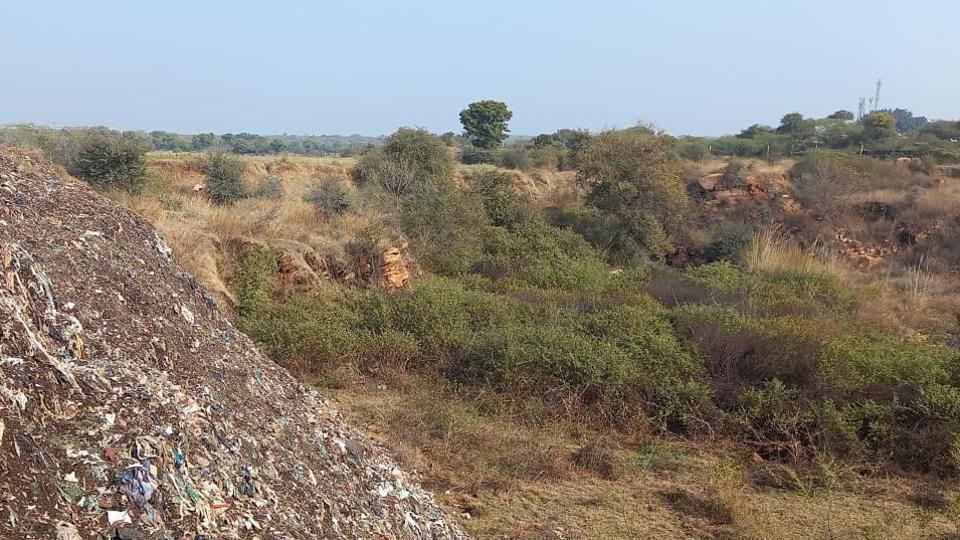
The Municipal Corporation of Gurugram (MCG), however, has denied the claims, stating leachate was being treated at the landfill site itself and no waste was entering the forest area.
In January, ABA had approached the Centre for Science and Environment (CSE) to collect samples from the area flagging possible contamination. On February 9, CSE released a report which showed high levels of biochemical oxygen demand (BOD), chemical oxygen demand (COD), nitrogen content, electrical conductivity and total dissolved solids (TDS) in the samples of liquid discharge it tested. It also found that levels of heavy metals, including chromium, nickel and mercury, present in the solid waste samples were above the prescribed standard.
CSE officials said they collected two samples of the leachate flowing into the forest adjacent to the landfill site, and a sample of the waste dumped into the forest area on the Delhi-Haryana border on January 14. One sample of the leachate and waste each was sent to CSE, while the second leachate sample was sent to Spectro, a private testing lab in Delhi.
CSE’s test results also showed that the liquid discharge entering the forest, which was collected only a few hundred metres from the landfill site, had 100 times the pollutants generally found in urban waste water. While the ministry of environment and forests’ standard for leachate discharge is 2,100mg/l for TDS, the leachate sample tested showed a level of 14,600mg/l. Meanwhile, the standard level for COD is 250mg/l, while the leachate sample tested showed a level of 10,892mg/l; and the BOD readings were found to be 2,465mg/l as opposed to a standard of 350mg/l. Faecal coliform was found to be around 93,000 as against a standard of less than 1,000 for every 100ml of water. Similar readings were observed from the private testing lab’s reports as well.
The solid waste found dumped inside the Aravallis around 500 metres to 1km from the landfill site was found to have a high presence of heavy metals--chromium and nickel levels tested at 262.7mg and 128.7mg--while the compost standards under the solid waste management rules prescribe the safe limit for both metals as 50mg.
Neelam Ahluwaliaof the ABA, who was also present on-site during the sample collection, said waste is dumped in several areas of the forest in Gurugram, including Mangar Bani. “This particular area is right next to the Gurgaon-Faridabad Road adjacent to the Delhi border, and it is clear both the leachate and the solid waste can cause environmental harm,” said Ahluwalia.
Experts say while these findings are not shocking near a landfill site, it is alarming that such high levels of pollutants are found in the Aravallis, which is an eco-sensitive zone.
“If the waste is found deep within the forested area and not around the landfill site, then it is cause for concern. Delhi, particularly south Delhi, has a low groundwater table and the remaining water can get contaminated this way through the leachate,” said Atin Biswas, programme director, municipal solid waste at the CSE.
Dr Shyamala Mani, an independent health expert who has served as a member of technical and advisory committees in the ministries of environment and forests, science and technology, health & family welfare, said the biodegradable component of mixed waste dumped on the roadside often degrades rapidly over a period of 15 days to a month, leaving behind materials that are non-biodegradable.
“That is what is seen in this analysis too. While the carbon and nitrogen content is low, the proportion of the non-biodegradables is high and the percentage of heavy metals, especially chromium, nickel and mercury, is high since domestic garbage often contains high amounts of discarded batteries, paints and bulbs especially tube-lights and CFLs. Such mixed waste can have an adverse impact on the surface and groundwater at Bandhwari and nearby villages and forests,” she says.
An MCG official, meanwhile, said there was a problem last monsoon at the Bandhwari landfill, but it was fixed. “Our capacity to treat leachate is 500 kilolitre per day and around 200 kilolitre of leachate is being produced. There was a problem last monsoon, but it was fixed. Similarly, waste was found to be dumped last month in a forest pocket, however no other instances have been reported,” an official said, requesting anonymity.