
 E-Paper



No gaushala built in Delhi in 20 years: MCD
Delhi's cow shelters are overcrowded, housing 20,485 cows despite a capacity of 19,838, as the city struggles with a stray cattle crisis for over two decades.


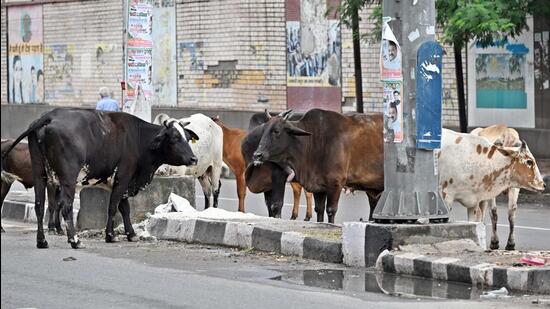
The city administration has failed to build any new cow shelters, or gaushalas, for stray cattle in over two decades, municipal officials said on Monday. Data from the Municipal Corporation of Delhi’s (MCD) veterinary department shows that shelters already house 20,485 cows — well beyond their sanctioned capacity of 19,838 — leaving thousands of stray cattle on the city’s streets and choking existing facilities.
“Initially, six official gaushalas were set up in the late 1990s — three in Narela-Bawana and three in Najafgarh. One unit was closed in the initial phase, while the Acharya Sushil Muni Gaushala was shut down in 2018, due to mismanagement and a high mortality rate. Despite repeated appeals for more space, no new facilities have been developed,” a senior municipal official said speaking on condition of anonymity.
The shortage of space was also highlighted in the MCD’s standing committee meeting on August 20. Anju Devi, who represents the Narela zone, said shelters were refusing to accept new cattle. “Even though shelters are in the Narela zone, they are not taking in more animals. The administration should also seek help from neighbouring states until new facilities are opened,” she suggested.
Shelters beyond capacity
Four official shelters remain operational on Delhi’s outskirts — Dabur Hare Krishna in Surhera, Manav Gausadan in Rewla Khanpur, Gopal Gosadan in Harewali, and Sri Krishna in Bawana’s Sultanpur Dabas. The Ghumanhera gaushala in Najafgarh was shut in 2018 after a spike in bovine deaths.
MCD data shows that all shelters are running at or beyond capacity. The Harewali shelter houses 4,016 cows against its capacity of 3,270, Sultanpur Dabas has 8,701 against 7,848, Revla Khanpur has 2,983 against 3,488, and Surhera has 4,785 against 5,232.
Veterinary department officials said Narela zone shelters have stopped taking cattle, while Najafgarh is being used only for emergency cases. “New sites must be identified, and Acharya Sushil Muni shelter should be reopened. It can hold 3,500 animals across 19 acres. Shelter operators are refusing new entries, citing lack of space,” said another official.
Stray cattle caught by MCD’s veterinary teams are handed over to the shelters approved by the animal husbandry department. For each cow, shelter operators are paid ₹40 per day — split equally between the corporation and the Delhi government. However, operators complain of delayed payments and rising fodder costs.
Despite these challenges, the impounding of stray cattle continues. Corporation figures show 13,191 cattle were impounded in 2022-23, 17,632 in 2023-24, and 13,780 in 2024-25. In the current year, 3,982 cattle have already been caught till June.
The animal husbandry department did not respond to a request for comment.
Stray menace
Once largely confined to rural belts of outer Delhi, stray cattle can now be seen across the capital — blocking arterial roads, feeding near garbage collection points, or roaming in central districts. Officials admit the problem is linked to illegal dairies that never shifted to designated colonies on the city’s outskirts.
MCD claims it sealed or shut down 135 dairies in 2022-23, 322 in 2023-24, 167 in 2024-25, and 117 so far this year. Yet enforcement has not been sufficient to prevent the cattle spillover. Compounding matters, the veterinary department faces an acute manpower shortage.
Delhi has faced a similar crisis before. In the mid-2000s, a large-scale cow mortality crisis led to the formation of a committee headed by then minister Ramakant Goswami. The panel recommended regular audits of gaushalas, advance funds to maintain fodder stocks for at least three months, oversight mechanisms, and greater public participation in shelter management.
However, municipal officials acknowledge that few of these reforms were ever implemented. “The recommendations were strong but remained on paper. Unless structural reforms are taken, the crisis will keep repeating,” one official said.
With shelters overcrowded and stray cattle increasingly visible on the city’s roads, municipal officials warn the problem will only escalate unless new facilities are established.
For now, MCD says it is pressing the Delhi government and animal husbandry department for approvals. But until new gaushalas come up, the city is left juggling between overcrowded shelters, angry residents, and a steady rise in stray cattle sightings across Delhi.
Stay updated with all top Cities including, Bengaluru, Delhi, Mumbai and more across India. Stay informed on the latest happenings in World News along with Delhi Election 2025 and Delhi Election Result 2025 Live, New Delhi Election Result Live, Kalkaji Election Result Live at Hindustan Times.


