E-Paper



Now, NDMC areas hit by water shortfall; Wazirabad levels drop
An NDMC official said that the water supply from the Delhi Jal Board (DJB) is about 40% short at Tilak Marg and Bangali Market Underground Reservoir (UGR)

 Prefer HTon Google


Parts of Lutyens Delhi have also started facing the impact of water supply shortage in the city. The New Delhi Municipal Council (NDMC), which manages the water supply in the New Delhi area, said on Monday that two of its underground reservoirs at Tilak Marg and Bengali Market are now recording 40% water shortfall, and supply to these areas from these reservoirs has been curtailed.
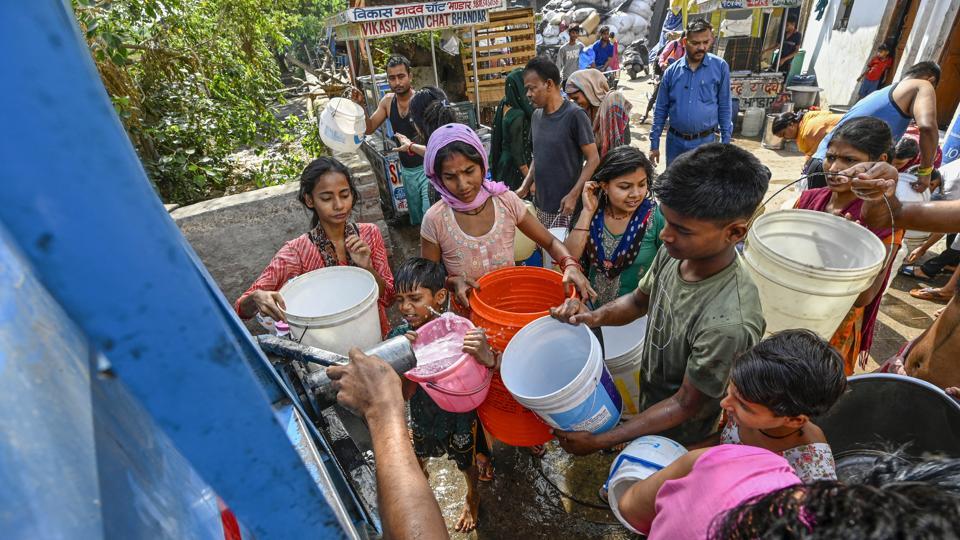
An NDMC official said that the water supply from the Delhi Jal Board (DJB) is about 40% short at Tilak Marg and Bangali Market Underground Reservoir (UGR) in NDMC area. “Due to the shortage of water supply, areas like Bengali Market, Ashoka Road, Harichand Mathur Lane, Copernicus Marg, Purana Quila Road , Babar Road, Barakhamba, KG Marg, Windsor Place, Firozshah Marg, Canning Lane and surrounding area would be impacted,” the official added.
NDMC has stated that, as per DJB information, the production of potable water from Wazirabad water plant is not running at full capacity due to non-availability of raw water. Hence, the water supply in the command area of Tilak Marg UGR and Bengali market UGR will be made available once a day and preferably during the morning. “The consumers of the affected area of NDMC may contact our control room for water tankers on phone numbers — 011-2336 0683 and 011-2374 3642,” the official added.
Alka Batra, a housewife who lives on Bhagwan Dass Road, said that that over the last week the residents have been receiving muddy water due to low pressure and the supply timing has been curtailed over the last two days. “Earlier, we used to receive water supply for over four hours, which has now gone down to just 40 minutes. The RO system is not functioning properly and even after the water is filtered, it has an aftertaste. So, we are now relying on canned water,” she added. Batra said that the houses do not have water pumps as the water supply pressure used to be high. “Now, the water is not reaching the first floor as the pressure is low,” she added.
Gopal Krishan, who heads the Federation of New Delhi RWAs, said that the situation is slowly but progressively getting worse. As most of the houses have overhead and underground tanks, the situation is under control for the time being, he added. “Earlier, we used to get water for two to three hours, but the supply has now been reduced to one hour a day. We have started to use the back-up tanks now. The situation must be controlled at this point,” he added.
The civic body has also issued an appeal to save water and use it judiciously. “There is a limited amount of water available with the municipality. The consumer must use our limited supply carefully. Don’t use drinking water for car washing and adapting micro irrigation techniques for garden or plantation,” the council said in a statement.
Unlike other parts of the city where DJB is the water utility, NDMC treats and manages the water supply network of New Delhi on its own. However, the council is dependent on DJB for supplying raw water to the area.
The permanent static population of NDMC is around 2.3 lakh and the floating population of the area is around 18 lakh with large number of office spaces, markets, tourist sites located in the region.