E-Paper



Only 1 tree transplantation project in Delhi met 80% survival rate criteria
Overall, only one-third, or 33.33% (5,487), of the 16,461 trees transplanted over the last three years survived the process, according to a recent assessment

 Prefer HTon Google


Out of all tree transplantation projects undertaken in Delhi over the last three years, wherein authorities relocate 100% of those identified, only one project has so far met the Delhi Tree Transplantation Policy’s survival rate threshold of 80%.
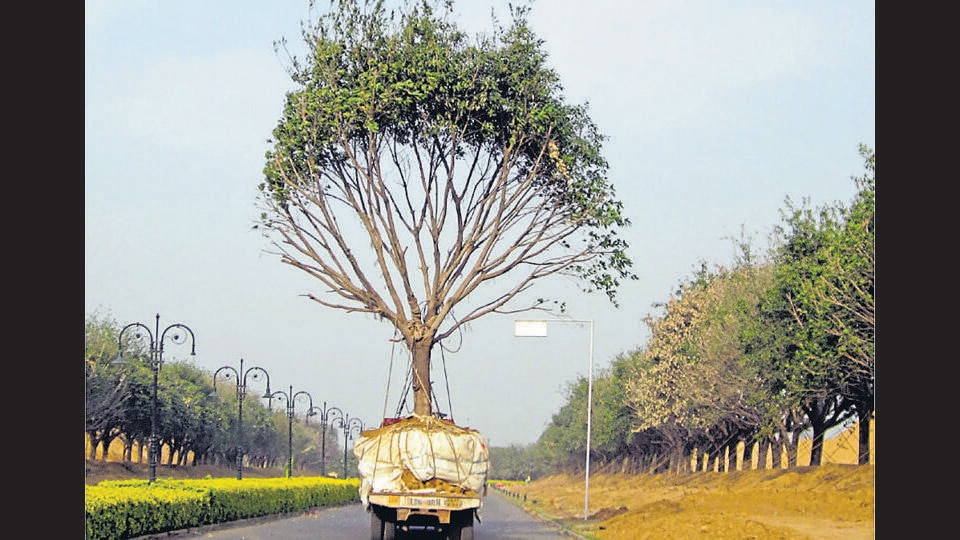
Unfortunately, a majority of these projects have had a low survival rate of around 20-30%, data submitted by the forest department in May 2022 through an affidavit in the Delhi high court showed.
This includes a meagre 7% survival rate for the Delhi Jal Board’s tree transplantation efforts for the rehabilitation of the Kondli Sewage Treatment Plant (STP). Delhi’s major projects have fared no better either.
Out of the 4,425 trees transplanted for the Dwarka Expressway Project from Shiv Murti to Road Under Bridge Sector 21, only 1,195 (or 27%) survived. Of the 927 trees transplanted as part of NBCC’s Sarojini Nagar GPRA redevelopment project, only 222 (or 24%) survived, the submission showed.
Overall, only one-third, or 33.33% (5,487), of the 16,461 trees transplanted over the last three years survived the process.
The Delhi Tree Transplantation Policy was officially notified in December 2020. However, projects from 2019 too began adhering to the norms. The policy mandates at least 80% of all trees identified to be felled, be transplanted, and at least 80% of these must survive the process.
Transplantation, as per the policy, should be carried out only through empaneled agencies identified by the government, and four such expert bodies were recognised last year.
Also read:Divergent data on survival of trees transplanted for Parliament’s expansion
Other projects mentioned in the affidavit include the ‘Proposed Expansion and Restoration project of Existing Parliament Building at Plot No. 118’ — a part of the Central Vista project, which according to the forest department, saw a low survival rate of 30% for its 404 transplanted trees. Another segment of the Dwarka Expressway project, for which 3,736 trees were relocated, only 1,382 (or 37%) survived.
The affidavit also mentioned 22 projects that involved tree transplantation over the last three years, of which 100% transplantation was completed in 19 of these projects. However, if data submitted by the user agency were to be considered, at least three different projects met the 80% survival rate threshold.
In most cases, the survival rate analysed by the user agency for the project differed significantly with the survival rate mentioned by the forest department.
For instance, the Okhla STP project required transplantation of 18 trees. While the DJB pegged the survival rate at 80%, with 14 trees surviving, the forest department said that only 12 survived, bringing down the survival rate to 66%.
While the forest department said only 1,382 out of the 3,736 trees survived from the Dwarka Expressway project, the NHAI pegged that figure at 2,465. Similarly, for the Central Vista Project, the CPWD said the survival rate was assessed at 66%, compared to 30% by the forest department.
Officials believe that difference in methodology and time of assessment carried out by the user agency may be a factor behind data disparity between the forest department and the user agency.
“Trees for all projects were assessed prior to the submission in May, whereas the user agency may have carried out their assessment earlier. It is possible that trees were healthy initially but were unable to survive the transplantation process after a few months,” said a forest official, stating that for a tree to survive, the monsoon season, along with summer and winter periods provide different challenges. “It is possible that the tree appears to be doing well initially, but is then unable to survive the winter, or the monsoon period,” the official added.
Experts in Delhi say that while skills and expertise in transplantation are important factors, the root type of the tree, its age and the soil regime all play a crucial role in determining its transplantation survival. “If a tree has deep tap roots, it is difficult to transport. This includes Jamun and Neem trees. On the other hand, trees such as Banyan, Pilkhan, or even from the fig family, have surface roots, and these can easily be cut and made into a ball,” says environmentalist Pradip Krishen.
Krishen stated that if the soil type and moisture regime don’t match, trees will not be able to grow. “If a tree is taken from the Yamuna landscape to a rocky Aravalli terrain, it has little chance of survival,” he said.
Environmental activist Bhavreen Kandhari said that a detailed tree preservation report should be prepared for each project, based on which decision should be taken on on-site preservation.
“It is a flawed and dangerous premise that large mature trees can be transplanted successfully from their location. As we have seen already with trees transplanted from the Dwarka Expressway, tree transplantation is a very challenging process and the success rate in Delhi is practically zero due to the climatic and soil conditions, tree species involved and other resource requirements like water that are in short supply,” she said.
While the NHAI told HT it will assess the reasons behind the differing figures, other agencies like the DJB, NBCC and CPWD did not respond to queries. “We have not seen the forest department’s assessment. We will try and analyse why there is a gap,” an NHAI official said.