The building that collapsed in south Delhi’s Satya Niketan on Sunday, killing several people, had no sanctioned building plan and unauthorised construction in its basement, according to a senior Municipal Corporation of Delhi (MCD) official aware of the early assessment following the latest tragedy. The rampant violations have again raised questions about how such structures went undetected in a neighbourhood where multi-storey PG buildings have proliferated for years.
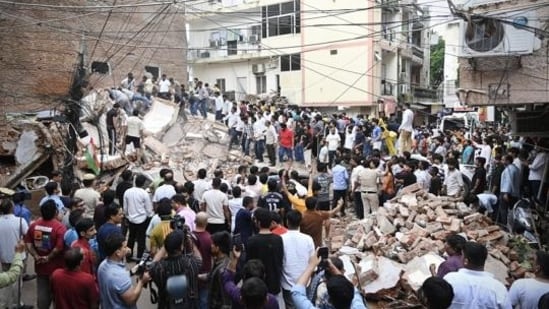
But much of the construction that transformed the low-rise settlement into a dense student hub happened outside the rules, with senior MCD officials saying no sanctioned building plan exists for the collapsed structure and that construction in its basement was unauthorised.
Also read: Total collapse of accountability
Rampant unchecked construction
The collapse has raised pointed questions about the civic body’s failure to control illegal construction in Satya Niketan — a densely packed neighbourhood next to Delhi University’s South Campus that came up in the early 1970s (one of Delhi’s first resettlement colonies) in an area originally developed as a resettlement colony, but now houses hundreds of five- and six-storey buildings, PGs, messes and eateries catering to a large student population.
An MCD official said the area was among about 45 resettlement colonies developed in the 1970s, with freehold rights granted in 2011. Its proximity to South Campus, however, transformed it into a major rental and student accommodation hub, with property owners increasingly adding rooms and floors to existing structures.
{{/usCountry}}An MCD official said the area was among about 45 resettlement colonies developed in the 1970s, with freehold rights granted in 2011. Its proximity to South Campus, however, transformed it into a major rental and student accommodation hub, with property owners increasingly adding rooms and floors to existing structures.
{{/usCountry}}“Permission for changes in basement of a standing structure cannot be granted. It is hazardous. It is the failure of the field staff to detect the activity,” the official said, adding that a fifth floor was also not permitted under Floor Area Ratio (FAR) regulations. Resettlement colonies have standard unit plans that cannot simply be altered, the official said, but the grant of freehold rights in 2011 led to rampant expansion.
Also read: 3 critical after boys’ PG building collapses in Delhi’s Satya Niketan, several feared trapped
MCD report flags no booking or sealing record
MCD’s official report said the collapsed property, “P-14 Satya Niketan,” stood on a 55 sq yard plot and comprised a basement and ground to fourth floor. It was reportedly constructed in the 1990s. “No record of booking or sealing available, no complaints received of any work in this property,” the report said.
That record has drawn scrutiny because the locality has seen a similar collapse before. In April 2022, another building in Satya Niketan collapsed, trapping six people and killing two.
Collapsed building had no fire NOC
The regulatory gap extends to fire safety. PG accommodation is permitted subject to minimum plot sizes and road widths, but buildings above 9 metres housing more than 20 students require a fire NOC. A second civic official said buildings crossing those thresholds are treated as assembly buildings. “This does not have any fire NOC despite so many rooms. Essentially, the whole area has mushroomed in a similar fashion,” the official said.
The concern is particularly acute because Satya Niketan is no longer simply a resettlement colony — today, it caters to thousands, if not millions of students with PGs, rented rooms, messes, cafes and eateries packed into a small neighbourhood originally planned as a low-density settlement.
Divy Upadhyay, a third-year student at Motilal Nehru College who lived in the collapsed building until a year ago, said the building’s condition had concerned him even then. “I lived here a year back. Accommodations in older buildings have slightly less rent, so that’s why students prefer them, at least in the first and second year. Later, in the third year, I moved into a flat with friends,” he said. “I had given similar feedback to four-five of my friends who came to live here to move out.”
Satya Niketan is not an isolated case. Fire and building safety failures in student-heavy neighbourhoods have repeatedly triggered enforcement drives, only for concerns to resurface later. In 2023, Mukherjee Nagar saw a major crackdown on PGs and coaching centres after a June 15 coaching-centre fire injured 61 students. MCD had said buildings above 9 metres housing more than 20 students could not operate without a fire NOC under the Master Plan and Unified Building Byelaws.
For thousands of students and young professionals, unplanned spaces like Katwaria Sarai, Hauz Rani, and Saidulajab offer affordable housing. From accommodation, shops, and basement reading rooms to internet service providers, the ecosystem caters to a rent-based economy. Authorities usually ignore these unplanned enclaves and their sheer lack of basic safety, until a tragedy occurs.
The latest collapse also comes against a wider backdrop of regulatory protection for unauthorised construction. The Delhi Laws (Special Provisions) Act protects certain unauthorised constructions existing up to June 1, 2014, from punitive action such as demolition and sealing. The second civic official said even the regularisation of 1,511 unauthorised colonies on an “as is, where is” basis could allow existing violations to persist without corrective measures.
Also read: 'The walls were cracking': Student who lived in collapsed Delhi boys’ PG recalls state of building
Expert blames housing shortage for illegal PGs
Jagdish Mamgain, urban planning expert and former MCD works committee chairman, said PGs and coaching centers exploit the helplessness of students to earn as much money as possible, while the administration and civic bodies are complicit. “There are not enough hostel rooms, so there is a clear demand. Illegal PGs keep adding cubicle-like rooms to meet this demand illegally. This Satya Niketan unit was also said to be carrying out alterations. Kingsway Camp, Malka Ganj near DU North Campus, urban villages near JNU, and areas around every educational institute in Delhi have a similar economy. Students are falling victim to poor planning that leads to a shortage of dwelling units, allowing illegality to fill that gap. The beldars and field workers of the building department collect money, and cuts go to everyone from junior engineers to commissioners, councillors, and MLAs,” he said.
Frequently Asked Questions
What led to the building collapse in Satya Niketan?
Has there been a previous building collapse in Satya Niketan?
What are the fire safety regulations for PG accommodations?
How has the Delhi Laws (Special Provisions) Act impacted unauthorized constructions?
Stay updated with all top Cities including, Bengaluru, Delhi, Mumbai and more across India. Stay informed on the latest happenings in World News along with Delhi Election 2025 and Delhi Election Result 2025 Live, New Delhi Election Result Live, Kalkaji Election Result Live at Hindustan Times.
Stay updated with all top Cities including, Bengaluru, Delhi, Mumbai and more across India. Stay informed on the latest happenings in World News along with Delhi Election 2025 and Delhi Election Result 2025 Live, New Delhi Election Result Live, Kalkaji Election Result Live at Hindustan Times.