
 E-Paper



SC on pollution debate: Easy for those sitting in 5-star hotels to blame farmers
A debate on stubble burning heated up proceedings over New Delhi’s pollution crisis in the Supreme Court on Wednesday, with the SC saying those sitting in air-conditioned hotels can never relate to the farmers’ plight


A debate on stubble burning heated up proceedings over New Delhi’s pollution crisis in the Supreme Court on Wednesday, with the country’s highest judicial body saying those “sitting in air-conditioned, five-star and seven-star hotels” can blame poor farmers but never relate to their “plight”.
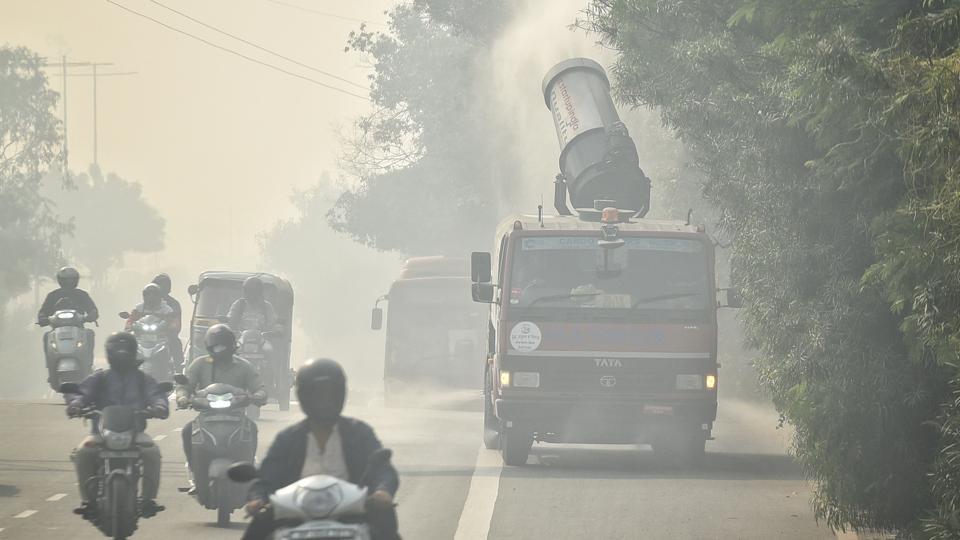
“What we have been seeing and observing in the court is that irrespective of the percentage of the stubble burning, nobody is concerned about the plight of the farmers who don’t have money and are asked not to burn the crop residue,” said the bench led by Chief Justice of India (CJI) NV Ramana as it resumed hearing of a public interest litigation (PIL) on tackling pollution in Delhi-NCR.
The bench said, “People sitting in Delhi in five-star and seven-star hotels are blaming the farmers that they are responsible for pollution to 10% or 40%, but nobody thinks about them. If there is a scientific solution, someone should go and convince the farmers. Someone has to reach out to the farmers.”
Also Read: Delhi pollution: Govt issues order, bans entry of trucks in Capital
The bench, which also comprised justices Dhananjaya Y Chandrachud and Surya Kant, clarified that the court “is not going to penalise the farmers” while it asked the Punjab and Haryana governments on Monday to persuade them to put off stubble burning for at least two weeks.
The top court’s comments came as senior advocate Abhishek Manu Singhvi, appearing for the Delhi government, urged the bench not to treat stubble burning as an insignificant factor in the ongoing pollution crisis in the Capital.
Singhvi cited a study conducted by System of Air Quality and Weather Forecasting and Research (SAFAR) under the union ministry of earth sciences to highlight that the contribution of stubble burning can range between zero and 58% during different times of the year.
“Last time, this court said we were chasing a remedy that is not a major cause. But stubble burning is a chief cause and it must be addressed,” the senior counsel argued.
The bench retorted, “We are not going to penalise the farmers. But we addressed this issue in the last order. You want us to make a statement that will create controversy. Everything will then be out and only blame game will remain. We think debates on TV are creating more pollution than anything else. They don’t understand the issue and they say anything. Everyone has their own agenda. How can we help?”
Singhvi then tried to cite some studies on stubble burning, but the bench said that institutes will come out with different numbers and therefore, the court wouldn’t want to get into these niceties. “We are here for a specific purpose. We want to bring down the pollution level from 500 to an acceptable level,” the bench said.
The bench also asked if anybody could say that burning firecrackers doesn’t cause pollution, although they are also a temporary phenomenon. “Can we ignore the fact that since Diwali, how much firecrackers have been burnt despite a ban order by this court? Why are they being burnt now?”
During the hearing, senior counsel DS Patwalia, appearing for the Punjab government, listed out measures taken by the state to stop stubble burning.
At this point, the bench asked Patwalia whether the Punjab government has picked up the crop residue lying in the fields. Patwalia said it has not been done completely, to which the bench responded saying, “So, you have left the farmers to the mercy of god. You have stopped them, but you have done nothing about the stubble in their fields.”
Patwalia said that the Punjab government was taking several steps to procure machines for managing the crop residue, and that they have also written to the Centre repeatedly asking for a cost compensation of ₹100 per quintal to the farmers over and above the minimum support price (MSP) to control stubble burning.
But the bench pointed out that no details have been given by the state about machines already procured. “How many machines have been bought? You say you are in the process of buying them. By the time you will complete the process, November-December will be over,” it told Patwalia.
The debate on stubble burning began on Wednesday with solicitor general Tushar Mehta standing up at the commencement of the hearing to clarify confusion over the exact contribution of stubble burning to the ongoing pollution crisis.
Mehta, who represents the Centre, submitted that the clarification was called for in view of “nasty” remarks made against him by “some people” on TV, alleging that the law officer misled the court on Monday.
He told the bench that the contribution of stubble burning was around 35-40% between October and November, and 4% was the annual average.
“Therefore, I never said it is 4% throughout the year. This was the average sectoral contribution computed annually... it is projected in some TV debates as if we said 4% because of upcoming elections,” the SG said.
To this, justice Chandrachud replied, “The moment I pointed out 4%, Vikas Singh (who appears for the PIL petitioner) referred to your affidavit about 35-40%. We could understand that the study was about the average contribution. We were not misled at all.”
The CJI said, “We are bound to get these types of criticism when we are holding public offices. We are working for the betterment of society. Forget all this... This is a matter of common sense. This is the season of harvesting and hence, it is bound to increase in these two months. So, these figures are not necessary for us. We have to ignore certain things. We have to focus on more important issues.”
Senior advocate Vikas Singh, however, recounted that the SG had verbally argued that stubble burning constitutes “less than 10%” and therefore, questions must be raised about these glaring anomalies.
A controversy had erupted following Monday’s hearing in which the union government cited different figures on the contribution of stubble burning to Delhi-NCR’s worsening air quality.
It had told the bench that stubble burning is not the prime cause of pollution, adding that it contributes just around 10% to the total air pollution. But the affidavit, placed by the Centre before the court on the same matter, also contains a finding that stubble burning has been contributing about 35-40% of the total pollution load in Delhi-NCR.
Interestingly, the same affidavit, at another point, refers to a scientific study to maintain that stubble burning contributes a meagre 4% to PM2.5 and PM10 pollutants during pre-winter and winter. The source of this scientific study has not been named in the affidavit.
The Delhi government’s environment minister Gopal Rai on Tuesday asked the Centre to clarify the exact contribution of stubble burning to New Delhi’s air pollution, citing different numbers cited by the Centre in its affidavit that was filed in the court on Monday.
He asked union environment minister Bhupender Yadav to look into the contribution and clarify the correct figure so corrective measures can be taken.
Stay updated with all top Cities including, Bengaluru, Delhi, Mumbai and more across India. Stay informed on the latest happenings in World News along with Delhi Election 2025 and Delhi Election Result 2025 Live, New Delhi Election Result Live, Kalkaji Election Result Live at Hindustan Times.


