
 E-Paper



Stray dog feeding spots in Delhi a pipe dream for 16 years
The issue returned to the spotlight on Friday, when the Supreme Court underscored the importance of regulating community dog feeding

 Prefer HTon Google


Almost 16 years after a 2009 Delhi High Court order directed the creation of designated feeding spots for community dogs, the Capital is still struggling to implement the directive. Today, only a handful of such spots exist in any usable form. While close to 100 official feeding spots were once established across the city, activists say many have since been dismantled, encroached upon, or deliberately destroyed by residents opposed to the idea of feeding stray dogs.
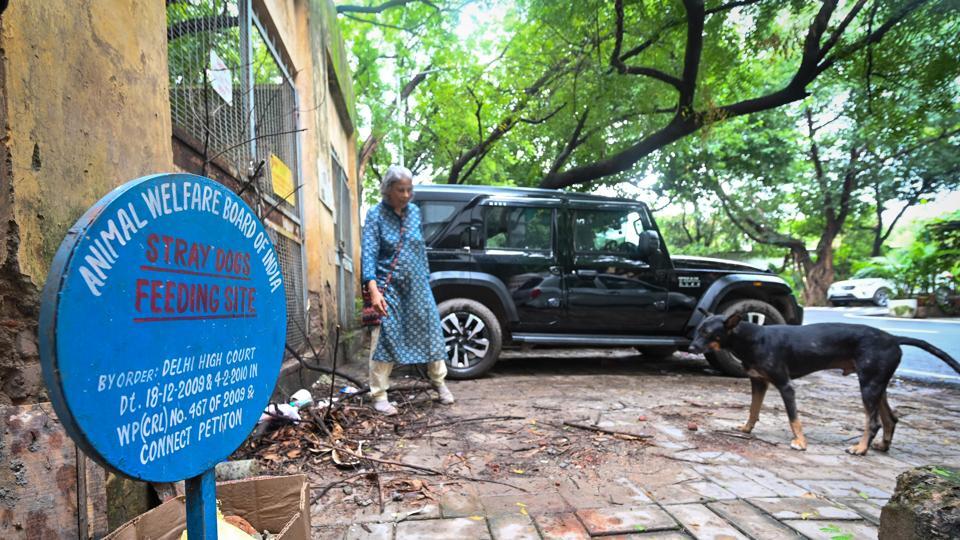
The issue returned to the spotlight on Friday, when the Supreme Court underscored the importance of regulating community dog feeding, clarifying that feeding in public places without designated sites cannot be permitted.
For activists such as Sonya Ghosh -- who had earlier been tasked by the Animal Welfare Board of India (AWBI) to coordinate feeding points in consultation with Resident Welfare Associations (RWAs) -- the 2021 order was a reminder of old promises that remain unfulfilled.
According to the 2021 order, “….in each colony of Delhi, Animal Welfare Board of India should identify, in consultation with Residents Welfare Association, Area SHO and the Animal Welfare Organisation working in that area, the spots/ sites which in its opinion, would be most suitable for the purpose of feeding dogs.”
“The 2021 order reiterated what the Delhi high court had said way back in 2009—that fixed feeding spots must be designated in every colony,” Ghosh said. “The whole purpose was to avoid daily conflict between feeders and residents. If dogs are fed at fixed locations, they can also be monitored for sterilization, vaccination, and re-vaccination.”
Between 2009 and 2011, Ghosh said she facilitated the establishment of at least 75-80 feeding spots in localities such as Vasant Kunj, Saket, Malviya Nagar, Khirki Extension, and Jawaharlal Nehru University (JNU). Yet, she says most of these spots have since been sabotaged.
“In JNU, the boards marking feeding spots were removed. In my own colony, people repeatedly encroach upon the designated areas,” she explained.
In a letter dated November 27, 2023, addressed to the Delhi’s State Animal Welfare and Animal Husbandry Department, Ghosh detailed repeated obstruction: “One feeding board was broken and never replaced by the RWA. Another has been fenced, gated, and locked with barbed wire. A third is now being used as a dumping ground for construction debris.” The letter also described her harassment at the hands of residents and urged authorities to clear the obstructions.
A visit by HT to her Vasant Kunj colony on Friday confirmed hers was one of the few neighbourhoods in Delhi where feeding points are still visible.
Elsewhere, the situation is more dire. In Khirki Extension, where two spots were set up with official sanction, residents quickly destroyed the signages. When HT visited the Saini community there, the grounds were covered in household waste and building debris. “We are forced to feed dogs on the streets, wherever we can find space,” said 49-year-old animal welfare worker Pankaja Sharma. “Even the clay bowls we keep for food and water are smashed and thrown away by those opposed to feeding. Now with the court’s order, we are stuck. The older dogs cannot travel far, but every time we set up a designated spot, it gets encroached upon.”
In Mount Kailash, Block A, resident Divyanshu Vij admitted that while some dog lovers feed strays informally, “there are no official points.” In Block E2 of Vasant Kunj, activist Subhalakshmi Sircar said their RWA initially resisted setting up more than one feeding spot. “Eventually, two were allowed inside the colony and two outside. But the boards vanished, and people began dumping garbage there deliberately.”
The problem persists despite new regulations. The Animal Birth Control (ABC) Rules, 2023, require RWAs to facilitate community dog feeding at fixed locations. But enforcement, residents acknowledge, remains patchy.
“It is easier in gated societies where residents pay membership fees and the RWA has more authority,” said MK Gupta, president of GK-1 S-Block RWA. “In freehold colonies, like GK-1, half the households pay no fees. So, there is no consensus. Many residents object to feeding points being set up in parks or near homes. We are left telling dog lovers to feed outside their own houses.”
For animal welfare workers, the lack of fixed spots has created a volatile situation. Feeders are frequently harassed or attacked; RWAs complain of hygiene and safety issues; and unregulated feeding often shifts the problem rather than resolves it.
Still, many activists welcome the Supreme Court’s latest intervention. “Unregulated feeding is not ideal. It can lead to conflicts and unsanitary conditions,” Sircar acknowledged. “But dogs have to be fed, especially old or injured ones. So fixed spots are the only sensible solution.”
Ambika Shukla, trustee of People for Animals, praised the ruling, noting that it reinforces the ABC Rules as the most humane and scientific approach to community dog management. “Sheltering dogs is not a sustainable option,” she said. “The long-term solution is to feed them at designated spots, sterilise them, vaccinate them, and prevent uncontrolled population growth.”
Shukla emphasised that the debate should not be about conflict between dog lovers and opponents, but about ensuring coexistence. “The Supreme Court has made it clear: the way forward is structured feeding and animal birth control. This is about reducing friction, not inflaming it.”

Stay updated with all top Cities including, Bengaluru, Delhi, Mumbai and more across India. Stay informed on the latest happenings in World News along with Delhi Election 2025 and Delhi Election Result 2025 Live, New Delhi Election Result Live, Kalkaji Election Result Live at Hindustan Times.


