E-Paper



Time for govt to revise list of Delhi pollution hotspots
Experts said that the data makes underscores the need to take more localised action when it comes to pollution

 Prefer HTon Google


Delhi has at least four more pollution hotspots than the 13 sites designated, according to average concentration of ultrafine particulate matter known as PM2.5 over the last year, which has been as bad or worse at these locations when compared to the demarcated ones.
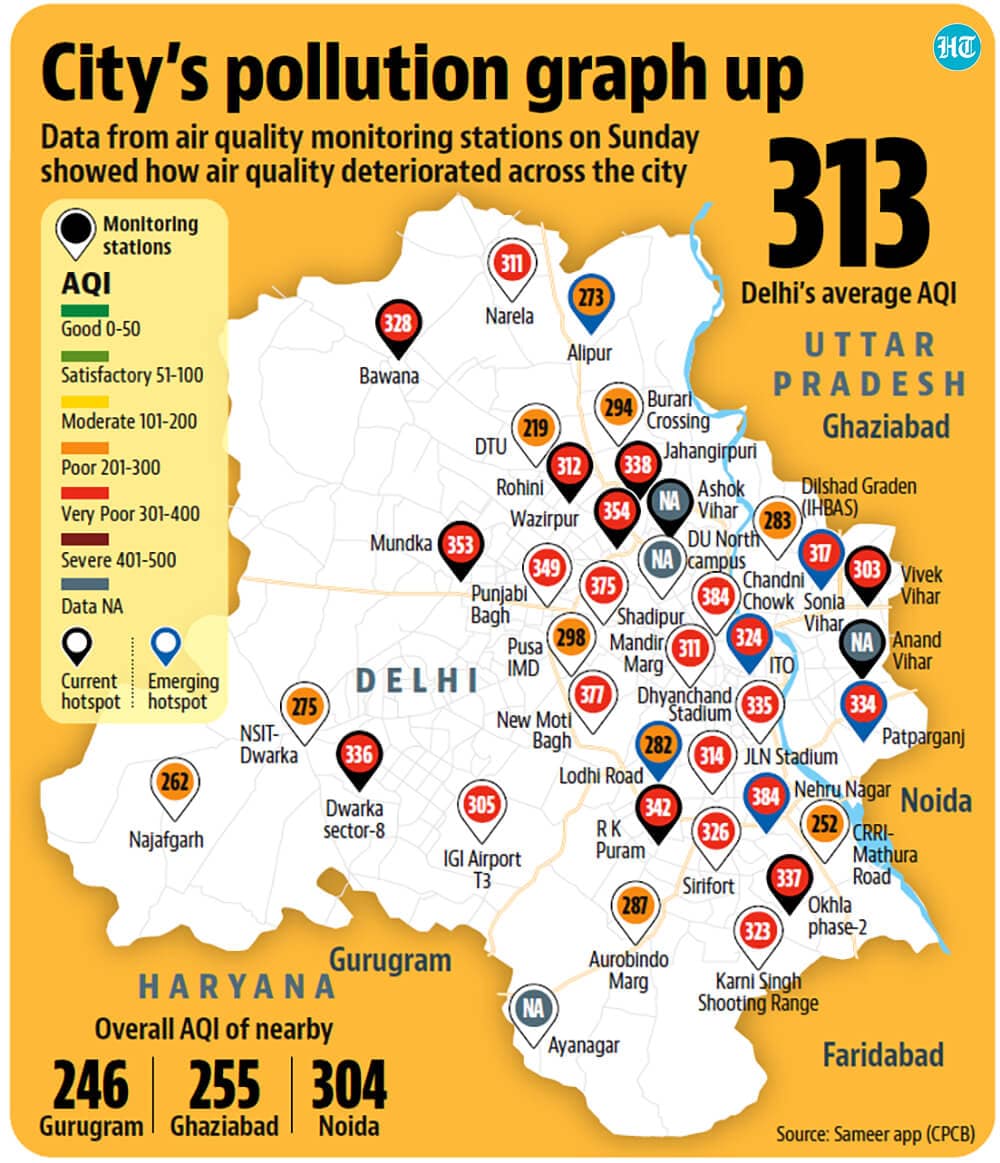
PM2.5 readings at Nehru Nagar (near Lajpat Nagar) in south Delhi, Lodhi Road in central Delhi, Patparganj in the east and Alipur in the north suggest they should be added the list of 13, which will force local administration to take additional measures to curtain pollution.
“Our action has been focused on these 13 locations. We may revise the list of hotspots again, particularly if other locations are recording such high levels,” a Delhi Pollution Control Committee official said, asking not to be named, but added that no review has been underway till now.
The existing 13 hotspots—Anand Vihar, Mundka, Wazirpur, Jahangirpuri, RK Puram, Rohini, Punjabi Bagh, Okhla, Bawana, Vivek Vihar, Narela, Ashok Vihar and Dwarka—were classified five years ago based on reading gleaned from weather stations and pollution monitors here.
To combat the problem at these locations, officials have in the past prepared hotspot specific action plans, including identifying the biggest sources, sprinkling water and deputing teams to crack down on violators.
The DPCC official cited above said that the focussed on the hotspots “resulted in a 21% reduction in the PM 10 levels compared to 2018, along with a 20% reduction in the PM 2.5 levels.
Delhi’s annual PM 2.5 data from its 40 ambient air quality monitoring stations showed Jahangirpuri was its most polluted location last year, recording an annual PM 2.5 concentration of 127 micrograms (μg) per cubic metre—over three times the annual PM 2.5 standard of 40μg/cubic metre. This was followed by Anand Vihar (124μg/cubic metre), Dwarka (118), Nehru Nagar (118) and Lodhi Road (118). While Anand Vihar and Dwarka are part of the 13 hotspots, Nehru Nagar and Lodhi Road are not, and action at these locations is largely limited to basic measures like sprinkling of water and mechanised road sweeping.
Patparganj (109), Alipur (104), Sonia Vihar (103) and ITO (102) were the other stations recording high levels comparable to the existing pollution hotspots, which, experts said, makes it imperative to revise this list.
Experts said that the data makes underscores the need to take more localised action when it comes to pollution. “We have amped up action on the ground at these hotspots over the last few years, but even though pollution levels are decreasing at these hotspots, new hotspots are emerging elsewhere. We cannot focus solely on these 13 locations and the data shows we need more localised action. At the same time, we cannot remain too hyperlocal. Macro-level action is needed at the city level, so we can see an overall reduction in Delhi’s background emissions,” said Anumita Roychowdhury, executive director, research and advocacy at the Centre for Science and Environment.
Twelve out of the 13 pollution hotspots still have a PM 2.5 concentration higher than 100μg per cubic metre, it has dropped to 94μg per cubic metre at Okhla. This is lower than a number of the other stations not yet tagged as pollution hotspots.
A second expert said manpower and funds needed to be diverted smartly, adding that the list needs to be dynamic and updated each year. “If a station has shown considerable improvement, for example, Okhla, then there is a case to remove it and add other hotspots. The manpower deployed at Okhla can accordingly be sent to emerging hotspots,” said Sunil Dahiya, analyst at the Centre for Research on Energy and Clean Air (CREA).
Earlier in October, the DPCC and the state environment department jointly identified 103 critical sources of local pollution across 13 hotspots in the city, fixing which, officials said, will be a priority this winter. At least 19 of 103 sources were traffic congestion points within the 13 locations.