
 E-Paper



What’s it like to live in the most polluted pockets of Delhi?
Several neighbourhoods in Delhi, one of world’s most polluted cities, record much higher levels of pollution than the daily average index value indicates

 Prefer HTon Google


For 35-year-old Rajesh Devi, pollution is a clear and present danger but despite knowing that it was taking a toll on her, she continues to travel from her house in Mundka to a factory where she works as a seamstress because, according to her, if she would stop, her family will starve.
Dhruv Sinha of Dwarka Sector 8 has confined the movement of his 74-year-old father to a room despite his doctor’s advising a daily walk to keep the septugenarian’s diabetes in control. Every winter, Sinha used to send his father to his native in Bihar to escape high levels of air pollution in the Capital.
Thirty-six-year-old Mumtaz, a resident of Bawana, has developed tuberculosis. Her doctor’s say that prolonged exposure to extreme air pollution levels is one of the primary reasons behind her condition.
The parents of Dhriti, 7, and Arunima. 12, in Chandni Chowk have told them to give up on their outdoor games, and play video games instead, since October so that they are protected from pollutants in the air.
Sagar Raj, a resident of Anand Vihar, says despite his locality consistently coming up in the list of most polluted neighbourhoods, the government authorities have done little over the years to address the issue. Raj says they were completely at the mercy of home air purifiers.
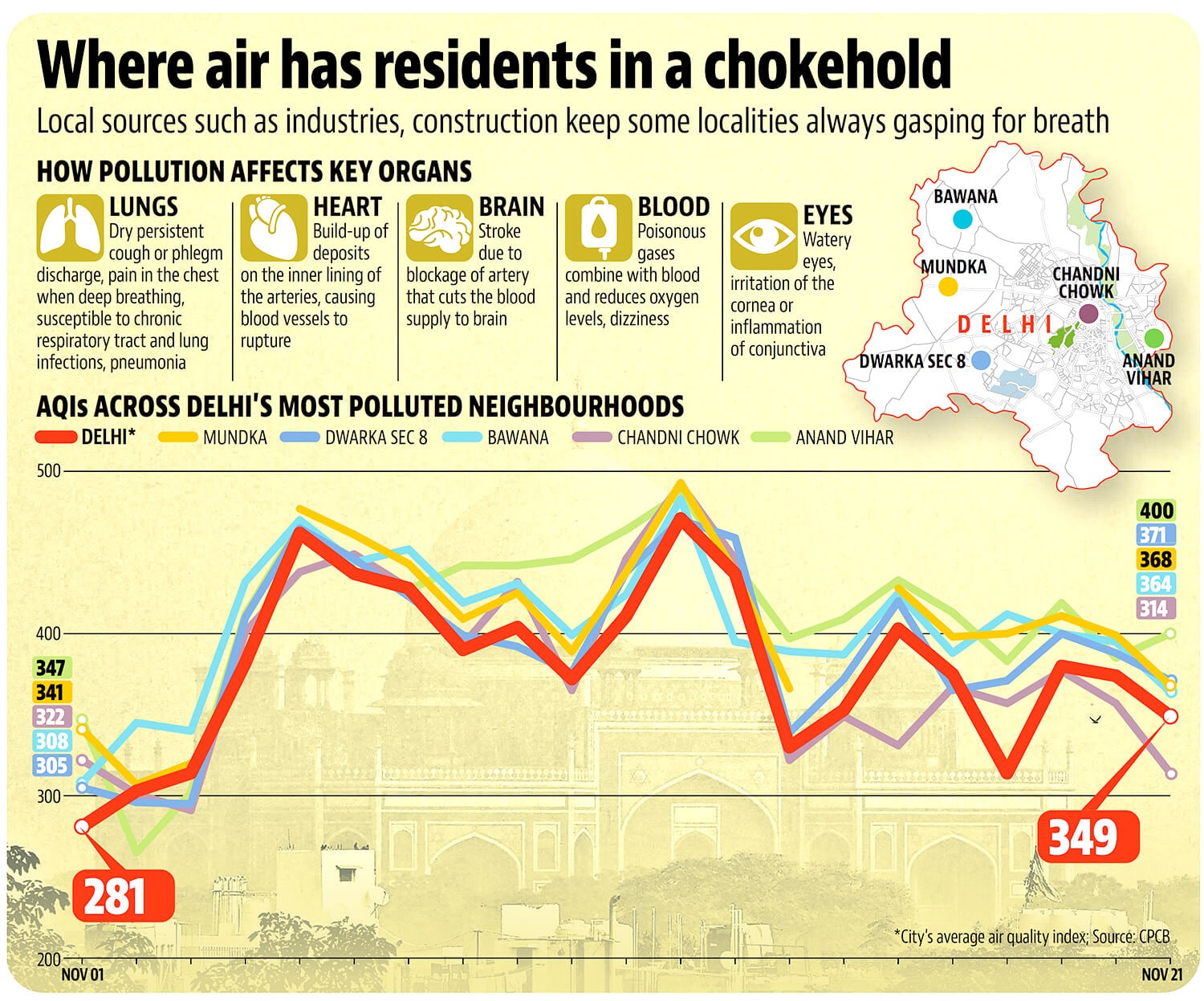
Several neighbourhoods in Delhi record much higher levels of pollution than the daily average index value indicates. For instance, between November 1 and 21, Delhi recorded its average AQI in the severe zone (between 400-500) for 8 days, compared to 14 severe days in Anand Vihar and 11 such days in Bawana.
This, doctors say, entails heavy costs in terms of health for the residents of these areas. “As doctors, we see the impacts of pollution on people firsthand, especially on the more vulnerable sections like senior citizens and children. In many health issues you might not see an immediate impact of pollution exposure but in more chronic cases, pollution does play a role in deteriorating a patient’s condition,” said Arvind Kumar, founder of Lung Care Foundation and chairperson of the Institute of Chest Surgery, Chest Onco Surgery and Lung Transplantation.
Weather forecasters and scientists have time and again pointed out that besides working on long-term and immediate measures to curb pollution levels in the city, the authorities must ensure area-specific plans and monitoring since every neighbourhood profile in the capital is different, and has different kinds of local sources of pollution. Anumita Roychowdhury, executive director (research and advocacy), Centre for Science and Environment said, “While Delhi needs to work on a holistic pollution control plan for the entire city, it is also imperative that there is a local action plan as well. This is because the pollution sources in each area are different. The landfill smoke and open garbage burning is not as big a problem in central and south Delhi as it is in the outer districts,” she said.
Over the last two weeks, Hindustan Times spoke to residents of Mundka, Bawana, Anand Vihar, Dwarka Sector 8 and Chandni Chowk, which reported the highest pollution levels since Diwali among the 39 areas where air quality is monitoredby central, local and scientific agencies.
Most of the residents that HT spoke to mentioned that despite the fact that the authorities know the exact months when pollution levels start rising, only “cosmetic” emergency measures are taken each year instead of a long-term action plan which works round the year.
Delhi government initiated several measures such as shutting of schools and construction activities in the city on November 13, a day when the Supreme Court slammed both the state and central governments for doing little to control pollution in Delhi NCR and blaming the farmers for burning stubble, instead.
The court also ordered the NCR state governments to hold an emergency meeting, following which on November 17, the federal anti-pollution agency, the Commission for Air Quality Management (CAQM) week-long measures across NCR such as shutting of schools, work from home for government staff and banning construction. However, most these steps were being implemented half heartedly, as meteorological factors such as improved wind speed coming to the rescue of the citizens and clearing air of pollutants to some extent.
HT finds how is it like to live in five of one of the most polluted residential pockets in the national Capital..
Mundka (highest average AQI in November: 493 )
Thirty five-year-old Rajesh Devi, who works as a seamstress in the Mundka industrial area, and lives in the area, said if people like her start sitting at home fearing pollution, then her children will starve to death.
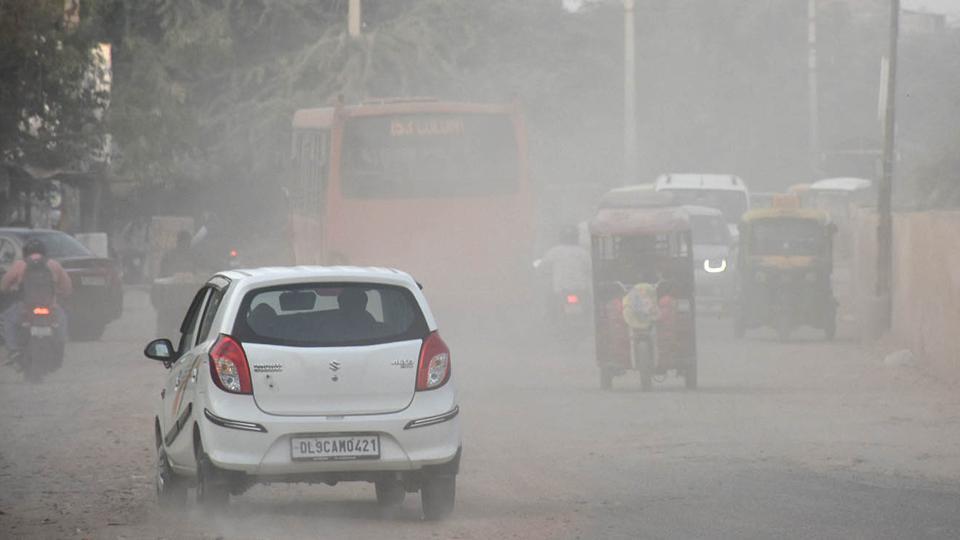
She said wearing whites is also a privilege for the residents here, because the toxic chemicals from industries, open garbage fires and the dust from unpaved roads, turn them pale yellow soon.
“The haze you see, you might find it unusual, but for us this is our everyday reality. You can ask any woman here, after one or two months, the white shirts of the school uniforms turn yellow. To mask it, I dip my kids’ uniforms in neel powder (indigo powder), but my daughter hates that because it makes her shirts blue. But that’s the only way these clothes will last a few years. We do not have the money to keep buying new uniforms every year,” said Devi.
Mundka, an industrial area located in west Delhi, is among the 13 pollution hot spots that the Delhi Pollution Control Committee (DPCC) recognized in 2018. Despite claims of focussed pollution control efforts, this locality has continued to top the list of the most polluted pockets of the Capital. On November 12, when Delhi’s AQI spiked to 471, the average AQI of Mundka had escalated to 493.
Naresh Kumar, a Congress leader who is familiar with the locality, said the condition of roads in the rural areas, including Mundka, is extremely bad and this is also adding to the pollution in the area.
“The mechanical sweepers and water sprinklers are reserved for the VIPs in Lutyens’ Delhi, the government and the municipal agencies have not bothered to deploy any pollution control measures here. Are the residents here not human beings? Or are their lungs made of steel?” asked Kumar.
Dwarka sector-8 (highest average AQI in November: 470)
Till Covid-19 pandemic hit the country, Dhruv Sinha, a resident of Dwarka Sector -8, would send his 74-year-old father, Brij Mohan Sinha, to his native town in Bihar every year in winters when the pollution levels in the national capital enters emergency levels, and remain consistently high for weeks.
For the past two years, the Brij Mohan has to stay confined to his room with an air purifier despite doctors advising him go for a daily walk to keep his diabetes under control.
“My father has not stepped out of the house since Diwali because of the high pollution levels. He gets cranky and depressed staying at home 24x7, because he is used to meeting his friends for evening walks. But our family doctor advised that going out in such high pollution levels might do his health more harm than good,” said Dhruv.
Sumegha Sharma, a resident of Dwarka sector-10, and an environmental activist who has been working in the area for over five years now, explained that the pollution levels in Dwarka, despite being a largely residential area, remain high primarily because of various construction projects going on in the sub-city and also because of open waste dumping and burning.
“Waste burning is a major pollution source in Dwarka. Since many plots are vacant, people have turned it into convenient garbage dumping points, and every few days it is set on fire after dark. The area is also developing, so many construction projects are ongoing and the AQI here tends to be higher than the rest of the city. Despite very specific issues, which are known to the authorities here, no action has been taken so far,” she said.
AQI recordings over the last two days show that even on days when the average air quality of the city has improved to the upper end of very poor category, Dwarka was among the areas that continued to remain in the severe zone. For instance, on Sunday at 2pm, the average AQI of Delhi was 371, considered in the very poor zone on CPCB’s AQI scale, but the pollution levels at Dwarka was 401, in the severe range.
Bawana (highest average AQI in November: 483)
When 36-year-old Mumtaz moved to Delhi with her husband over 15 years ago, she had hopes of a better life from what she had back in her village in Uttar Pradesh. She planned to set up a small shop of beauty products while her husband earning a steady income from his work.
But life took a turn for the worse for her in 2017, when she was diagnosed with tuberculosis. The doctors at the local government hospital told her that the prolonged exposure to the pollutants at the factory where she worked could be one of the reasons behind her disease.
“It could be that or someone from the workforce had it and transmitted it to me, because the workspace where we all work is very small. It took me a year to completely recover, but even now I find it difficult to breathe on certain days. I feel tightness in my chest. Now I think that life back in our village was better, at least we could have clean air and drinking water,” said Mumtaz.
A study titled, ‘Association Between Ambient Air Pollution and Elevated Risk of Tuberculosis Development’, conducted in Taiwan in 2019 highlighted broad-scale evidence showing the significant association between ambient air pollutants and the development of tuberculosis (TB). The study showed that short and long term exposures to particulate matters with aerodynamic diameters less than 10ug/m3 (PM10) and 2.5ug/m3 (PM2.5), carbon monoxide (CO), nitrogen oxides (NOX), and nitrogen dioxide (NO2) are highly likely to be associated with the elevated risk of TB.
Doctors back home have also highlighted the health risks associated with exposure to such high levels of pollution.
Dr Rajesh Chawla, senior consultant of pulmonary and critical care at Indraprastha Apollo hospital, said that there was nearly a 20% increase in the number of patients coming in with exacerbations of their chronic respiratory conditions around Diwali this year.
Chandni Chowk (highest average AQI in November: 492)
Every day exactly at 5pm, seven-year-old Dhriti and her 12-year-old sister Arunima, leave whatever they are doing and sit before the television set to play video games for an hour. Till October, this was the time that they ran outside to play with their friends in the neighbourhood park, but because of the high pollution levels they have been confined to their house.
“We bought them this video game set last year after Covid-19 pandemic, when they could not go outside and play. Children also need some entertainment. For one hour every day, we allow them to play video games, after which they have to go back to their homework or reading a book or any other chore,” said Sumitra Vishwas, Dhriti and Arunima’s mother, a resident of Chandni Chowk’s Gupta Residency.
Many like the Vishwas family are concerned that the high pollution levels in the national capital could ruin the health and quality of life for their children. They said children are forced to stay cooped up at home, instead of freely running around and playing with their friends in the park.
“You would see many children playing around in the local parks here in the evening, but on days when the pollution levels are high the number of those who venture outside is very less. You do not need any monitoring equipment; you can see the haze in the air. Who would want to subject their children to such toxic air? It is better to keep them safe,” said Mohammad Irshad, a resident of Daryaganj.
Senior Delhi Pollution Control Committee officials said the pollution levels around Chandni Chowk are showing a rising trend this season because of multiple development activities going on in the area.
“You have the some road repair work going on in Chandni Chowk area, plus in less than five kilometre radius you also have the other construction work going on at the Pragati Maidan,” a senior official said.
The children in the area have also become more aware of the need for a partnership between citizens and governments so that Delhi’s air can be improved.
“We are taught in school how Delhi is the most polluted capitals in the world. It is definitely the government’s responsibility but everyone in Delhi, including children like us need to do our bit as well. We can plant more trees in our areas and tell our parents to avoid private cars and take the Metro instead. This will be our contribution towards making our own future better,” said 16-year-old Sayali Parashar, a resident of the area.
Anand Vihar (highest average AQI in November: 486)
Anand Vihar, which located right at the Delhi-Uttar Pradesh border, has been suffering from a locational disadvantage from years. While known as a transport hub, the area also has many residential complexes. The residents in these areas said that several complaints to shift the transport hubs to the outskirts of the Capital have been ignored by the government.
“Despite being one of the most polluted locations of the city, no government agency has bothered to take any significant pollution control measures in this area. Recently a smog tower was installed here, but we are not very sure how much filtering of air is happening because of it,” said Sagar Raj a resident of Gitanjali Apartments, which is barely four kilometres away from the Anand Vihar bus terminal.
Many older residents in his society prefer to move to their children’ houses to escape the winter pollution, Raj said.
“The filters of my air purifiers need to be changed every year, because it gets choked. According to the company representatives, it needs changing only after three-four years in Indian cities. Imagine if the air purifier filters are getting to choked, what this pollution is doing to our lungs,” he added.
A senior DPCC official said that they have created a list of localities apart from the 13 major pollution hotspots, where action is being tightened.
“We made a list of 150 localities within these 13 hotspots and other areas where there were specific pollution problems. We have ordered the agencies to tackle these problems and submit regular reports to us,” the official said.
Jogi Ram Jain, standing committee chairperson of the north Delhi municipal corporation said that they are making all efforts to minimise pollution levels in the city.
“We have started 24x7 patrolling of our areas and special teams have been made for this purpose. We are also following all directions of the pollution monitoring agencies and conducting regular water sprinkling and sweeping of roads to control dust levels,” Jain said.


