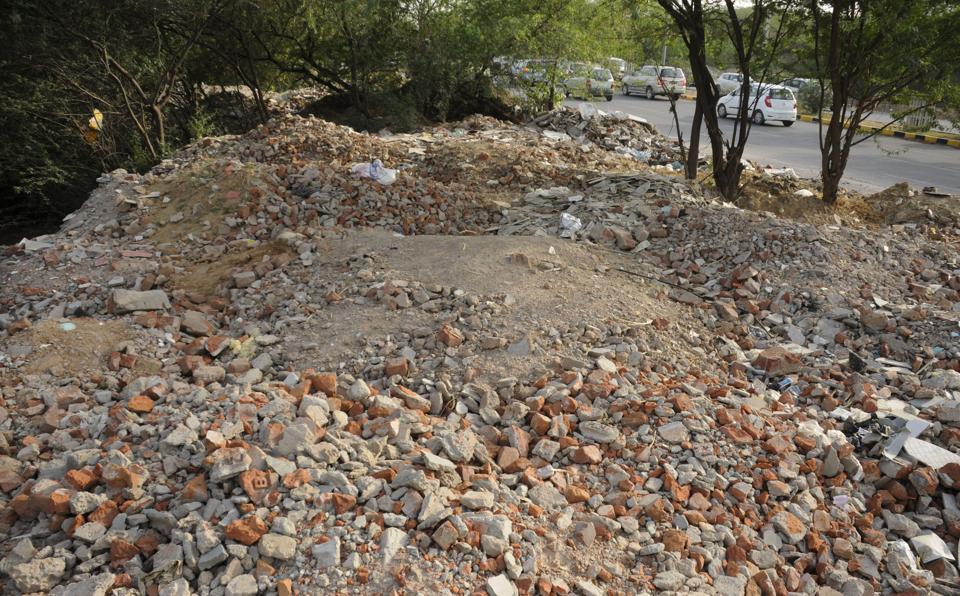
Why a chunk of Delhi's Construction and Demolition waste is dumped in the open
Poor monitoring and a lack of accountability are two crucial issues that must be solved to tackle waste. This will also help reduce Delhi's air pollution burden
New Delhi: The construction and demolition (C&D) waste left behind by the Supertech twin towers demolition may have a strict timeline of three months to be lifted, but the reality is that most projects in Delhi don't see C&D debris lifted at all. And in cases where it is lifted, it is not guaranteed to reach Delhi’s five existing plants, the latest data shows.
Delhi currently has 257 designated collection centres for C&D waste, spread across the jurisdiction of three local bodies. (Parveen Kumar/HT PHOTO)
As per the most recent annual report prepared by the Delhi Pollution Control Committee (DPCC) for 2021-22, out of the 3,449 tonnes per day (TPD) of C&D waste being generated in Delhi, only around half of which — or 1,770 TPD — is currently being processed or recycled. This means that the remainder is either dumped illegally in Delhi’s ridge areas, across the Yamuna floodplains or ends up at open sites, including landfills. This, despite Delhi’s five C&D waste recycling plants having the capacity to manage 5,150 TPD of waste.
The report prepared by the DPCC, was shared with the Central Pollution Control Board on July 29 and states that Delhi currently has 257 designated collection centres for C&D waste, spread across the jurisdiction of three local bodies — the Municipal Corporation of Delhi, the New Delhi Municipal Council (NDMC), and the Delhi Cantonment Board. However, a large chunk of waste falls under MCD’s jurisdiction. Out of the 3,449 TPD of waste being generated in Delhi, 3,370 TPD come from the erstwhile north MCD, south MCD and east MCD areas which now form the unified MCD, while only around 79 TPD come from the NDMC and Delhi Cantonment Board jurisdictions.
Municipality
Wards
Tonnes per day (TPD) of waste generated
Tonnes per day (TPD) of waste processed/treated
North MCD
104
1,238
194
South MCD
104
1127
682
East MCD
64
1,005
816
As per the report, the NDMC can process its entire quantum of C&D waste, while there is a gap of 0.54 TPD in the Delhi Cantonment Board area in terms of the waste being generated and processed.
Poor monitoring and lack of accountability
Delhi's five existing C&D waste recycling plants are located in Jahangirpuri, Rohini, Shastri Park, Bakkarwala, and Mundka. While the Jahangirpuri plant can process 2,000 TPD of C&D waste in a day, the next three can process 1,000 TPD each, while the Mundka plant can process 150 TPD of waste. These facilities, after processing this C&D waste, turn it into items such as paver blocks, kerb stones, CC bricks, aggregates and Granular Sub-Base (GSB), which in turn can be used in other projects as well.
Experts, however, say an improper mechanism in terms of monitoring waste collection, along with poor accountability, is leading to the improper utilisation of Delhi’s recycling plants, and in turn of the recycled materials, with the waste that is not collected, contributing to both air pollution as well as environmental degradation.
“We have created the infrastructure to treat this C&D waste. The combined capacity is greater than what Delhi is producing, yet the capital is failing to collect the entire waste being generated and this indicates poor efficiency in the overall system. At the same time, the recycled products created are also not being popularised. The government and civic bodies have so far failed to incorporate the informal sector, which may be collecting the waste but eventually dumping it somewhere,” says Anumita Roychowdhury, executive director, research and advocacy at the Centre for Science and Environment (CSE), asking for strict measures to be put into place to quantify waste generation at each construction site, which can be tracked to ensure proper disposal.
Tanushree Ganguly, programme lead, Council on Energy, Environment and Water (CEEW) also feels while guidelines on the management of construction waste and dust exist, its compliance across sites needs to be strengthened. “Going forward, the Delhi government must focus on increasing compliance by improving monitoring of construction sites, creating awareness, and building capacity around clean construction practices among project developers, site supervisors, and construction workers. Finally, the government should identify model construction sites to illustrate how clean construction can reduce the impact of dust from construction sites."
The Delhi government meanwhile said that to ensure transparency in the handling of C&D waste, it launched a self-assessment portal in October 2021 for all construction sites in Delhi with an area of more than 500 sqm. “This will ensure accountability and bring transparency to the process. Sites found to have not registered or not sharing data can be fined,” said a Delhi government official.
Experts also feel private construction sites need a similar mechanism in place, with the need to deposit a fee before any construction work begins. “There needs to be an overhaul of the system, which makes sure that before carrying out any construction or renovation for a house, one needs to alert the local civic body and deposit a fee in advance, through which the waste generated gets lifted. There also needs to be incentivisation for the private sector, or for informal players, which rewards them for collecting waste and dropping it at a collection centre located nearby,” says Bharati Chaturvedi, founder and director at Chintan, a non-governmental organisation (NGO) working on waste management in Delhi.
C&D waste: A major part of Delhi's bad air problem
As per a 2018 source apportionment study for Delhi — carried out by The Energy and Resources Institute (TERI) — the latest such study for Delhi, around 25% of particulate matter (PM) 10 in winters come from dust arising out of construction and demolition activities and road dust resuspension, with this figure increasing by 42% in the summers. Roychowdhury states that not only does C&D waste increase particulate matter pollution, but concrete dust is also toxic, particularly if inhaled over a long period.
“It is a problem area, particularly as C&D waste dumped in the open and in some cases, we have it seen lying out in the open at construction sites, without adequate covering. Dust is a constant source of pollution and PM 10 to Delhi’s air,” said Roychowdhury.
C&D waste was one of the 10 focus areas the Delhi government had picked out in its Winter Action Plan last year, with it also forming a part of the 15 key focus areas in this year’s Winter Action Plan, Delhi environment minister Gopal Rai said.
Bhavreen Kandhari, an environmental activist said that C&D waste is ending up in a lot of places through illegal dumping, a problem which can only be fixed if agencies are imposed heavy fines. “The entire machinery and monitoring system needs to change and if an agency is found illegally dumping it instead of ensuring it reaches a C&D waste management facility, then the fines imposed should be strong enough to act as a deterrent,” she says.

 E-Paper