
 E-Paper



Yamuna level dips in Delhi
The Yamuna River continues to recede, flowing at 205.14m, while Delhi's MCD ramps up vector control to combat rising mosquito-borne diseases.


The Yamuna continued its slow retreat on Monday, with the river flowing at 205.14 metres late in the evening — just below the danger level of 205.33m — a day after finally dipping beneath the red mark.
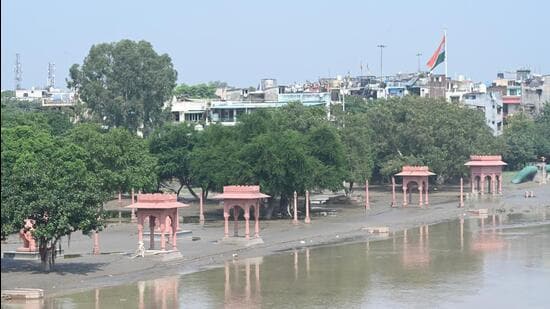
At 10pm on Monday, it fell to 205.09m.
Delhi traffic police on Monday evening announced that the Old Iron Bridge has once again been opened for traffic. The bridge was closed for traffic movement on September 2 in wake of rising river levels.
According to Central Water Commission (CWC) forecasts, the river is following a steady declining trend and is expected to reach 204.95m by 8am Tuesday.
Data from the Old Railway Bridge showed water levels at 205.31m at 11pm Sunday, 205.24m at 6am Monday and 205.19m by 5pm. Delhi’s Irrigation and Flood Control (I&FC) department classifies 204.5m as the warning level, 205.33m as the danger level, and 206m as the evacuation mark.
On the ground, residents in low-lying areas such as Yamuna Bazar and Monastery Market spent the day shovelling out thick layers of silt and sludge left by receding waters. Landscaped lawns at Vasudev Ghat lay ravaged, carpeted in mud.
The river had breached the 206m evacuation mark last Tuesday evening, forcing large-scale evacuations in the Capital and neighbouring NCR districts. Records show that the Yamuna has crossed the 207m mark only four times in the past 63 years, most recently in July 2023 when it rose to an unprecedented 208.66m, submerging large parts of central Delhi.
This year’s surge, triggered by heavy rainfall in the upper Himalayas and upstream states, again highlighted the vulnerability of Delhi’s riverside settlements and civic infrastructure.
MCD ramps up vector-control drive
With water levels abating, the Municipal Corporation of Delhi (MCD) has launched an intensive vector-control drive in flood-affected areas to prevent a spurt in mosquito-borne diseases. Officials said Sunday leave for sanitation and public health workers has been cancelled to ensure round-the-clock spraying and fogging.
Civil Lines, Central, Narela, Najafgarh, Shahdara North and Shahdara South zones were among the worst affected, with nearly 19,000 people displaced. “The risk of mosquito-borne diseases has risen in these areas. Additional staff has been deployed and relief camps are being covered,” a senior MCD official said.
Over the past four days, 34 relief camps were sprayed with larvicides, anti-mosquito medicines were used at 1,346 sites, fogging was carried out in 4,329 houses, and 76 awareness posters were installed.
So far, 29 malaria cases, 58 dengue cases and five chikungunya cases have been reported in the past week, but officials said the situation remains under control.
Stay updated with all top Cities including, Bengaluru, Delhi, Mumbai and more across India. Stay informed on the latest happenings in World News along with Delhi Election 2025 and Delhi Election Result 2025 Live, New Delhi Election Result Live, Kalkaji Election Result Live at Hindustan Times.


