
 E-Paper



Elephant terror continues to torment Sonbhadra villagers
VARANASI Wild elephant terror has been haunting several villages of Sonbhadra district for about a month, so much that several villages have fled their homes to


VARANASI Wild elephant terror has been haunting several villages of Sonbhadra district for about a month, so much that several villages have fled their homes to save themselves from the wrath of the pachyderms.
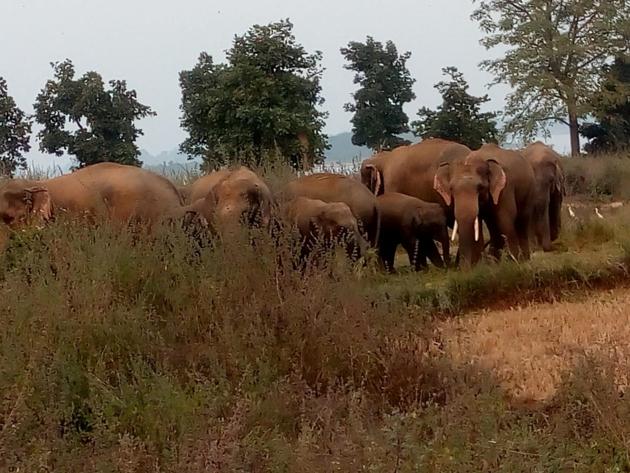
The presence of police and forest department officials in the affected villages has made no difference and the villagers continue to bear the brunt of the wild elephants’ anger, say villagers.
“We have been living in fear of the wild elephants for almost a month now. They haunt us at night daily, creating a ruckus and destroying crops. They have damaged several houses in different villages of the region,” said Parasnath Pal, a resident of village Kajalpani, in Sonbhadra district, which shares boundaries with Chhattisgarh, Madhya Pradesh, Jharkhand and Bihar.
On Sunday night, a herd of elephants uprooted several papaya and banana trees and destroyed paddy crops in the fields of Parasnath, Ramajor Pal, Maan Singh and Gopi Paal.
The pachyderms, about 13 in number, then reached Dumarchua village, near the Rihand Dam, and destroyed crops of pigeon pea and paddy and two houses outside the village.
“To save themselves, several locals locked their houses and fled,” said another Maan Singh, a villager.
Another local, Gopi Pal said the herd of elephants entered the dam in the wee hours of Sunday, where a calf died accidently. This came to light when a group of local teenagers went close to the dam where the elephants were present. The children saw the calf lying in the water. They ran back to the village and informed locals.
The panicked locals informed forest officials and police. Beejpur police station officer inspector SB Yadav reached the village along with heavy police force and camped there the whole of Sunday.
A forest team, led by divisional forest officer (DFO) MP Singh, patrolled the villages near the dam at night as a preventive measure as the elephants were present about a km away from the village.
Singh said a team of three experts, including a veterinary surgeon, has been constituted to ascertain the cause of death of the calf after performing a post-mortem examination.
During the night, some locals played recordings of a lion roar and also burst crackers in an attempt to drive away the elephants. The herd left the spot in the wee hours of Monday. However, forest officials opine that the herd would not have gone farther than 3-4 km and could be present somewhere in the forest.
During the past one week, wild elephants damaged crops in Nemna, Nawatola, Kodar, Samtharhawa, Sirthothi, Bodaridad, Nawapath, Sirsoti and other villages, said a senior forest department official.
Jarha forest ranger Dinesh Kumar confirmed the development. He said wild elephants, which crossed the border and entered UP, have cause panic among the locals in more than one dozen villages like Nemna and Nawatola.
The wild elephants’ herd is either from a sanctuary of Chhatisgarh or Madhya Pradesh, he said.
“The forest and police teams are patrolling the area together. Locals have been advised not to go close to the elephants and have been asked to light a fire outside their houses at night,” Kumar said.
A team from Beejpur police station is also deployed in the area.
On Monday, farmers again woke up to destroyed crops in their fields. The elephants damaged houses of Shiv Baiga, Harishchadra, Tejbali, Panje Lal and Ramanuj in the villages in Beejpur and Babhani area.
Locals recall that wild pachyderms from MP and Chhatisgarh strayed into the area two years ago and caused similar devastation. However, the intensity of devastation is high this time.
The DFO said efforts were on to keep the elephants away from the villages and drive them back into the forests from where they have come.
He said the villagers have been advised to keep a fire burning in front of their houses at night and make a loud sound to drive the elephants away when they hear the herd walk towards the village.
A senior forest official, who didn’t wish to be identified, said that felling of trees and shrinking forest areas appeared to be an apparent cause of the frequent visits by wild elephants. “With the crops standing in the field, they get food easily. That is why they come back in the wee hours and then return at night,” he said.


