
 E-Paper



After 74mm rainfall, Gurugram wakes up to an underwater cityscape
Gurugram recorded a sharp seven-degree drop in maximum temperature on Sunday, settling at 30°C, down from 37.1°C the previous day

 Prefer HTon Google


A heavy pre-monsoon spell on Saturday night drenched Gurugram with 74mm of rainfall, according to data from district administration, plunging the district into chaos with widespread waterlogging, stalled traffic, and civic breakdowns. The intense showers, compounded by strong winds, uprooted trees, damaged infrastructure, and reignited public fury over the city’s perennial monsoon preparedness failures.
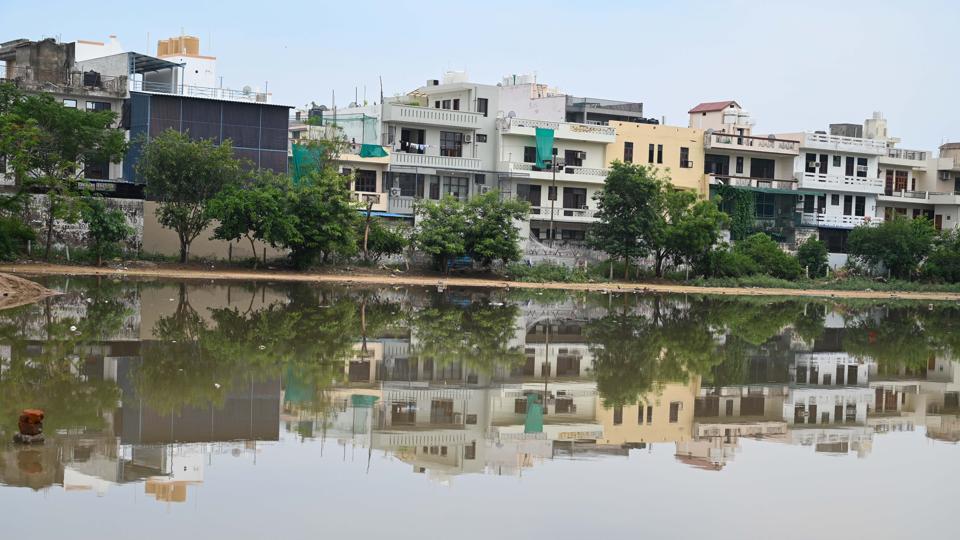
Several residential and commercial sectors—particularly Sectors 14, 15, 17, 21, 22, 23, 31, 40, and 45—were left waterlogged, while arterial roads such as Hero Honda Chowk, IFFCO Chowk, and service lanes along the Delhi-Gurugram expressway saw significant traffic disruptions. In Palam Vihar and DLF Phase 2, residents waded through ankle-deep water as stalled vehicles blocked flooded underpasses and service roads.
Following a spell of heavy rain, Gurugram recorded a sharp seven-degree drop in maximum temperature on Sunday, settling at 30°C, down from 37.1°C the previous day, according to the India Meteorological Department (IMD). The minimum temperature also dipped, reaching 21.5°C on Sunday.
The rainfall also brought a slight improvement in air quality. The district’s air quality index (AQI) stood at 123 (moderate) on Sunday, compared to 143 on Saturday, Central Pollution Control Board (CPCB) data showed. To be sure,only one out of four air quality monitoring stations participated in the measurement on Saturday, and Sunday.
Sector 45 residents expressed frustration. Persistent drainage failures have gone unaddressed, despite multiple directions from the municipal commissioner, said Puneet Pahwa, president of the Sector 45 RWA. “It’s only when media reports go viral that officials respond,” he remarked.
A GMDA official, speaking on condition of anonymity, said, “High-intensity rainfall in a short span overwhelmed the existing drainage capacity. In several areas, ongoing infrastructure work like road widening and realignment of drains also contributed to water accumulation. Temporary solutions have been deployed, and permanent upgrades are underway.”
MCG officials admitted delays in cleaning secondary drains and issues with clogged rainwater harvesting pits. “We have intensified desilting efforts and are coordinating with GMDA for better synchronisation of drainage channels across overlapping jurisdictions,” an MCG spokesperson said, also asking not to be named.
“Despite having stormwater drains mentioned in the GMDA-approved layout, the connecting cuts have either been blocked or left incomplete,” said Sunil Sareen, vice president of the Imperial Gardens condominium in Sector 102. “Every shower turns our locality into a swamp. The GMDA has shown complete disregard for commuting convenience,” Sareen added.
In Sector 4, the main market road has been flooding routinely ever since a contractor allegedly left a stormwater drain disconnected two years ago. “A leading sweet shop had to shift to the community centre during festival season,” said Sandeep Garg, a local social worker. “How many more monsoons do we need to endure before the MCG takes responsibility?” Garg questioned.
From neglected drains to illegal encroachments, residents are now questioning the Municipal Corporation of Gurugram’s (MCG) priorities. Capt. Raj Chopra, president of the South City 1 RWA, accused civic authorities of prioritising revenue over basic rights. “Before MCG asks for house tax, let them restore our right to a safe and clean neighbourhood. Residents are living amid decay and disorder,” he said in a letter to the authoritieson Sunday.
Saturday’s rainfall was exacerbated by strong winds that uprooted 34 trees across the city. The MCG’s horticulture wing, acting on instructions from commissioner Pradeep Dahiya, initiated emergency clearance operations across sectors including 9, 9A, 15, 23, 31, 40, 47, 48, 55, 56, 57, and Palam Vihar. Assistant Engineer Sachin Yadav supervised the effort. “Our teams worked round the clock to ensure minimal disruption to traffic and civic services,” the commissioner said in a statement.
However, trust in the administration remains low. The Sector 45 RWA has submitted three formal letters since February this year demanding urgent restoration of an underground stormwater drain running through Greenwood City Block-A.
“Despite repeated verbal and written assurances, no field action has taken place,” wrote Om Prakash Yadav, president of the Sector 45 RWA. “We fear stagnation during the upcoming rains.”
Saturday’s civic paralysis has renewed fears of a repeat of the infamous Gurujam of July 2018, when a sudden downpour crippled NH-48 and left commuters stranded for over 18 hours.
Despite the widespread waterlogging, traffic officials reported minimal disruption due to it being a Sunday. “Traffic movement remained manageable as vehicle volume was low. The worst-affected stretches near Hero Honda Chowk and the Sector 31/40 dividing road were cleared by late afternoon after dewatering,” said a senior Gurugram traffic police official.
Commuters, however, had a different experience. “I was headed from Sushant Lok to Sector 45 and it took me over an hour for a route that usually takes 20 minutes. Half the intersections were flooded, and there was no traffic police presence at bottlenecks,” said Rohit Arora, a private sector employee.
Another commuter, Preeti Mehta, a resident of Sector 23, shared, “My scooter stalled twice near the IFFCO Chowk service lane. The roads were invisible under water, and I didn’t spot a single barricade or warning sign. It felt like navigating a river.”
The lack of effective drainage, weak enforcement, and reactive crisis management continue to haunt the city’s infrastructure. “This cannot become another Gurujam repeat. Accountability has to be fixed now,” said Amit Jindal, president of the RWA at Vipul Greens.

Stay updated with all the Breaking News and Latest News from Mumbai. Click here for comprehensive coverage of top Cities including Bengaluru, Delhi, Hyderabad, and more across India along with Stay informed on the latest happenings in World News.


