
 E-Paper



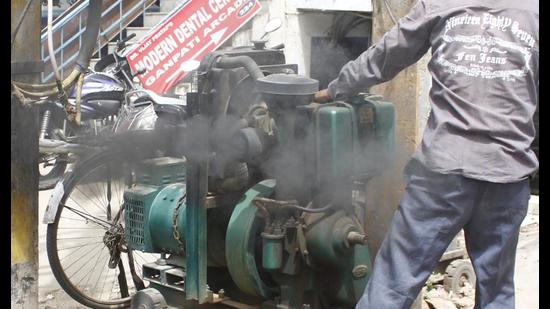
Diesel generator sets banned under Grap in Haryana
A day after the Central Pollution Control Board issued directions banning the use of diesel generator sets in the NCR, the Haryana State Pollution Control Board on Friday ordered all NCR districts of the state, including Gurugram, to follow the directions strictly


A day after the Central Pollution Control Board (CPCB) issued directions banning the use of diesel generator sets in the National Capital Region keeping in view the deteriorating air quality, the Haryana State Pollution Control Board (HSPCB) on Friday ordered all NCR districts of the state, including Gurugram, to follow the directions strictly.
S Narayanan, member secretary of HSPCB, said, “We have issued orders to all NCR districts to follow the directions as air quality is likely to dip to ‘very poor’ category by next week. On October 1, we directed the power department to ensure uninterrupted electricity supply to minimise the use of DG sets. No exemptions will be given as the power department has assured us that supply will be uninterrupted.”
The CPCB on Thursday banned the use of diesel generator sets and ordered enhancing of parking fee by up to four times in Delhi-NCR, measures listed under the Graded Response Action Plan (Grap) when the air quality hits ‘very poor’.
Though the air quality in Gurugram has been oscillating between ‘satisfactory’ and ‘poor’ categories over the past five days, pollution levels have increased fast during the period. On Friday, Gurugram recorded ‘poor’ air quality with an air quality index (AQI) value of 262, according to CPCB’s daily bulletin. Before this, the city reported ‘poor’ air quality on October 20, after which the air quality improved to ‘satisfactory’ on October 24, but again there was a sharp dip by Friday.
The CPCB order to enforce the implementation of Grap measures under ‘very poor’ category came after a meeting by a sub-committee of the Commission for Air Quality Management in Delhi-NCR and adjoining areas concluded that the air quality in Delhi-NCR is likely to reach ‘very poor’ category in the coming days. The committee also said that the minimum temperature is likely to drop to 14-15°C with increased moisture, which is unfavourable for dispersion of pollutants.
Besides ban on diesel gensets and increase in parking fee, other measures that will come into force include ban on the use of coal and wood in restaurants and open kitchens and augmentation of bus and Metro services. These measures will be in addition to the steps that were enforced on October 18 listed under ‘moderate to poor’ category such as ban on firecrackers, stopping burning of garbage, mechanised sweeping of roads, and sprinkling of water on unpaved roads, among others.
Meanwhile, officials from the Dakshin Haryana Bijli Vitran Nigam (DHBVN) said that they are prepared to give uninterrupted power supply to all residents in Gurugram. “We are trying to give uninterrupted power supply to all households across the district, except some areas where builders have not laid down the power infrastructure as per norms for providing connection and the issue is under consideration with the government,” said Naveen Kumar, chief engineer of DHBVN.
Sherebanu Frosh, a resident and member of Warrior Moms said, “Putting a ban on diesel generator sets just during the winters will not solve the problem. Stopping the use of diesel gensets can cause problems to elderly residents. The condominiums where such sets are used can get the latest tech devices fitted to the sets which can reduce pollutants by almost 80%.”
In December 2020, around 19 residential societies in both Gurugram and Faridabad were dependent on diesel generator sets for power supply, which was down from 209 in 2019. For this year, officials could not provide the numbers.
Stay updated with all the Breaking News and Latest News from Mumbai. Click here for comprehensive coverage of top Cities including Bengaluru, Delhi, Hyderabad, and more across India along with Stay informed on the latest happenings in World News.


