
 E-Paper



Fresh waste inflow hampers Bandhwari landfill clearance
Waste processing infrastructure in Faridabad is being overhauled as authorities move to reduce dependence on the Bandhwari landfill.

 Prefer HTon Google


Efforts to clear a 37-metre-high garbage mountain in Gurugram are being slowed by the continuous inflow of, what official say, is largely unprocessed waster from Faridabad.
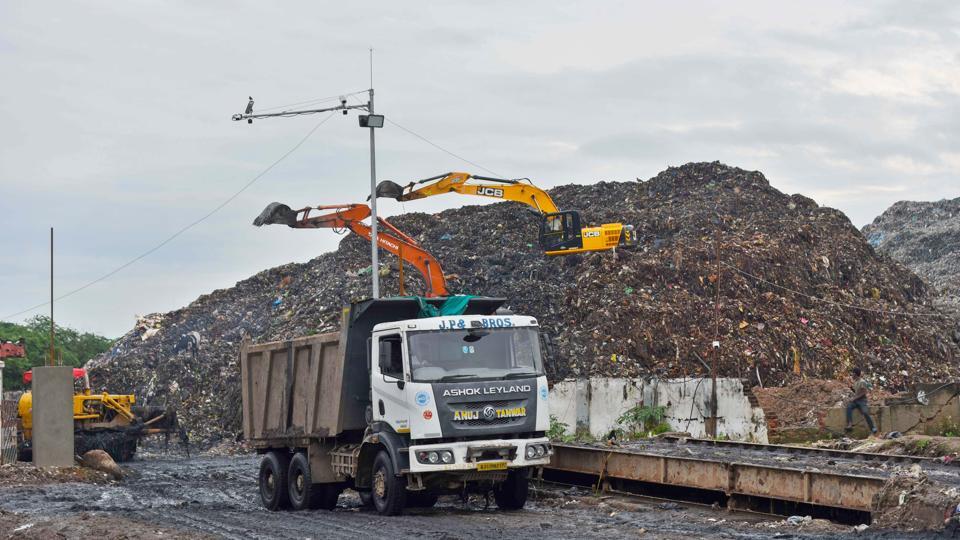
The Bandhwari landfill, which serves both Gurugram and Faridabad, currently holds about 1.66 million tonnes of legacy waste, according to municipal officials. Additionally, it receives an average of 2,200 tonnes of fresh municipal waste every day — about 1,200 metric tonnes from Gurugram and roughly 1,000 metric tonnes from Faridabad, according to municipal data.
Officials said this sustained inflow is offsetting part of the gains made through excavation and processing of old waste heaps.
However, they added that no timeline has yet been set for completion of legacy waste remediation at Bandhwari. The MCG had submitted a timeline to NGT last year to clear legacy waste by 2028 starting Jan 2026. MCG has already started the processing work.
A senior MCG official said Faridabad alone is sending about 600–700 metric tonnes. The waste from Gurugram and Faridabad are coming to Bandhwari of waste daily at present, compared to 600–800 metric tonnes earlier last year. “Faridabad’s civic agency needs to strengthen local processing. They should develop material recovery facilities, create their own landfill capacity and process waste locally. Refuse derived fuel (RDF), a type of fuel produced from municipal solid waste (garbage) and inert material should be channelled to paper mills and other users. Land must be identified and the process started,” the official said requesting anonymity, adding that the entire waste is sent unprocessed which is a challenge.
Faridabad municipal officials said they will look into the issue and will come up with a solution shortly. However, they did not clarify why the bulk waste remains unprocessed before being transported to Bandhwari.
To be sure, waste processing infrastructure in Faridabad is being overhauled as authorities move to reduce dependence on the Bandhwari landfill. The Municipal Corporation of Faridabad is rolling out a mix of decentralised, ward-level facilities and larger integrated waste-to-energy projects aimed at strengthening local processing capacity and easing the load on existing dumping sites.
The Bandhwari landfill site, long considered an environmental eyesore, has been a major concern for authorities and residents due to recurring waste piles, foul odour, and toxic leachate seeping into the ground and nearby water systems.
Official data from last month shows Bandhwari had about 3.04 million tonnes of waste as of January 2023. Between January and December 2023, about 606,000 tonnes of fresh waste was added, while another 584,000 tonnes tonnes reached the site between January 2024 and November 21, 2024. During the same periods, 1.65 million tonnes and 1.71 million tonnes of waste, respectively, were processed and disposed of. In total, about 3.37 million tonnes has been processed so far through bio-mining — excavation and mechanical separation of legacy landfill waste into reusable fractions — and segregation, officials said.
Officials added that multiple agencies are currently engaged at the site using trommel machines and segregation systems to scientifically process legacy waste and reduce the height of the dump.
“Our emphasis is not just on dumping but on continuous bio-mining and scientific disposal. Along with clearing old waste, we are also working on better treatment of fresh waste so the landfill load can be reduced in a planned manner,” a senior official said. Authorities said efforts to improve segregation, processing capacity and environmental safeguards are being scaled up alongside remediation work.

Stay updated with all the Breaking News and Latest News from Mumbai. Click here for comprehensive coverage of top Cities including Bengaluru, Delhi, Hyderabad, and more across India along with Stay informed on the latest happenings in World News.


