
 E-Paper



Gurugram Congress protests, seeks CEC resignation over poll process
Congress leaders Raj Babbar, Sanjay Dutt and Rao Narender Singh joined the Gurugram protest, while BJP’s Arun Yadav urged the party to introspect.

 Prefer HTon Google


The Gurugram unit of the Indian National Congress on Monday protested, demanding the resignation of chief election commissioner Gyanesh Kumar and an independent and impartial probe into what the party alleged were irregularities in electoral rolls and the election process.
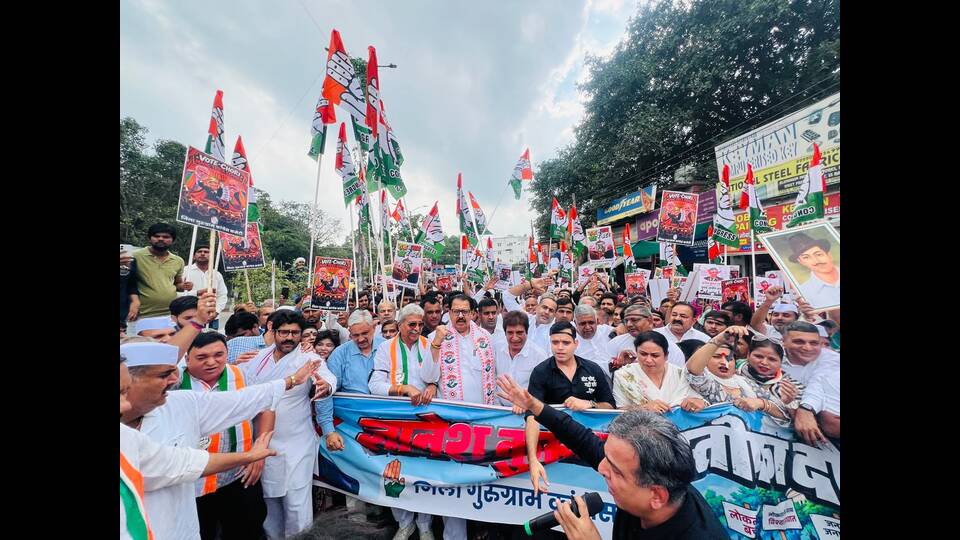
The demonstration was organised jointly by the Gurugram rural and urban district Congress committees and led by rural district president Vardhan Yadav and urban district president Pankaj Dawar. Haryana Congress in-charge Sanjay Dutt, Haryana Pradesh Congress Committee president Rao Narender Singh and former MP Raj Babbar participated in the protest.
Congress workers marched from the district Congress office at Kaman Sarai to Sadar Bazaar, carrying party flags, placards and an effigy of the chief election commissioner. They raised slogans against the Election Commission and the Central government and demanded greater transparency in electoral-roll revision, an independent investigation into the allegations raised by the party and accountability of the Election Commission.
Sanjay Dutt said the credibility and impartiality of the Election Commission were fundamental to public confidence in democracy. “The serious questions being raised about the Election Commission’s impartiality and credibility must be answered transparently,” he said. He demanded an independent, impartial and high-level inquiry into allegations and decisions concerning the electoral process, adding that if the investigation established criminal responsibility, action should be taken according to law.
Dutt also called for a review of decisions and electoral processes undertaken during the tenure of the chief election commissioner.
Rao Narender Singh referred to questions raised by Leader of Opposition in the Lok Sabha Rahul Gandhi regarding electoral rolls and the election process. He said allegations concerning voter-list revision, Form 6 and the Special Intensive Revision (SIR) process required impartial examination.
Singh said the Congress had raised concerns over the alleged deletion or addition of large numbers of names in voter lists and demanded that the Election Commission make relevant data and details of the process public. “The accuracy of the voter list is not merely a technical issue; it is a question linked to a citizen’s democratic right,” he said.
Former MP Raj Babbar said serious questions concerning the electoral process should receive a transparent and factual response, adding that public confidence could be maintained only when such allegations were examined transparently.
Vardhan Yadav said the protest was about voters’ rights and public trust in the democratic system. “Any alleged irregularity in the electoral process or voter list should be independently investigated, and the facts should be placed before the country,” he said.
Pankaj Dawar said, “There is no right greater than the people’s vote in a democracy.” He said the Election Commission should respond with facts to serious questions concerning electoral rolls or the election process and that the Congress would continue raising the issue through democratic means.
In response to the protest, Bharatiya Janata Party national co-convener Arun Yadav said Congress should first introspect over its own role in the 2024 Haryana defeat before alleging “vote chori (vote theft)”. He said the party should present evidence of electoral manipulation, but also address infighting, factionalism, ticket distribution and rebel candidates that were cited as factors in its defeat. “The protest should begin at home. Accountability should begin at home,” he said.
The protest was part of the Congress’s wider campaign over allegations concerning electoral rolls and the functioning of the election process. On August 21, 2026, Congress workers waved black flags at Haryana Chief Minister Nayab Singh Saini’s convoy in Gurugram’s Civil Lines area, leading to arrests, police suspensions and subsequent political protests.


Stay updated with all the Breaking News and Latest News from Mumbai. Click here for comprehensive coverage of top Cities including Bengaluru, Delhi, Hyderabad, and more across India along with Stay informed on the latest happenings in World News.


