
 E-Paper



Gurugram sees cleanest post-Diwali air in seven years: Experts
Experts attributed the cleaner post-Diwali air this year to two factors -- faster south-easterly winds and fewer stubble fires due to a rain-delayed harvest


Gurugram on Tuesday recorded the cleanest post-Diwali air quality since Central Pollution Control Board (CPCB) started measuring the Air Quality Index (AQI) in 2015, according to Central Pollution Control Board (CPCB) data --- a trend that was observed across NCR cities of Delhi, Noida, Ghaziabad and Faridabad.
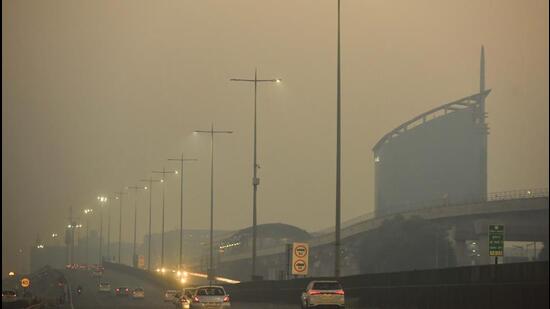
In Gurugram, the average air quality index on Tuesday was recorded at 292 (poor), better than the reading of 322 (very poor) recorded on Monday, the data shows.
This is in stark contrast to last year’s post-Diwali AQI on November 5 that was recorded at 472 (severe), as well as previous years’ post-Diwali AQI-- 425 (severe) on November 15, 2020, 372 (very poor) on October 28, 2019, 389 (very poor) on November 8, 2018, 397 (very poor) on October 20, 2017, 298 (poor) on October 31, 2016. There was no AQI data for Gurugram on the CPCB website during 2015.
An AQI reading between zero and 50 is considered “good”, 51 and 100 “satisfactory”, 101 and 200 “moderate”, 201 and 300 “poor”, 301 and 400 “very poor”, and 401 and 500 “severe”.
The Haryana government had banned the use of traditional firecrackers, but allowed use of green crackers. To be sure, administration and police enforcement teams clarified that they only received complaints regarding noise. No complaints about use of traditional firecrackers were received, they added.
Police said they received at least 100 noise complaints regarding the bursting of firecrackers. Preet Pal Sangwan, assistant commissioner of police (crime), said there were no reports of the violation of the ban on traditional crackers. “Only noise complaints were received. Necessary action was taken by police teams,” he added.
Experts attributed the cleaner post-Diwali air this year to two factors -- faster south-easterly winds and fewer stubble fires due to a rain-delayed harvest. They added that this year, Diwali did not coincide with the duration when the stubble fires are at their peak, like the case last year.
Faster winds, they added, helped disperse pollutants faster, and a sunny, warmer day on Tuesday aided in the dispersion of pollutant particles.
“Tuesday’s average AQI, which is a day after Diwali, was the cleanest in the last several years due to Diwali being celebrated between phases of stubble burning, clubbed with favourable meteorological factors,” said Sachin Panwar, a city-based air quality expert.
Panwar said that first phase of stubble burning takes place in mid-October, while the second phase takes place in early November in Haryana and Punjab.
“Due to this, pollutants from stubble burning and Diwali crackers didn’t combine to increase severity,” Panwar said.
He said the geographical topography of Delhi-NCR is like a bowl, due to which pollutants remain suspended in air in this region for a longer time. However, the wind direction changed to south and south-westerly from about 11.30pm on Monday at a speed of 10-15km per hour, due to which the pollutants could not accumulate in the region, thus improving AQI levels on Tuesday.
Several calls were made to Haryana State Pollution Control Board (HSPCB) officials for comment, but they didn’t respond.
Manmohan Singh, director of India Meteorological Department (Chandigarh), said that north or north-westerly winds are dry in nature, which is why they didn’t cause any haze and smog on Tuesday morning. “Wind from the same direction will continue to blow for the next 4-5 days,” he said.
Panwar said that the air quality from here on will continue to deteriorate till October 27, after which it will improve again for four to five days due to easterly winds but the respite would be temporary.
Stay updated with all the Breaking News and Latest News from Mumbai. Click here for comprehensive coverage of top Cities including Bengaluru, Delhi, Hyderabad, and more across India along with Stay informed on the latest happenings in World News.


