
 E-Paper



Gurugram set to float ₹402-crore waste collection tender after months of delay
The tender—part of a long-awaited overhaul of Gurugram’s waste management system—will open for bidding on Wednesday.


After months of delay, multiple revisions, and growing public outcry over mounting garbage across neighbourhoods, the Municipal Corporation of Gurugram (MCG) has received final approval to float a ₹402-crore door-to-door (D2D) waste collection tender.
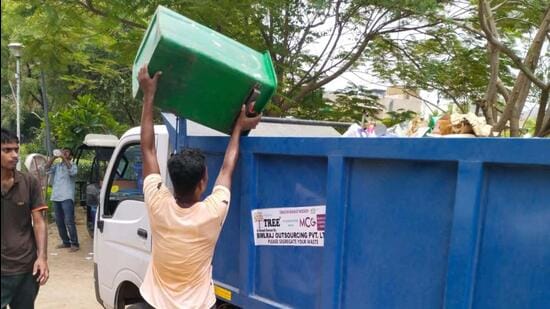
The tender—part of a long-awaited overhaul of Gurugram’s waste management system—will open for bidding on Wednesday. Civic officials confirmed that each selected agency will be given 21 days to apply and begin operations in their assigned zones by December 1. Officials said 90 days time is boarding time for the private agencies.
MCG commissioner Pradeep Dahiya told Hindustan Times that the file was cleared on Tuesday by Ankit Lohan, executive engineer-4 with the directorate of urban local bodies (ULB), Haryana. A copy of the approval letter, reviewed by HT, gives MCG the go-ahead to invite bids under its revised decentralised waste collection model.
“The city has waited long enough, and now we’re moving ahead with full force,” said Dahiya. “Four distinct agencies will be hired—one for each of the four city zones. This decentralised model will eliminate monopolies, encourage healthy competition, and ensure better accountability. We are expecting five tenders for the each.”
Dahiya said they will add 748 electric or CNG vehicles more for the waste collection and will add more each year.
The new ₹402-crore tender spans a five-year contract, extendable by two years based on performance. It includes key technological features such as GPS-enabled waste collection vehicles, QR code-based tracking, source-level segregation, real-time monitoring dashboards, and a grievance redressal system. Residents, importantly, will not be required to pay user charges directly. Penalties will be levied on contractors for service lapses.
The tender’s journey has seen several revisions. MCG initially proposed a two-agency model for the city, then a three-agency structure, before finalising the current four-zone system. Officials said the shift aims to distribute operational responsibilities evenly and reduce the risks of inefficiency or collusion. “One agency per zone means no firm can dominate the entire contract. This ensures efficiency and reduces risk of collusion,” Dahiya said.
The urgency stems from a sanitation crisis that followed the expiry of the city’s previous D2D contract on June 15. In the absence of a long-term replacement, MCG scrambled to implement an interim plan. The state’s ULB department approved the emergency hiring of 400 light commercial vehicles (LCVs) on June 8 for a six-month stopgap period—100 vehicles per zone—to manage daily waste collection. However, residents continued to report erratic or non-existent garbage pick-up in many areas, prompting fresh criticism of MCG’s handling of the issue.
“The sanitation issue was flagged as a priority, and I pressed for urgent action,” said Dahiya, who has faced growing pressure from civic groups and RWAs over the deteriorating cleanliness standards in the city. “The new model will be strictly monitored, and lapses will be penalised.”
To strengthen oversight, MCG also set up a dedicated sanitation cell on June 23 under additional commissioner Ravinder Yadav. The unit is responsible for supervising not only D2D collection but also road sweeping, legacy waste clearance at Bandhwari, and management of construction and demolition (C&D) debris.
The tender release this week marks a critical turning point. MCG officials say they aim to transition from temporary measures to a structured, citywide waste management system by the end of August.
Meanwhile, the ULB department has also updated its solid waste management policy. Contract durations have been revised from seven to five years, with an optional two-year extension based on performance reviews—bringing consistency across municipal bodies in the state.

Stay updated with all the Breaking News and Latest News from Mumbai. Click here for comprehensive coverage of top Cities including Bengaluru, Delhi, Hyderabad, and more across India along with Stay informed on the latest happenings in World News.


