
 E-Paper



Gurugram Ward 7 no-man’s land for civic agencies after houses creep up on IAF depot
Residents said that the IAF’s previously requested boundary of 900 metres included even parts of Sectors 14 and 17

 Prefer HTon Google


A section of the 250,000 residents of Gurugram’s Ward 7 face a problem not shared by those of most other wards — their houses may be demolished over national security concerns.
And the reason is an ammunition depot of the Indian Air Force, located adjacent to the ward. For security reasons, the Air Force would prefer there be no construction within 300 metres of the depot’s peripheral boundary, and that the area in question be placed under their control.
However, a large number of houses have come up on the land in question in the past two to three decades. The affected 269 houses, according to civic officials, comprise Block C and part of Block A in Sanjay Gram, home close to at least 2,000-3,000 people. The IAF wants the state government to demolish these houses and hand over the land to them, but the residents have got a stay from the Punjab and Haryana high court on any coercive action. The court has said that only those houses within 100 metres of the depot’s boundary wall will be demolished. The case is under litigation in the Supreme Court.
When the IAF ammunition depot was built, there were no constructions around. But slowly constructions began coming up around it which the state government authorities failed to check.
The IAF had initially wanted 900 metres of land from the peripheral boundary to be clear of any construction but later, it reduced the distance to 300 metres as restricted zone. But the owners of the houses falling in the 900-metre range are yet to geta no-objection certificate from the ministry of defence due to a three-decade-old litigation.
Deputy commissioner Nishant Kumar Yadav acknowledged the challenges faced by the residents and said the authorities are trying to address them. “We are fully aware of the difficulties that the residents of Ward 7 are facing due to the high court stay and the resulting lack of development. While the legal constraints limit our ability to initiate new projects, we have already identified the key issues, including the poor sanitation services and deteriorating road conditions. Continuous efforts are being made to improve the situation, and the concerned teams have been directed to ensure that these problems are addressed at the earliest possible opportunity,” Yadav said.
MCG commissioner Narhari Singh Bangar said, “We are implementing measures to improve waste collection services and ensure that sanitation in Ward 7 is brought up to acceptable standards. MCG is committed to working diligently to resolve these problems and provide the residents with a cleaner and healthier environment.”
Unending litigation and uncertainty
There are 200 to 240 houses in Sanjay Gram, of which most of those in Block C are within 300 metres of the boundary of the IAF ammunition depot. Residents said that the IAF’s previously requested boundary of 900 metres included even parts of Sectors 14 and 17.
Sanjay Gram residents said that in the past three decades, several ministers visited the locality, including sitting MP Rao Inderjit Singh, with a promise to get the issue resolved, but still there is no solution in sight.
SS Tripathi, a Sanjay Gram resident, said Municipal Corporation of Gurugram (MCG) officials and contractors in the field are exploiting the situation and don’t allow any construction work. “However, they take illegal gratification from those barred from carrying out the construction work and permit them to illegally do the same,” he said, adding that it’s a financial burden for residents who have been contesting the matter in the courts for decades.
He said it would had been helpful if the Haryana and the central government could have amicably resolved the situation.
Residents pool money to build roads
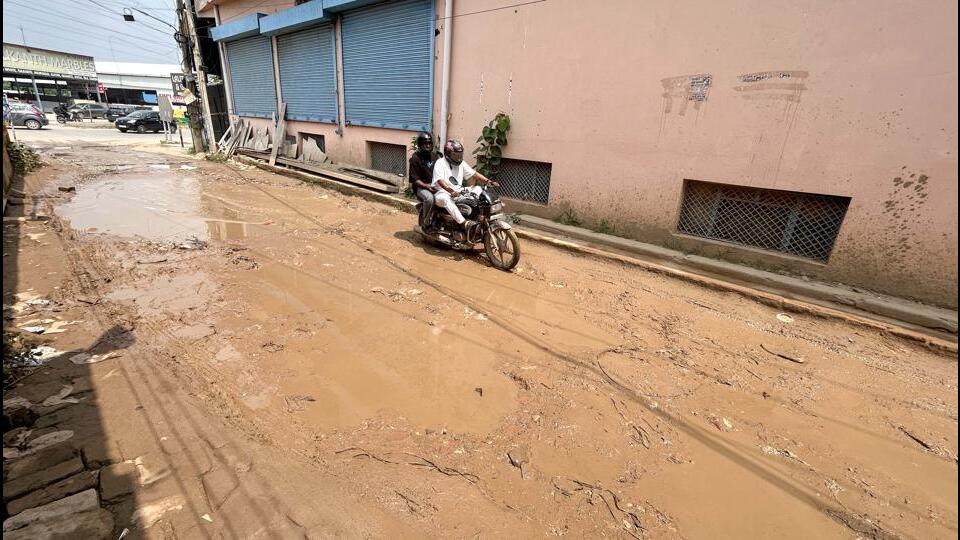
Tripathi said that MCG or Gurugram Metropolitan Development Authority (GMDA) officials have never seriously considered their area for infrastructure development, probably due to their litigation with the defence ministry and the IAF. “The condition of our area’s roads was poor in the past. Four to five years back, we pooled money by collecting ₹10,000 to ₹25,000 from every homeowner and built our own road,” he said.
Tripathi said that there were still some internal roads in bad shape and remain waterlogged most of the time. “There is no water supply crisis as we have at least nine pumps which run for all the residents in the three blocks of Sanjay Gram. Power supply is also uninterrupted, except for some outages in summers,” he added.
Roy Syriac, another resident, said that the sewage system was constructed with the help of former minister Sukhbir Kataria six years ago. “There were severe issues in our area but we do not depend on civic agencies for repair or development. We pool money and carry out the required work immediately,” Syriac said.
Improper waste collection
Aside from the litigation over the IAF land, Sanjay Gram, and neighbouring Rajiv Nagar, face a severe sanitation problem. Residents said that MCG sanitation workers hardly ever collect garbage on time from their areas.
They said that the household waste generated everyday is collected and dumped at a designated site on the main road for collection by MCG but instead, it keeps lying there for days.
They said that the roads and pavements are hardly swept by MCG sanitation workers. An HT spot check on Monday found the main road of the ward that connects with the Old Delhi-Gurgaon Road severely littered with garbage.
Residents clean sewers
Rajiv Nagar residents alleged that they were forced to clean the sewers on their own, 10 years after they had collected money to lay the sewer lines. The population of a few hundred then has increased and the existing drainage infrastructure is unequipped to deal with the increase in population. They said that the four-inch-wide sewer pipeline get clogged repeatedly and the person in front of whose house a manhole is present takes the responsibility to clean it several times a week to prevent waterlogging.
When HT visited the spot, Suraj Kumar, a 61-year-old resident of Rajiv Nagar lane number one, was trying to open the manhole in front of his house to clean the clogged sewer.
“We are helpless. MCG never cleans these clogged sewers. Before the area gets inundated with sewer water, I clean it to avoid waterlogging in front of my house,” Kumar said, adding that large-scale mosquito breeding occurs in their area.


