
 E-Paper



MCG, Gurujal plan pilot urban forest based on Miyawaki method
Gurujal has shortlisted at least 10 available open spaces in the city where a pilot project — to test the feasibility of this proposal — will begin later this year, officials privy to the matter confirmed.

 Prefer HTon Google


The Municipal Corporation of Gurugram (MCG) and the district administration’s Gurujal society are planning to develop an urban forest in the city using a technique developed by Japanese botanist Akira Miyawaki, whose methods have been gaining popularity across India. Gurujal has shortlisted at least 10 available open spaces in the city where a pilot project — to test the feasibility of this proposal — will begin later this year, officials privy to the matter confirmed.
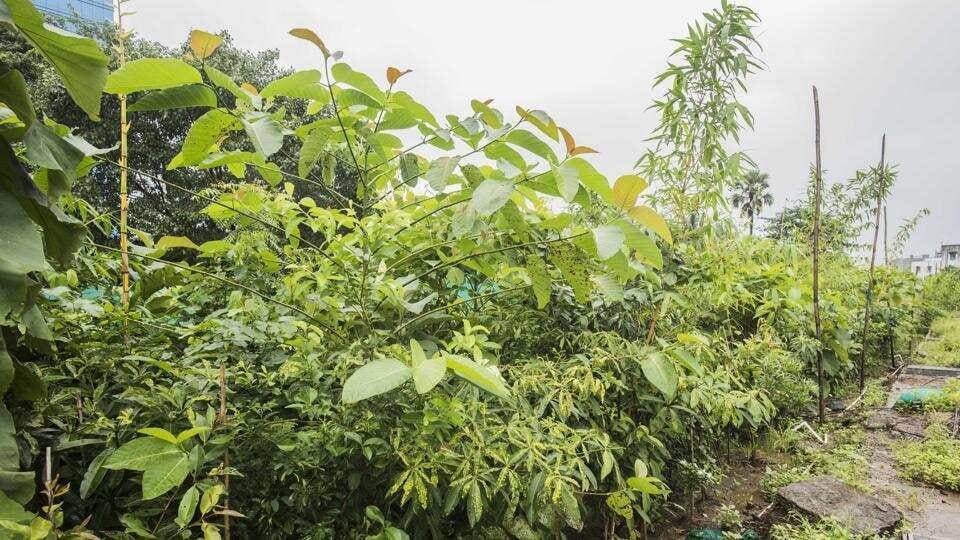
The Miyawaki method is heavily dependent on enhancing soil quality by first digging up the earth, and then pouring in large amounts of compost and natural material such as rice husk, which help retain water. Saplings (or seeds) are then scattered close together, forcing plants to compete with one another for space and sunlight, resulting in a green cover that can be up to 30 times denser and 10 times taller than traditional plantations.
The use of native vegetation — with emphasis on four to five dominant species — is a key feature of this method, that also requires a careful, pre-emptive analysis of local agro-climactic conditions.
“We have surveyed about 10 locations where we can test this concept. The most suitable so far is a two-acre plot owned by the MCG in Sector 109. We had started plantation work there last year to develop a city forest, but the saplings did not survive. Now, the area is under consideration for this Miyawaki forest. We are in talks with a Bengaluru-based organisation that has done multiple projects using this method, and will be finalising timelines soon,” said Anjali Singh, community outreach coordinator, Gurujal.
Officials said that the proposal is only in a preliminary stage, and that greater proof of concept is required before full-scale plantation work can begin. “The Miyawaki method is much more expensive than traditional plantation, and requires close monitoring and regular maintenance for the first three to four years. After that, the forest becomes self-sustaining. We will need to first do a small scale experiment if this can be done in Gurugram,” said Singh, adding that no specific plans or budgets have been detailed for the final project as yet.
Miyawaki horticulture has been gaining popularity in India in recent years due to the tall, dense vegetation that it can be created in a relatively small amount of time. NGOs, as well as urban local bodies in Karnataka, Maharashtra, Telangana and Tamil Nadu, have all launched their own Miyawaki plantations in the last three to four years, though privately developed plantations — such as those on institutional campuses — have used this approach earlier.
Vijay Dhasama, an eco-restoration practitioner who helmed the development of Gurugram’s Aravalli Biodiversity Park, likened the Miyawaki method to “gardening on steroids”. “This process can be very expensive, touching almost ₹12 lakh just for completing plantation work on a single acre of land, as per my own rough calculations. The plants need to be fed and monitored constantly. This sort of intensive horticulture would not be well suited for dry-deciduous forest ecosystems that are native to Gurugram. The term Miyawaki ‘forest’ is a misnomer. These are not natural forests,” he said.
Dhasmana also said that it is too early to declare India’s Miyawaki forests — for which there is no official count — as a success story. “These plantations will be self-sustaining only if there are enough resources available for them to grow. Such resources, such as good soil and water, are constantly under threat in urban settings. There are also no long-term studies done, specifically in India, which show that the Miyawaki method provides any more ecological benefit than others. On the contrary, its popularity seems to be driven more by the perceived aesthetic value of tall plantations,” he said.


