
 E-Paper



Narnaul’s 16th-century Jal Mahal reservoir restored after nearly a decade
Officials are exploring evening musical performances and cultural events, subject to approvals, while the ASI will oversee future water-body upkeep.

 Prefer HTon Google


After remaining dry for nearly a decade, Narnaul’s historic Jal Mahal has once again been surrounded by water, restoring a defining element of the 16th-century monument’s original setting and strengthening plans to develop it as a major heritage and cultural tourism destination in southern Haryana.
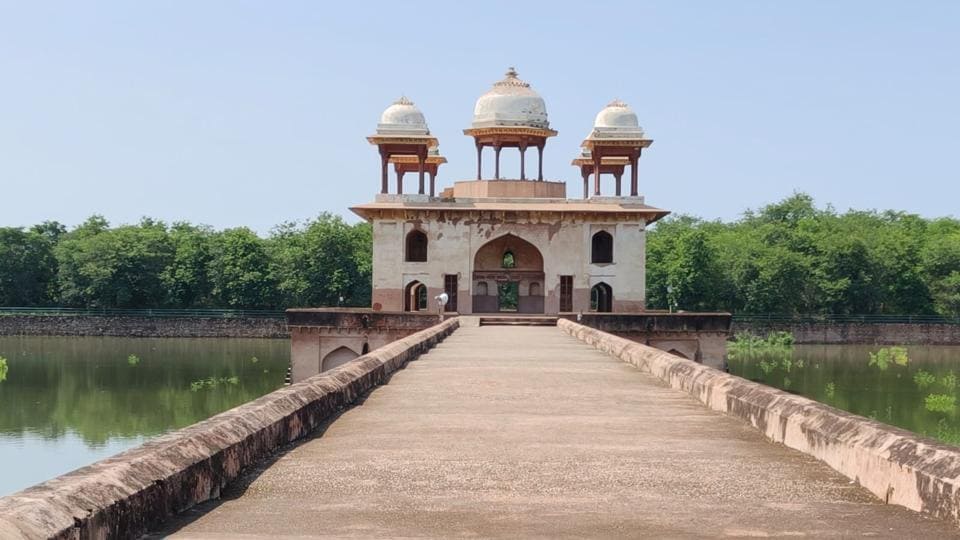
The revival was undertaken through coordinated efforts of the Buildings and Roads (B&R) and Irrigation departments of the Haryana Government, with the main restoration work beginning in 2023-24 and concluding last year. The project, which cost approximately ₹70 lakh, included restoring water channels, improving surrounding infrastructure and constructing a protection wall and boundary wall with grills around the water storage structure. The protection wall and boundary wall were constructed in 2023, while minor repairs, plastering and flooring work had also been carried out five to six years earlier. To fill the reservoir to a depth of five feet, around 170 million litres of water, sourced from rainwater and an irrigation canal, was used, officials added.
Mahendragarh deputy commissioner Anupama Anjali described the revival as an important step towards establishing Narnaul as a prominent heritage destination. “The revival of Jal Mahal marks a key milestone in positioning Narnaul as a premier heritage hub. The restoration of the water body has brought back an important element of the monument’s original character and will significantly enhance the visitor experience. We are also looking at ways to make the site more engaging for visitors while ensuring that its historical integrity is fully respected,” she said.
Anjali said the administration was exploring cultural programmes at the monument. “Subject to the necessary departmental approvals, we plan to introduce evening musical performances and cultural events within the complex. The objective is to offer visitors an immersive heritage experience while respecting the monument and following all necessary conservation and visitor-management protocols,” she said.
Commissioned in 1591 AD by nawab Shah Quli Khan, governor of Narnaul during Mughal emperor Jalal-ud-Din Muhammad Akbar’s reign, Jal Mahal was designed as a royal pleasure pavilion surrounded by water. The monument is officially designated as a Monument of National Importance and is protected by the Archaeological Survey of India (ASI). The ASI will be responsible for maintaining the water body and funding its future upkeep, officials told HT.
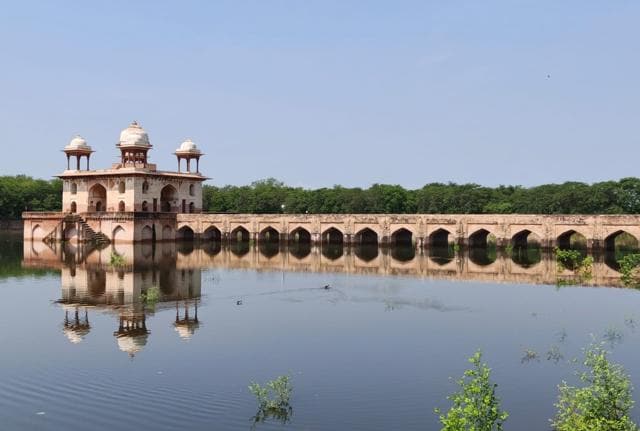
The reservoir was also part of a traditional water-management system in which monsoon runoff was channelled along natural slopes into the central basin. Archaeologist Dr Banani Bhattacharyya, Program Manager, Haryana Heritage Museum, Raahgiri Foundation and former Deputy Director, Archaeology & Museums Department, Haryana, said its revival was significant beyond its visual impact. “The Jal Mahal of Narnaul, a centrally protected 16th-century monument, has witnessed a significant revival after nearly a decade, with its historic reservoir once again filled with water. The monument embodies the historic relationship between traditional architecture, water management and the cultural landscape of Narnaul, forming an integral part of the region’s broader water-heritage continuum,” she said.
Bhattacharyya said the restored water body could support heritage walks, traditional performances and educational programmes, provided they followed scientific conservation and visitor-management principles. She added that Narnaul’s nearly 16 state- and centrally protected monuments, including havelis, baolis, palaces and water structures, offer potential for a comprehensive heritage and water-heritage circuit.
“The refilling of the Jal Mahal represents more than an aesthetic restoration—it marks the revival of a historic landscape and the renewal of Narnaul’s collective cultural memory,” she said.
The monument features a causeway supported by 16 arched bays, an ornamental northern gateway with historic guard quarters, a square central hall, double-storey corner chambers, a large octagonal dome and semi-circular cupolas.
Kala Ramachandran, former principal secretary, Haryana Tourism, said sustained upkeep would be crucial. “Conservation is not a miracle; it is discipline. If we keep practising it, the city and its heritage will not decay again,” she said.
Anjali urged visitors to treat the site as a protected heritage asset. “This is a national treasure, and its preservation is a shared responsibility. Visitors should maintain cleanliness, follow safety instructions and ensure that no damage is caused to the historic structure. People can enjoy the restored landscape and its beauty, but they must maintain a safe distance from the water,” she said.
The administration is considering measures to strengthen visitor management and interpretation. Bhattacharyya said sustaining the revival would require scientific monitoring of structural stability, water quality, seepage, vegetation and visitor impact.


Stay updated with all the Breaking News and Latest News from Mumbai. Click here for comprehensive coverage of top Cities including Bengaluru, Delhi, Hyderabad, and more across India along with Stay informed on the latest happenings in World News.


