
 E-Paper



Potholes, debris, and traffic masks Gurugram’s ‘premium’ Golf Course Extn Rd
The road is a stark reflection of Gurugram’s collapsing infrastructure where the cost of real estate climbs relentlessly while the quality of civic life falls.

 Prefer HTon Google


Golf Course Extension Road (GCER), once branded as the city’s premium corridor promising smooth connectivity and luxury living, has today become the face of Gurugram’s urban decay. Pothole-ridden stretches, overflowing sewage, piles of construction debris, and broken street lights have turned it into one of the most unsafe and unlivable routes in the city.
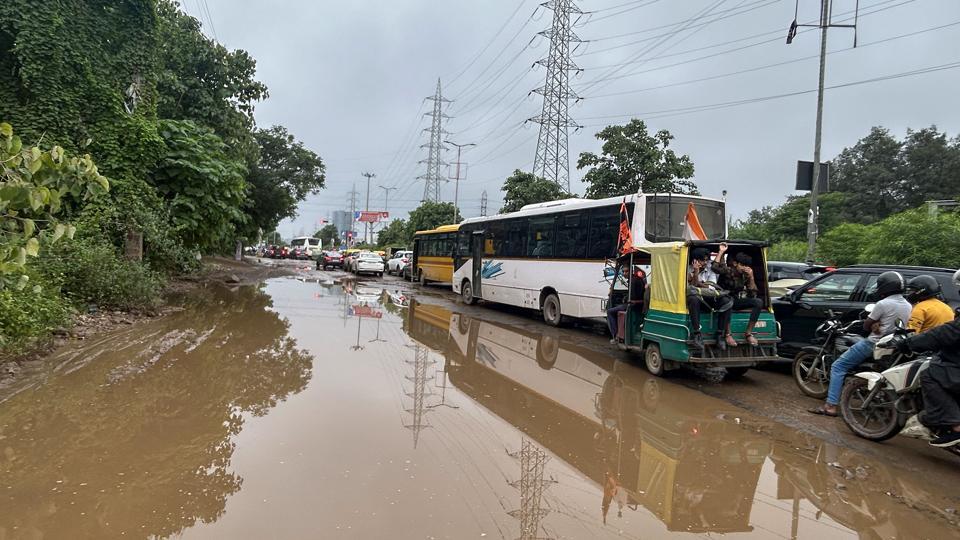
For hundreds of commuters and residents of the upscale condominiums lining the road, the daily ordeal has gone from inconvenience to outright danger with vehicles breaking down, rising accidents, and commuting during the monsoon, making it a game of survival.
The story of GCER is not just about one road. It is a stark reflection of Gurugram’s collapsing infrastructure where the cost of real estate climbs relentlessly while the quality of civic life falls.
Residents voice frustration
“Golf Course Extension Road is a perfect example of infrastructure neglect and lack of administrative will. Despite national guidelines under the Graded Response Action Plan (GRAP) plan which specifically call for dust management, this corridor remains buried under debris and sand. These massive hills of construction waste are not just ugly, they make the soil impervious to water absorption, leading to waterlogging and worsening the potholes. Authorities act only after disasters. When will citizen welfare finally become a priority?” asked Ruchika Sethi Takkar, a resident of Nirvana Country.
Lt Gen J.K. Sharma (retd), a resident of The Hibiscus in Sector 50, described the road as a “death trap.” He said, “The four-lane road has been reduced to a single-lane nightmare. Truck-sized potholes swallow up smaller vehicles and two-wheelers are at constant risk of toppling. With heavy rains, the road from Vatika Chowk to Sector 56 is submerged on one side. To make it worse, the south bank of the road doesn’t even have a drainage line. Who approved such a road without basic drainage? Why has no one been held accountable?”
Maj Gen Yash Mor (retd), another Sector 50 resident, echoed the concern: “This is supposed to be an arterial road connecting new sectors, premium projects, and thousands of families. Instead, it has become the worst-maintained stretch in the city. Half the road is waterlogged, garbage dumps line the sides, and sanitation has collapsed. If GCER—supposedly a flagship corridor— can be allowed to decay like this, what hope does the rest of the city have?”
The condition of the road has had a direct impact on commuter safety. Nilesh Tandon, president of Fresco Apartments RWA in Sector 50, said, “We have seen multiple two-wheeler accidents in the past two months. Riders skid over water-filled potholes, cars lose control, and bumpers and suspensions are getting damaged daily. Some residents have even suffered fractures. It is appalling that one of Gurugram’s most expensive addresses cannot guarantee a safe commute for its people.”
For daily commuters like Nitin Sirohi of Sector 66, the frustration runs deeper. “We bought homes here with the promise of premium living, but what we face is the opposite. Instead of green belts, we see garbage piles leaking toxic waste into the ground. Instead of wide, smooth roads, we drive through cratered potholes and waterlogging, risking our vehicles and lives. It feels like we are living in reverse development,” he said.
Governance failure and political blame game
Residents are not just frustrated by the state of the road but also by what they see as chronic governance failures. Lt Gen Sharma added, “Every monsoon, we hear claims from ministers making Gurugram pothole-free by September 15. It never happens. The city is mocked as ‘Gurujam’ instead of Gurugram, and no one in power seems to care.”
Businessman and columnist Suhel Seth, who has been vocal on Gurugram’s urban decay, summed it up saying, “The government apathy is glaring with no immediate relief in sight. Citizens continue to pay the price while the system remains unaccountable.”
Authorities respond with assurances
On its part, the Gurugram Metropolitan Development Authority (GMDA) has promised action. Arun Dhankar, chief engineer, GMDA, said, “Filling of potholes and rectification work is already underway. Priority stretches are being taken up through patchwork and granular sub-base (GSB) filling to provide immediate relief. Once weather conditions improve, we will lay a bituminous layer for durability. GMDA is committed to ensuring motorable and safe roads for commuters.”
Meanwhile, the Municipal Corporation of Gurugram (MCG) commissioner Pradeep Dahiya inspected the road on Tuesday. He directed teams to intensify cleaning drives, clear waterlogged patches, and remove debris heaps. “We are working on a priority basis to restore cleanliness and sanitation. Continuous inspections will be carried out until the situation is under control,” he said.
A city in regression?
For the ordinary resident, however, these promises sound all too familiar. The daily struggle with potholes, broken roads, overflowing drains, and choked traffic signals has made life in Gurugram increasingly hazardous. The larger concern is not just about infrastructure gaps but about accountability.
“Why is it that a city with some of India’s costliest real estate cannot even guarantee safe commuting during monsoons?” asked Sharma. “If GCER, once hailed as the city’s future, has fallen apart like this, what does that say about the future of Gurugram itself?”
The road ahead
The Golf Course Extension Road stands today as a cautionary tale of what happens when rapid urban expansion is not matched with robust civic planning. Unless long-term, systemic solutions are implemented—not just patchwork after every monsoon. Residents warn that Gurugram risks sliding into deeper civic collapse.
As one frustrated commuter put it at Vatika Chowk, “We wanted a millennium city, but all we got is Gurujam.”

Stay updated with all the Breaking News and Latest News from Mumbai. Click here for comprehensive coverage of top Cities including Bengaluru, Delhi, Hyderabad, and more across India along with Stay informed on the latest happenings in World News.


