
Residents seek control of sanitation services in Gurugram’s Sector 45
Stating that the sector has remained in disarray for several years despite repeated complaints, residents alleged that services by the current agency — despite being paid over ₹7 lakh — are “grossly inadequate” and do not justify the expenditure of public funds
The Residents’ Welfare Association (RWA) of Sector 45 has submitted a request to the Municipal Corporation of Gurugram (MCG) seeking control of sanitation services in the area citing prolonged neglect by the MCG-appointed agency to maintain the cleanliness.
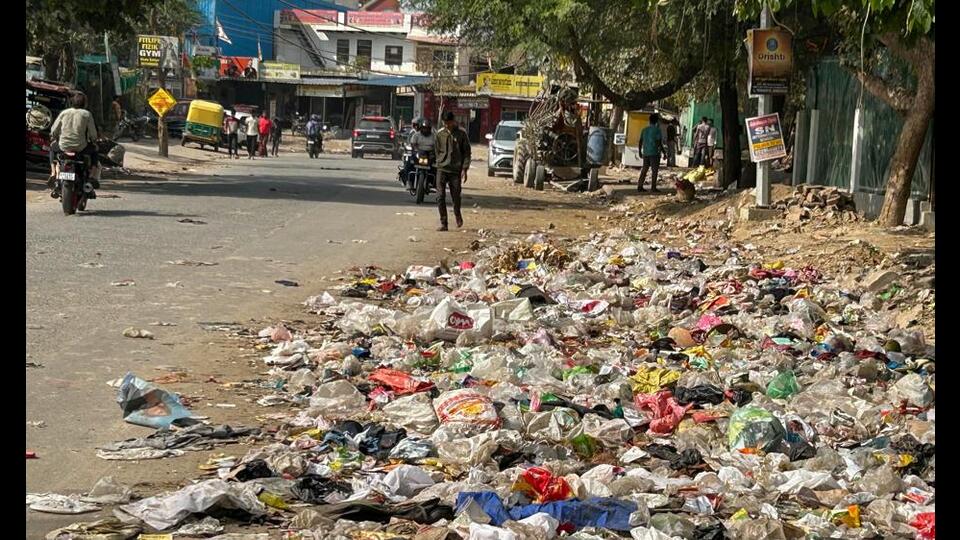
“The condition is very bad and it is not fair to live in filth. There is no sanitation in the area. Sector 45 has been neglected for years. We have been forced to employ private cleaners to keep our streets liveable. How long can residents continue to bear the burden of a service they already pay for through taxes?” Om Prakash Yadav, RWA president of the sector said.
Stating that the sector has remained in disarray for several years despite repeated complaints, residents alleged that services by the current agency — despite being paid over ₹7 lakh — are “grossly inadequate” and do not justify the expenditure of public funds.
The RWA, in its letter to MCG commissioner Pradeep Dahiya, also requested to halt all payments to the agency and has decided to deny the entry of the sanitation staff until an overhaul is initiated. They have also attached a petition signed by over 700 residents and a USB drive containing photographs of unhygienic conditions in the area.
“This is not a spur-of-the-moment move. We first submitted our concern on September 1, 2023. Since then, there have been multiple meetings — including one with United Gurugram RWAs where a framework was proposed for handing over sanitation responsibilities to registered RWAs. Unfortunately, there has been little progress,” Puneet Pahwa, general secretary of the RWA said.
Dahiya acknowledged the concerns and welcomed the RWA’s approach. “We are reviewing the proposal positively. If an RWA demonstrates the capacity and willingness to maintain sanitation standards better than existing arrangements, we are open to working with them,” he said. “Our objective is to ensure cleaner neighbourhoods, and any workable, citizen-driven model that supports this goal will be considered on merit.”
ABOUT THE AUTHORLeena DhankharLeena Dhankhar is Senior Editor and Bureau Chief, Gurugram, at Hindustan Times, where she has spent over 17 years chronicling the transformation of one of India's fastest-growing urban regions. From starting her career as a crime reporter to leading the Gurugram bureau, her journalism has been defined by investigative reporting, in-depth storytelling and an unwavering focus on public interest. Over nearly two decades, she has reported extensively across crime, politics, civic governance, elections, real estate, environment, courts, sports, education and entertainment, covering Gurugram, Faridabad, Nuh and Palwal. Her reporting has exposed several major scams and systemic failures, including insurance frauds, waste management irregularities, illegal arms manufacturing units in Nuh, illegal mining in the Aravallis, organised crime networks and governance lapses affecting millions of residents. Known for her investigative work and exclusive stories, Leena has reported on high-impact national issues, including the Nicaragua charter flight carrying Indian migrants that was turned back amid allegations of human trafficking, exposing the growing network of illegal immigration rackets. Her work has also focused on gang wars, prison administration, juvenile crime, women and child protection systems, the functioning of the Juvenile Justice Board and Child Welfare Committee, and environmental challenges such as pollution, waterlogging and deteriorating civic infrastructure. Beyond hard news, Leena has extensively documented Haryana's rich heritage, forests and wildlife, bringing attention to the state's historical landmarks, biodiversity, conservation efforts and ecological challenges through immersive reportage and feature writing. Her journalism has consistently gone beyond breaking news. She has documented Gurugram's rapid urbanisation through long-form narratives and enterprise reporting on issues ranging from pothole-ridden roads, flooding and waste management to the changing social fabric of India's Millennium City. She also writes widely read feature columns, including The Outsider, Changemaker, and Concern for Gurugram, profiling people, places and ideas shaping the city's identity. Leena is the author of Gurugram School Murder, published by Juggernaut Books, a deeply reported account of one of India's most high-profile school murder investigations. She is currently working on her second book, an investigative work exploring some of India's most significant scams and fraud investigations. Beyond print journalism, she has expanded her storytelling through public speaking and digital media. She is a TEDx speaker and has produced podcasts exploring Gurugram's transformation, civic challenges and untold stories. Her work reflects a commitment to narrative journalism that combines rigorous reporting with compelling storytelling. A law graduate with an MBA in Human Resources, Leena brings a multidisciplinary perspective to her reporting, particularly on governance, public policy and legal affairs. She has travelled extensively across India to pursue investigative assignments, often reporting from remote locations and conflict-prone areas in search of stories that matter.Read More
Stay updated with all the Breaking News and Latest News from Mumbai. Click here for comprehensive coverage of top Cities including Bengaluru, Delhi, Hyderabad, and more across India along with Stay informed on the latest happenings in World News.

E-Paper


