
 E-Paper



After Mahakumbh, Magh Mela to draw 12-15 crore pilgrims: Yogi Adityanath
Uttar Pradesh CM Yogi Adityanath reviews preparations for annual religious fair in Prayagraj, asks officials to ensure timely completion of work

 Prefer HTon Google


After the success of the Prayagraj Mahakumbh 2025, the Magh Mela 2026 is expected to draw nearly 12 to 15 crore (120-150 million) pilgrims, chief minister Yogi Adityanath said as he reviewed preparations for the annual religious congregation here on Saturday.
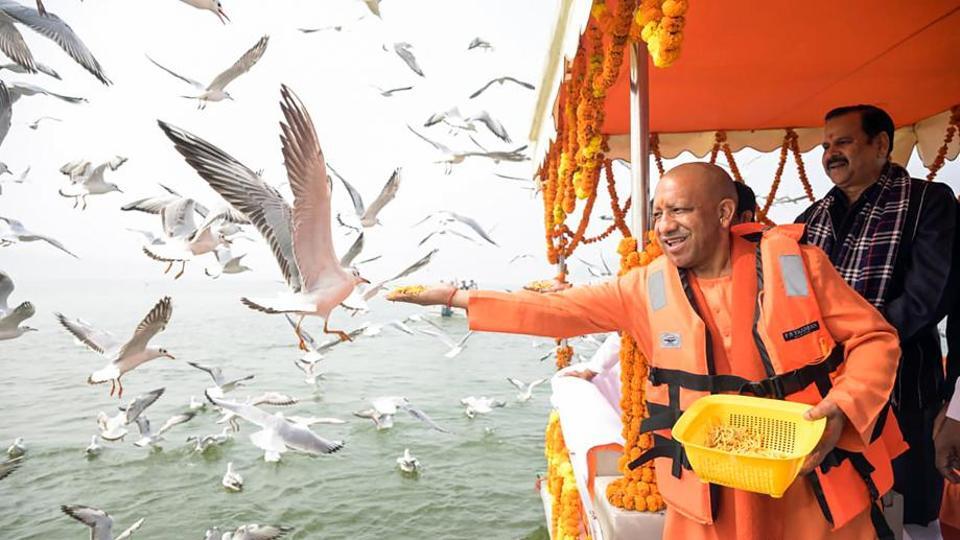
The arrival of 20- 25 lakh pilgrims is likely daily during the nearly one-and-a-half month-long Magh Mela that will begin on the occasion of Paush Purnima on January 3 and conclude with the Mahashivratri snan on February 15, the chief minister said.
The fair will be spread across 800 hectares and divided into seven sectors, with 42 designated parking areas for visitors arriving through different routes.
The Magh Mela is held annually at Sangam, while the Mahakumbh is organised once every 12 years. According to UP government estimates, over 66 crore (660 million) pilgrims visited the Mahakumbh 2025. This is the first Magh Mela after the Mahakumbh 2025.
During the review meeting, the chief minister directed officials to ensure timely completion of all work. All arrangements for the fair were progressing rapidly, he stated.
The major bathing dates are: Paush Purnima on January 3, Makar Sankranti on January 15, Mauni Amavasya on January 18, Basant Panchami on January 23, Magh Purnima on February 1 and Mahashivratri on February 15. A large influx of pilgrims is expected between January 3 and February 1. Around 20 to 25 lakh Kalpavasis are also expected to stay at the Mela for an entire month, observing penance and performing religious rituals.
The chief minister said the government has established the Prayagraj Mela Authority, headed by the divisional commissioner, to oversee the Magh Mela, Mahakumbh, and related events.
Preparations for the 2026 Magh Mela have already commenced with arrangements being scaled up further compared to the 2024 event. The chief minister added that the team had gained valuable experience from organising the Mahakumbh 2025, which left a lasting impression globally and further strengthened pride in India’s Sanatan cultural traditions.
Efforts were underway to maintain a minimum continuous supply of 10,000 cusecs at the Sangam. Namami Gange has also been assigned the responsibility for water purification.
The Power Corporation has also started working to provide uninterrupted electricity.
The chief minister added that the public works department will manage external and internal road connectivity. To ensure smooth traffic flow, seven pontoon bridges will be constructed, and checkered plates will be installed along a 160-km route. The UP Jal Nigam is laying 242 km of drinking water pipelines, of which 85 km has already been completed.
He further said two fully equipped 20-bed hospitals were being constructed to provide immediate medical care to pilgrims during the Magh Mela. In addition, twelve Public Health Centers (PHCs) will function as primary health facilities. A vector control unit will also be deployed, along with five Ayurvedic and five Homoeopathic hospitals, and 50 ambulances will be available to ensure a timely medical response.
He stated that the urban development department had initiated work to ensure adequate sanitation and lighting across the mela area. During the event, 25,000 toilets, 8,000 dustbins, over 10 lakh liner bags, 20 suction vehicles, and 3,000 sanitation workers will be deployed to maintain hygiene and cleanliness.
Uttar Pradesh Police has made extensive arrangements to ensure safety and smooth crowd management, he added. Along with the superintendent of police for the mela, additional SPs, COs, inspectors, and other police personnel have already been deployed in the first phase, with the remaining arrangements in progress. Police facilities are being strengthened with expanded police lines, 17 police stations, 42 police posts, 20 fire tenders, seven fire stations, 20 fire watch towers, a dedicated water police station, one main water police control room, and four sub-control rooms. Additionally, eight km of deep-water barricading will be installed to ensure safety along the river banks.
The chief minister also stated that the urban development department will monitor crowd movement, density patterns, and safety incidents using 400 CCTV cameras equipped with AI technology. He directed officials to prepare an integrated inter-district and interstate traffic and crowd management plan.
Approximately 3,800 buses, including 3,000 operated by the Uttar Pradesh State Road Transport Corporation, will be deployed. Seventy-five shuttle buses will operate within the Mela area, and electric buses will be available to facilitate movement between the city and the Mela area. Two hundred buses will be kept on standby. A tent city is also under construction to accommodate pilgrims and visitors.


