E-Paper



Chota Imambara’s gates to get a new lease of life
Restoration of neglected gates of Chota Imambara, symbols of Nawabi era, set to begin by end of March with help from INTACH to preserve heritage.

 Prefer HTon Google


The two gates of Chota Imambara which have been neglected for a long time now are all set to be restored.
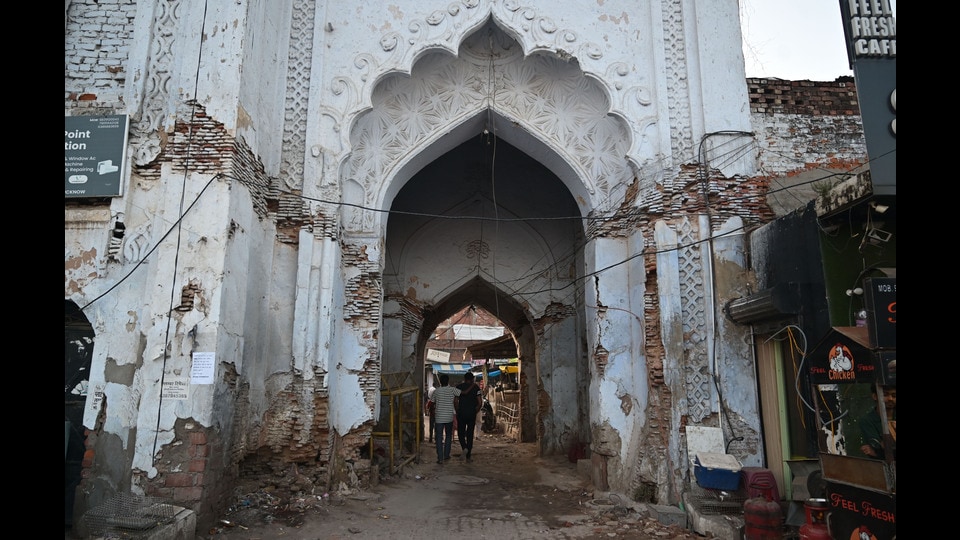
The gates, a symbol of the Nawabi era and constructed in 1839 and located on both sides of Chota Imambara, are falling apart with its brick and walls decaying slowly.
The decision to restore two gates of Chota Imambara has come as a joy to the city heritage lovers whose past efforts to draw the attention of authorities towards the edifice had gone in vain.
“The work for restoration will begin by the end of March,” said Habibul Hasan, assistant superintendent, Hussainabad and Allied Trust (HAT).
HAT is a custodian of important Nawabi monuments, including Bada Imambara, Chota Imambara, and other waqf properties, built by King Mohammad Ali Shah in 1839 for charity and welfare of the Muslim community.
“Lucknow Development Authority has roped in the Indian National Trust for Art and Cultural Heritage (INTACH) for the work,” said Hasan.
INTACH is a non-profit membership organisation dedicated to Heritage conservation.
Restoration includes facade, signage uniformity in shops
The Chota Imambara has three gates, including the Southeast Gate (facing Rumi Darwaza), the North Gate (in front of Chota Imambara) and the West Gate (towards Hardoi Road).
Talking about the renovation work, Jayant Krishna, INTACH’s UP State Convenor, said that barring the Southeast Gate, the entire structure is part of the renovation work.
“The traditional methods such as using lime mortar and replacing the torn brick with the same lakeshore bricks will be used during restoration,” he said.
As there is a large tourist footfall in the entire area every day, the restoration will be done keeping in mind the eatery shops, he said.
“The legal shops, barring the encroachments, are a part of the renovation which includes facades, uniform signages with appropriate uniform lighting,” said Krishna.
Krishna said that a detailed proposal was given to the divisional commissioner and municipal commissioner after the authorities roped INTACH for the work. “However, the final acceptance is awaited,” he said.
Krishna reasoned the exclusion of Southeast Gate in the renovation plan as the structure belonged to the Archaeological Survey of India or HAT. However, Aftab Hussain, a superintending officer of Lucknow Circle, ASI, refuted saying the entire structure belongs to HAT.
Why gates were made
According to historian Ravi Bhatt, the gates were built during the same period when the Chota Imambara was made by Mohammad Ali Shah in 1838. These gates were made to mark the territory of the building.
“In that era, the gates had three passages of different sizes, with a bigger one in the centre for the movement of royal procession like those with elephants. Two small passages on the right and left side for the movement of the masses. The small structures around Chota Imambara gates which are now shops were meant for the temporary stay of visitors,” he said.
He also added that these gates are part of the architectural culture of not just Lucknow but across India as similar gates were present in Kolkata, Murshidabad, Bhopal, and Jaipur among others and some of them were made during Akbar’s period which was called Tripolia gates.