
 E-Paper



Four female dolphins, two calves rescued from Lko’s Achilikheda Barrage
As the irrigation department had lowered the water level in the barrage for maintenance work, the aquatic mammals got trapped


Four female dolphins and two (of their) calves were rescued from Achilikheda Barrage, in Mohanlalganj forest range, where they had got trapped, on Wednesday.
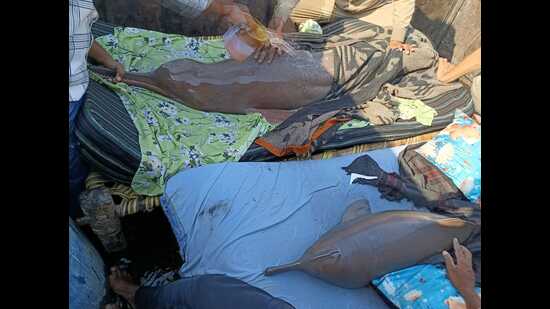
As the irrigation department had lowered the water level in the barrage for maintenance work, the aquatic mammals got trapped and had to bear with the rising temperature in water during the day. Teams of the forest department along with volunteers of Turtle Survival Alliance Foundation reached the Achilikheda Barrage.
“They were released in the Ghagra river,” said Sitanshu Pandey, divisional forest officer (Awadh Range), after the release was completed.
The rescue was done in five-phases. In the first phase a female dolphin was brought out and in the second phase another female dolphin and its calf. Two other female dolphins were brought out in the third phase and in the end the remaining calf was rescued.
“Chandan Chaudhary, sub-divisional officer in the forest department along with the team of volunteers ensured the rescue operation went smoothly and the dolphins remained unharmed,” said Pandey.
“They were in good health and found fit to be released into their natural habitat,” said Arunima Singh, biologist with Turtle Survival Alliance Foundation India (TSAFI).
The information about stranded dolphins was given by locals first after which officials planned the rescue.
Uttar Pradesh is home to 2,397 dolphins out of 6,327 dolphins in India, according to a report on river dolphins, released in March-2025. In 2023, Uttar Pradesh declared the dolphin as the state aquatic animal.
The Gangetic River Dolphin is listed in the Schedule –I of the Wildlife (Protection) Act, 1972, according them the highest degree of protection. The Gangetic River Dolphin is included as one of the 22 critically endangered species for providing financial assistance to states under the Centrally sponsored scheme ‘Development of Wildlife habitats’.


