
 E-Paper



Freedom in the air for rhinos in UP’s Dudhwa national park
Under the upcoming study programme, initially three to four one-horned rhinos would be released into the Dudhwa forests with radio collars around their necks for uninterrupted roaming in the wild


Dudhwa rhinos would soon feel fresh air of freedom away from their fenced enclosures in Dudhwa National Park (DNP) here. For this, a study programme on one-horned Dudhwa rhinos will be launched in active collaboration with World Wide Fund (WWF) and rhino experts.
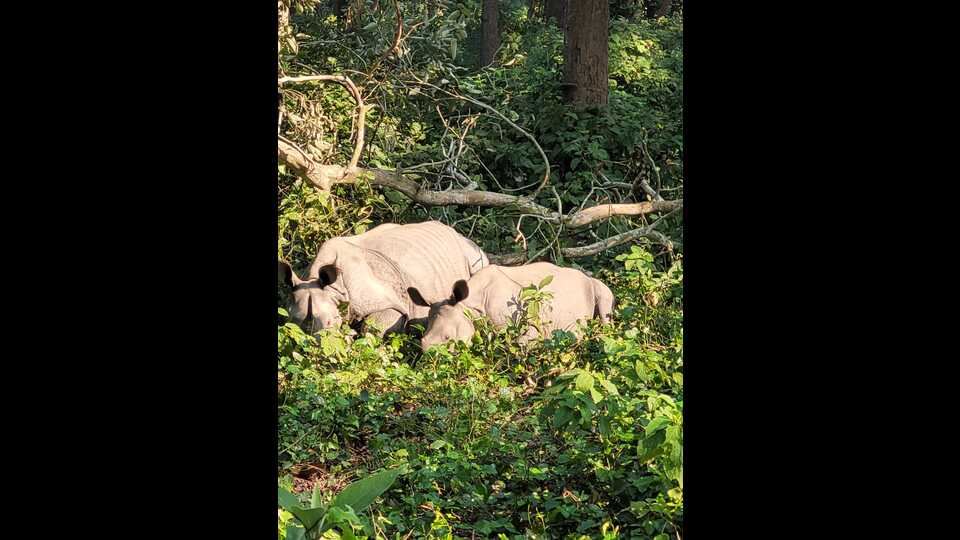
“Under the programme, initially three to four one-horned rhinos would be released into the Dudhwa forests from their 32-year-old fenced enclosure ‘rhino rehabilitation area’ (RRA-1) with radio collars around their necks for uninterrupted roaming in the wild,” said field director, Dudhwa Tiger Reserve (DTR), Sanjay Kumar Pathak. A radio collar is a wide band of machine-belting fitted with a small radio transmitter and battery used for animal tracking.
A dedicated team of forest officials and experts would closely monitor the roaming of these radio-collared rhinos through video high frequency (VHF) and satellite, Pathak added. He further said through this close monitoring, their behaviour, food pattern, dwelling conditions etc would be recorded for an intensive study.
“In case of any adverse indications, the rhinos would be brought back to their designated enclosures,” he said. “If the study yields positive results, some more rhinos would be released into the forests,” Pathak said. He said the behaviour of these selected rhinos released under the programme would be studied till 2030 and if the final outcome was recorded satisfactory, fencing of enclosures could be removed.
Pathak said the step was being taken on the directives of UP chief wildlife warden to ensure exposure of Dudhwa rhinos to free ranging and habitat improvement. “The rhinos preferred eating coarse grasses disliked by other herbivores,” he said.
“While roaming freely in the wild, the rhinos would eat away the coarse grasses, paving way to sprouting of fresh and soft grasses, edible for all other herbivores,” Pathak added. As per him, a fresh identification and indexing programme for Dudhwa rhinos was also likely to start in the next few days.
“This would include providing fresh unique ids to each and every Dudhwa rhino besides collecting their DNA samples under the rhino DNA index system (RhODIS),” Pathak said. Unique ids to Dudhwa rhinos were first allotted in 2014 based on their physical characteristics.
During the last eight years, the number rhinoceros has grown and physical characteristics of some of them have also changed. Similarly, DNA profiling of Dudhwa rhinos was first carried out in 2018 when their number was reported to be 38 while at present, Dudhwa is reported to have roughly 42 rhinos. “Unique ids and DNA analysis would help provide a scientific basis of rhino population in Dudhwa which may be over 42,” Pathak said.


